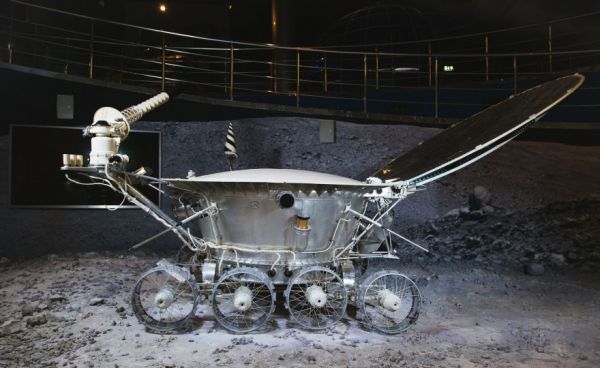
The story of the Space Race as most of us know it is that the Soviet Union was the first to launch a satellite into orbit in 1957 and the first to launch a human into orbit in 1961. The Americans scrambled to catch up, and won the big goal of landing astronauts on the moon in 1969. It was only years later that we learned what else the Soviets did, because they weren't keen on sharing information and they pulled most of their funding for space exploration after the Apollo moon landing.
The world eventually learned about the Lunokhod program, in which the USSR was the first to land remote-controlled robots on the moon in 1970 and 1973. The US didn't do that until Sojourner landed on Mars in 1997. Lunokhod 1 and 2 were equipped with a reflector that bounced laser signals from earth and back to relay information. The rovers also moved, unlike reflectors left by the Apollo missions. While Lunokhod 2 continued to reflect signals after its mission ended, Lunokhod 1 was lost for almost 40 years. No one knew how far the rover had traveled before its power died.
Then in 2010, the Lunar Reconnaissance Orbiter (LRO) determined the exact coordinates of Lunokhod 1, and researchers at the Apache Point Observatory in New Mexico were able to bounce laser signals off its reflector. The results were better than signals from Lunokhod 2, showing us that the reflector was still in good shape. Read about the lost and found Soviet robot on the moon at Daily Galaxy. -via Damn Interesting
(Image credit: Музей Космонавтики)