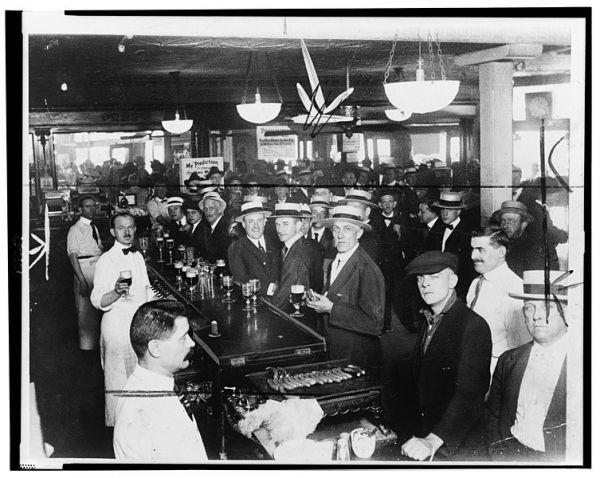
Collaborations and innovations are made over drinks. Or at least, that's what we hear. Mike Andrew heard it, too, and began to look into the geography of collaboration, to find out exactly where great minds get together to bounce around ideas. To test whether saloons had an effect on innovation, he looked into data on Prohibition in the US.
Across the United States, these new laws promptly shuttered the imbibing regions’ bars and taverns. A century or so later, Andrews realized this was the holy grail of social-science research: a natural experiment. He downloaded patent data, compared the number granted to inventors in the wet and dry counties before and after statewide prohibition began, and came up with a measurement of the importance of slightly drunken discussion to invention.
The result? A 15 percent decrease in the number of patents. The areas whose saloons shuttered had become less inventive.
This is a meaningful change, comparable to the effect the Great Depression had on invention across the United States. In other work, Andrews has calculated that the establishment of a new university results (eventually) in a roughly 45 percent increase in local patents. This suggests that the bars’ closure had an effect one-third as strong as a county gaining a university—albeit in the opposite direction. Which is pretty remarkable! After all, universities are centers of knowledge, and bars are businesses that exchange beer for money.
Andrews tested the data in other ways to check his hypothesis, such as measuring the effect of Prohibition on patents by women and patents by corporations, and the effects of the Great Depression and World War II on patents. Read what he found at Atlas Obscura.