Minnesotastan's Blog Posts

Homemade Snowmobiles


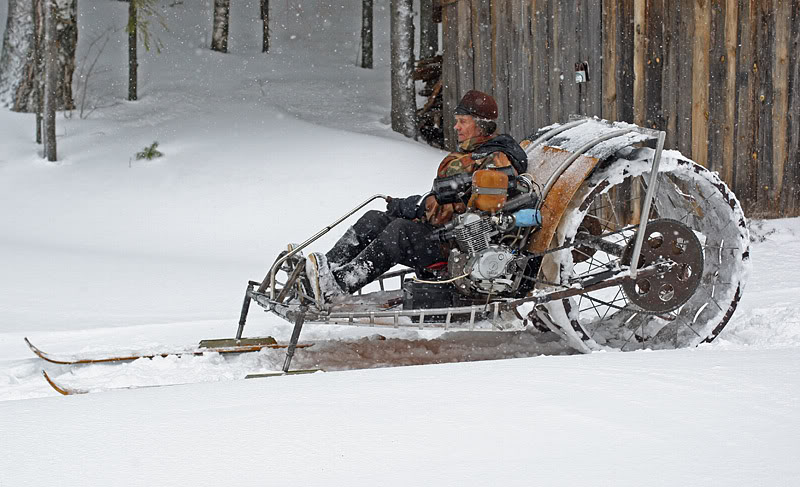
English Russia has a gallery of snowmobiles made from scrap and repurposed materials.  The one above is arguably the most awesome:
This bulky machine constructed by one enthusiast retiree from the Russian city of Kirov is powered by the old Yamaha motorcycle engine and is entirely made of scrap. Fiberglass seat was formerly a part of a small carousel, gear shift lever was a part of an unidentified old Coca-Cola souvenir. The front skies are covered with fluoroplastic, a material with extremely low friction factor. The main distinctive feature of this snowmobile is a big wheel instead of a regular for such kind of transport rubber heavy caterpillar made of metal and rubber. For this reason this monster is very light which allows it to drive on fresh crumbly snow.

They also note that heat from the engine will warm both the passenger and the fuel tank.  There are a number of other interesting contraptions in the gallery, several of which incorporate propellors in the style of a swamp airboat (the last one at the link uses a rotary lawnmower blade mounted on an inflated innertube!)

Link.
Dog Leads Rescuers to Burning Building

YouTube link.

A 23-year-old Alaskan was in his workshop when a heater unexpectedly ignited some chemicals, and the building suddenly burst into flames.  For help, he turned to his dog Buddy:
"I just told him, 'We need to get help,' and then that's the last time I seen him," Heinrichs told the News-Tribune. "I didn't train him or nothing. He just took off and went and did what he did. ... He was just being a good dog."

It's a good thing Buddy sprung into action because trooper Terrence Shanigan, who was responding to the call about a fire, was having trouble with his vehicle's global positioning system, which wasn't working properly, reports the News-Tribune. "Shanigan, who almost took the long way around the neighborhood, came across Buddy on Caswell Loop Road," reports the News-Tribune. "The dog took off, and acting on a hunch, Shanigan followed the dog down a side road."

The budding young chemist received minor flash burns.  Buddy will be receiving a silver-plated dog bowl.

Story link.

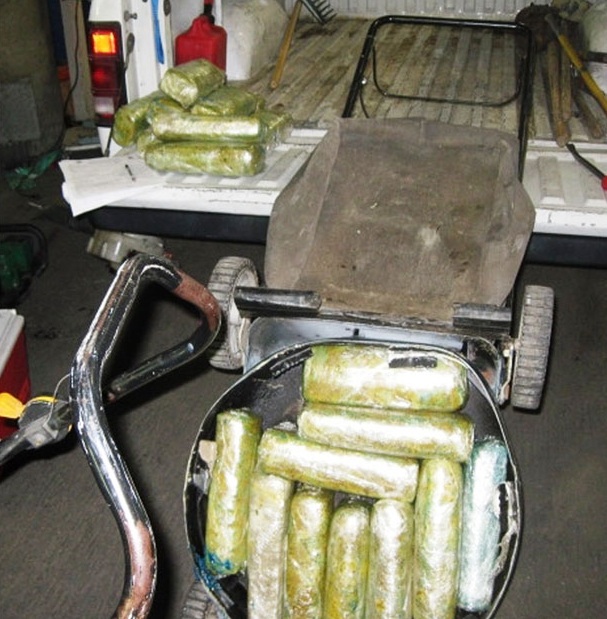
Rotary Lawn Mowers Can Get Packed With Grass


That was the problem facing a gardener who was driving his pick-up truck and tools across the border from Tijuana.   In this case customs agents made the diagnosis.

Link.  Photo: Splash News.

Earthworms Move in Herds

Forget any preconceptions you may have had about earthworms as solitary free-thinking individuals.

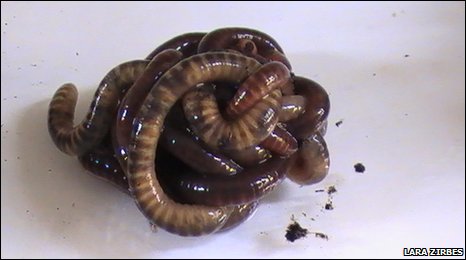
Recent studies at the University of Liege have revealed that annelids can communicate by touch and make "group decisions" regarding their movements.  Researchers placed earthworms in chambers and discovered that their choice of exits was not random - they preferred to move together.  Subsequent trials suggested that the sense of touch rather than chemical trails governed the decisions:
After the worm chose its route to the food... the second worms were no more likely to take the same route as their predecessors. This indicated that the worms did not leave a chemical trail behind them that communicated their direction of travel. Yet if two worms were placed together at the start of the maze, they were more likely to follow one another, suggesting that they used touch to communicate where they were going.

Further details at the BBC link, where the copyeditor used "herd" to describe a group of worms.  Most compilations of collective nouns suggest that the proper venereal term is "clew," as in "Unifying Democrats is like trying to herd a clew of worms."

This gives us the opportunity to insert the "cat herding" commercial for EDS, which ran during the Super Bowl a decade ago.  With apologies to those who feel that the content here should be restricted to new material, here is the commercial which, inexplicably, has apparently never been posted at Neatorama.

YouTube link.

Link.  Photo credit Lara Zirbes.

Wouldn't This Look Nice on Your Mantelpiece?

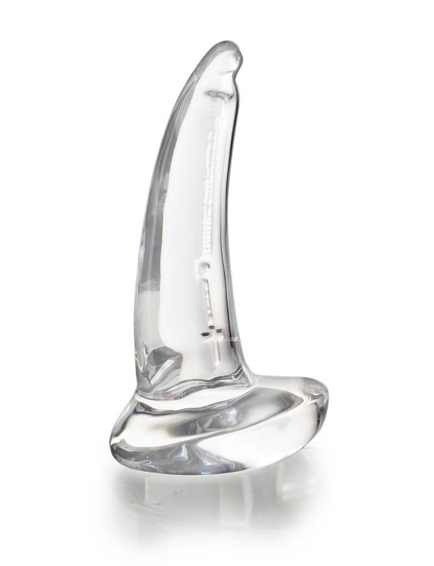
Or perhaps displayed in some other prominent location in your home.  This 24 centimeter (9.5 inch) figurine has been masterfully crafted out of the finest crystal by Atlantis - one of the premier glassmaking companies of Portugal.

The piece is entitled "Nossa Senhora" ("Our Lady").  It is a stylistic representation of the Virgin Mary - most evident from the small cross incised near the base of the figure.  Even if your family is not religious, one would have to think that a piece of art like this would be a wonderful conversation starter at parties.

Link, via Oregon Expat.

An "Ancient Roman Burrito"


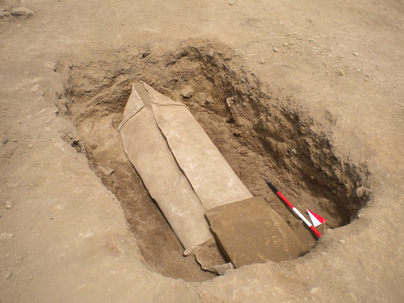
A lead sarcophagus was not per se unusual in Roman times; several hundred examples have been found, but none have been configured like the one in the photo above.
The discovery of the 1,700-year-old body was made in the ancient city of Gabii, 20 kilometres from Rome, by a team of researchers including McMaster University visiting professor Jeffrey Becker.

"Instead of being in a box, the lead is more of a wrapping," Becker says.  "The person was wrapped inside sheets of lead folded around the body, crimped at the end and kind of folded into a seal."

Researchers would like to study the contents of the container without unfolding or otherwise damaging it, but they realize that xray and CT scans will not be possible.

Link, via Explorator.

The Ross Sisters Perform "Solid Potato Salad"

YouTube link.

The Ross Sisters (Aggie, Maggie, and Elmira) were a trio of singing acrobatic contortionists who rose to brief fame in the 1940s.  The scene above is from a 1944 MGM musical entitled "Broadway Rhythm."  The term "solid" was period slang for "excellent."

Some people like their taters Lyonnais, some prefer French fries.
I prefer mine with mayonnaise, cole slaw on the side.
Solid potato salad, that’s solid salad, Jack,
Solid potato salad, boy, take a plate, fill it up, bring it right back.

The rest of the lyrics are searchable with Google, but they are not the point of the film segment.  You will need to watch beyond the first minute of the video to see the rather remarkable athleticism of these young ladies.

The Power of an Earthquake


Most photographs of earthquakes depict damage to buildings and roads, or fissures in the earth.  The one above is most unusual.  On April 4, a magnitude 7.2 earthquake struck northern Mexico and the Baja region just south of the U.S. border.
Brothers traveling in Mexico during Sunday’s deadly earthquake photographed this surreal sight: The power of the quake lifting a layer of dust off a mountain range.  "We felt the truck shake and the roads cracking," Roberto wrote to NBCSanDiego. "We stopped and looked at the big hills, and the force of the quake shook the mountains and dust stared to come up."

Link, via Found Here.  Photo credit Roberto and Adrian Marquez Marquez.

Unusual Photo Made With a Pinhole Camera


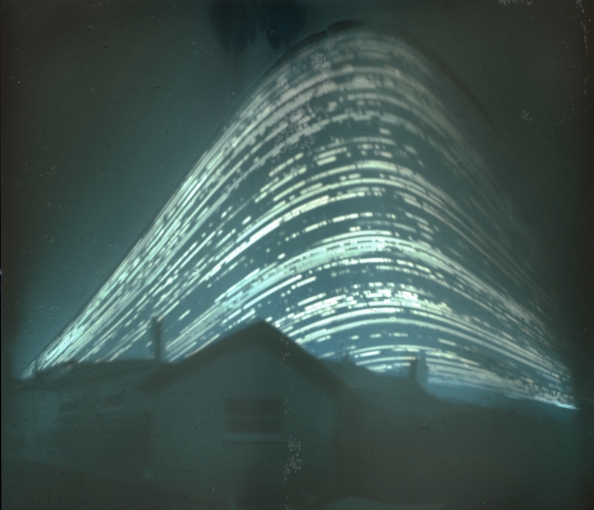
A pinhole camera is the ultimate in simple photographic devices - a lightproof box with a small aperture (often literally a pinhole) and a bit of film or photo paper.  The image above was made with such a camera.

In the foreground is the pointed roof of a house or small building. Behind that is... what???

The surprising answer is at the link, with further explanation here.

Link.  Via Kottke.

Meet the Turtle Ant


Cephalotes varians ants live in pre-existing cavities in trees and branches, so one class of their workers has developed a most unusual adaptation.
Turtle ants aren't fighters. Rather, they're all about defense. If a colony gets hold of an old beetle burrow, the heavily armored majors will plug the entrance with their head shield and sit tight, budging only to let their nestmates pass. They are literally living doors.

Found at Myrmecos.  Elsewhere in the blog you can read about "formicophilia" (a newly named paraphilia).

Can an Automated Postal Center Stamp Help You Beat a Deadline?

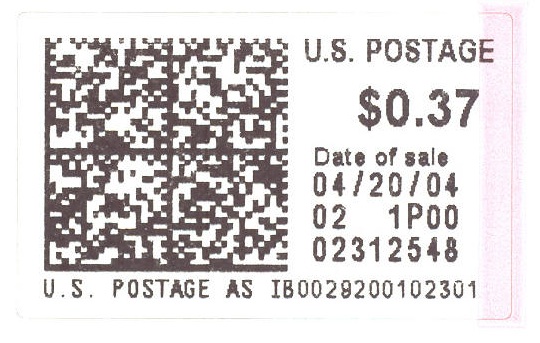
Automated postal centers print stamps on demand, and the stamps are imprinted with the date of purchase.  Now, suppose you need to mail something that is time-sensitive requiring a postmark by a certain date - an application, a monthly payment, a proof-of-purchase - or your taxes.  Could you use a preprinted APC stamp after the designated date and fool the recipient regarding when the letter was posted?  David Malki conducted a "postmark experiment" to address that question.
I figured that to really put these stamps to the test, I should send the letters to an address relatively far away — to make sure it went through a lot of depots, verification centers, biometric drug-sniffers, or whatever. I don’t know how this stuff works; I assumed the barcode encoded a lot of crucial information about where the letter came from, where it was going, and how long the stamp should be honored. So I arranged with friends a thousand miles away (in Seattle) to receive the letters, and as a control subject, sent one letter that night of April 15.  The next letter was sent the next day.  And so on, at increasing intervals of time, through April 29, a full two weeks after the date of the stamp. I expected that letters sent in the first week or so would arrive, and then they’d start coming back.  I was wrong. They all made it.

The interesting part was that, as predicted, not all of the stamps arrived with cancellations. Of the ten sent to Seattle, only six arrived there canceled — meaning that four envelopes (40%) arrived indicating only the April 15 date and no other postmark.

In the course of his experiment he discovered that the letters that arrived uncancelled could be remailed, and were accepted a second time by post office processing equipment.  Doing that is strictly against postal regulations; you are not allowed to reuse "skips" (stamps not cancelled in transit).  But his observation that an item can be posted after the date printed on the stamp is potentially useful in a variety of situations.

Link.  Image credit [yes, we know it's an old one...]

A Musical Instrument Without a Name

YouTube link.

For this brief video, a mouthpiece and vinyl tubing have been combined to illustrate some basic principles regarding the generation of musical notes.  It reminds me of the unusual musical creations of Gerard Hoffnung, who commissioned the "Grand, Grand Overture" by Malcolm Arnold (scored for three vacuum cleaners and an electric floor polisher).  One instrument Hoffnung devised was the "hosepipe" - a mouthpiece attached to a garden hose.

And a hat tip to Yucatanstan [nice name!] for identifying the instructor as Dr. John Winkler, Professor of Trumpet at West Virginia University's College of Creative Arts.

Via Arbroath.

Outsourced Grading of College Papers

Corporations have taken advantage of outsourcing for decades; the process lowers costs and often allows services to be provided which could not be otherwise accommodated. Now some university faculty believe the same principle can be applied to the task of grading papers written by undergraduates.
The graders working for EduMetry, based in a Virginia suburb of Washington, are concentrated in India, Singapore, and Malaysia, along with some in the United States and elsewhere. They do their work online and communicate with professors via e-mail. The company advertises that its graders hold advanced degrees and can quickly turn around assignments with sophisticated commentary, because they are not juggling their own course work, too...

The assessors use technology that allows them to embed comments in each document; professors can review the results (and edit them if they choose) before passing assignments back to students. In addition, professors receive a summary of comments from each assignment, designed to show common "trouble spots" among students' answers, among other things.

Critics decry the lack of personal relationship between teacher and student, but defenders of the process counter that grading in the past has often been done by teaching assistants, and the use of "virtual TAs" in the Indian subcontinent is not fundamentally different.  The process is not inexpensive; one example cited at the link indicates a cost of $12 per assignment per student.

The responses of students and the reactions of faculty at various universities, graduate schools, and community colleges is discussed in the excellent article at The Chronicle of Higher Education.  Not discussed at the link is to what extent the papers being outsourced for grading were outsourced by the students to be written by someone else...

Link.  Bobblehead image via the Neatoshop.

Should Individual Tax Records Be Public Information?

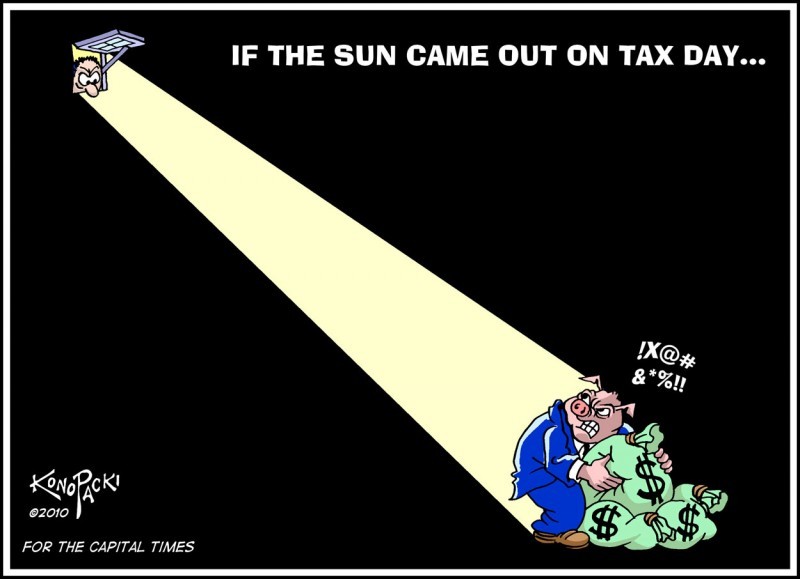
A recent essay in the New York Times raises the question as to whether individual tax payments should be considered public information.  It has been suggested that public disclosure of tax payments would create pressure to correct inequalities and loopholes in the current tax system.  Surprisingly, strict secrecy regarding tax records is a relatively modern aspect of the system.
In the first half of the 20th century, Congress twice required tax disclosure. In 1923 and 1924, individual and corporate taxpayers had to make public their tax payments but not entire returns. Proponents of disclosure said the measure would encourage tax compliance and reduce improper business conduct...

In the wake of accounting scandals and corporate earnings frauds of recent years, not to mention aggressive tax avoidance schemes, some experts say we should bring back corporate tax disclosure...

“If people could see how terrible the system is,” Professor Kotlikoff said, “perhaps then the appeal of a simple, straightforward and fair tax system might rise.”

Presidential candidates do release abbreviated tax records for public inspection.  Should individuals be expected to do the same?

Link, via The Cap Times (whence the image).

Swingless Golf Club

YouTube link.

With an exciting final round of the Masters Tournament pending at Augusta National Golf Club, this seems an appropriate time to post a video of a golf club that uses an explosive charge to propel the ball.
The club uses a plastic strip of five (5) small powder charges, called a Power Strip. Energy from the charge drives the striker in the club head forward to hit the ball. An adjustable range control enables shots from approximately 25 to 200 yards. The handle grip has two parts - the upper grip slides up a few inches to cock the club, and the lower grip has the safety and the trigger. Holding the club like a regular driver, position it on the grass about an inch behind the ball (no tees needed) and press the safety and the trigger on the lower grip. With no swing involved there are no divots, fewer errant shots and fewer lost golf balls.

This would be the club of choice for Anton Chigurh.

Link.

Email This Post to a Friend
""

Separate multiple emails with a comma. Limit 5.


Success! Your email has been sent!

close window

Page 11 of 23     first | prev | next | last

Profile for Minnesotastan

  • Member Since 2012/08/04


Statistics

Blog Posts

  • Posts Written 339
  • Comments Received 3,475
  • Post Views 646,559
  • Unique Visitors 533,789
  • Likes Received 51

Comments

  • Threads Started 428
  • Replies Posted 0
  • Likes Received 18
X

This website uses cookies.

This website uses cookies to improve user experience. By using this website you consent to all cookies in accordance with our Privacy Policy.

I agree
 
Learn More