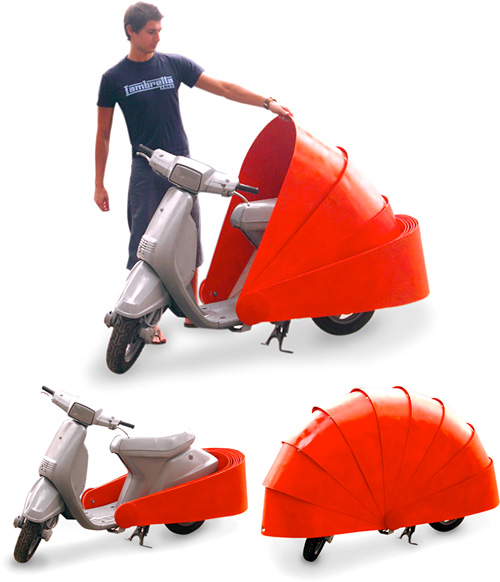
Inspired by the armadillo, designer Marc Graells Ballve made this retractable armored shell for his scooter to protect it from theft. Do you think that it will work?
via OhGizmo! | Designer's Website | Image: Marc Graells Ballve
Integrated into the board and the plinth is an electromagnetic system which levitates the board. A laser system stabilises the object in the air. In the making of this work, this artist was thinking about different ways of presenting sculpture. In fact it's a reflexion on the multiple possibilities of how to give a sculpture full spatial autonomy.
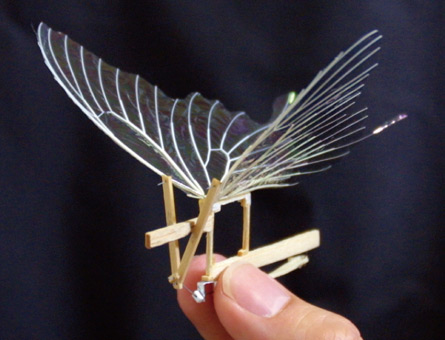
To prove that the swallowtail achieves forward flight with simple flapping motions, the researchers built a lifelike ornithopter in the same dimensions as the butterfly, copying the swallowtail's distinct wing shape and the thin membranes and veins that cover its wings.
Using motion analysis software, the researchers were able to monitor the ornithopter's aerodynamic performance, showing that flight can be realised with simple flapping motions without feedback control, a model which can be applied to future aerodynamic systems.
Birds generally rely mostly on sight to locate their supper. But vultures like Sherlock have a keen sense of smell and are able to detect the scent of rotting flesh from 1,000 metres (3,000 feet) up in the air.
He can even find remains in woodland or in thick undergrowth. And unlike sniffer dogs, who need regular breaks, Sherlock is indefatigable and can cover vast tracts of land.[...]
The bird, whose is more at home soaring over South America's Andes or the Atacama Desert than northern Germany's Lueneburg Heath, is being taught by trainer German Alonso to love the putrid smell of dead human flesh.
Every day Alonso puts pieces of meat in small cups, on top of a strip of cloth -- provided by the police -- that has been used to cover a corpse. Sherlock's mission is to locate these tasty morsels.
Teleportation over distances of a few hundred meters has previously only been accomplished with the photons traveling in fiber channels to help preserve their state. In this particular experiment, researchers maximally entangled two photons using both spatial and polarization modes and sent the one with higher energy through a ten-mile-long free space channel. They found that the distant photon was still able to respond to changes in state of the photon they held onto even at this unprecedented distance.
However, the long-distance teleportation of a photon is only a small step towards developing applications for the procedure. While photons are good at transmitting information, they are not as good as ions at allowing manipulation, an advancement we'd need for encryption. Researchers were also able to maintain the fidelity of the long-distance teleportation at 89 percent— decent enough for information, but still dangerous for the whole-body human teleportation that we're all looking forward to.
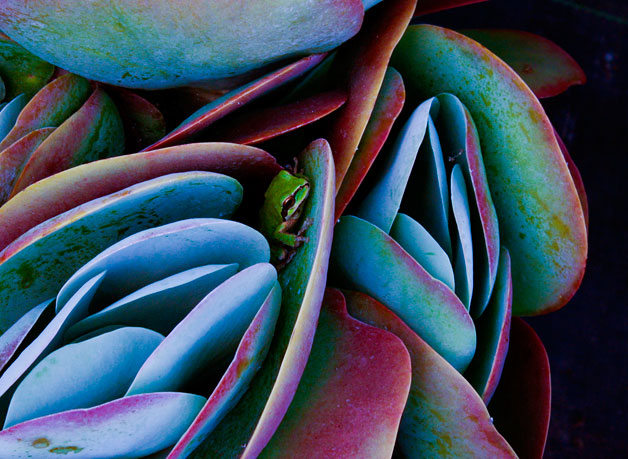
King was experimenting with a new camera in a local Mendocino County garden when a frog paused for a moment on the leaves of a nearby plant. She snapped; it hopped. “I’ve gone halfway around the world looking for new experiences,” she says. “This photo will always remind me of the beauty in my own backyard.”
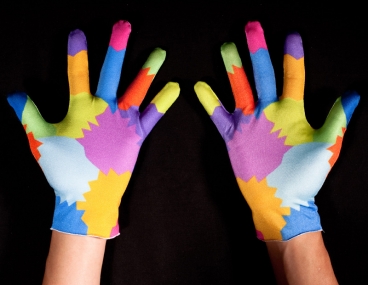
Other prototypes of low-cost gestural interfaces have used reflective or colored tape attached to the fingertips, but “that’s 2-D information,” says Robert Wang, a graduate student in the Computer Science and Artificial Intelligence Laboratory who developed the new system together with Jovan Popovi?, an associate professor of electrical engineering and computer science. “You’re only getting the fingertips; you don’t even know which fingertip [the tape] is corresponding to.” Wang and Popovi?’s system, by contrast, can translate gestures made with a gloved hand into the corresponding gestures of a 3-D model of the hand on screen, with almost no lag time. “This actually gets the 3-D configuration of your hand and your fingers,” Wang says. “We get how your fingers are flexing.”
The most obvious application of the technology, Wang says, would be in video games: Gamers navigating a virtual world could pick up and wield objects simply by using hand gestures. But Wang also imagines that engineers and designers could use the system to more easily and intuitively manipulate 3-D models of commercial products or large civic structures.
The various colours of paint were dumped onto the road in large puddles at different locations throughout the intersection. As traffic drove through, the paint was spread around creating lots of colourful lines. The whole action took only a few seconds: bikers had poured paint from big boxes in front of cars that waited for green lights. So the cars and their wheels, if the driver wanted it or not, became the brush tool for this guerilla public art piece.The creators of the project posted signs on post nearby explaining that the paint wasn’t harmful and would simply wash off with water
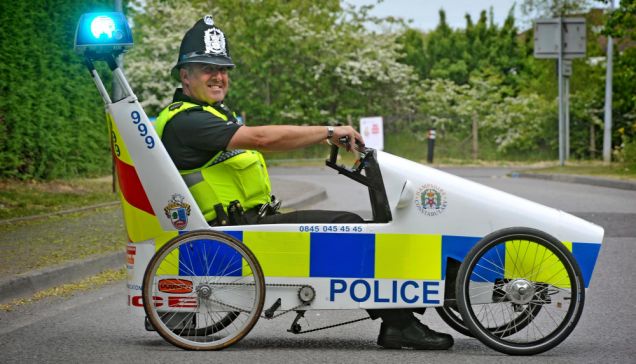
Officers believe building their new five-gear vehicle, which has a top speed of 20 miles per hour, will help combat anti-social behaviour.[...]
PC Keith Waller, who will pilot the vehicle, spent 40 hours painstakingly building the replica car with children aged 13 to 16 at Ringwood Comprehensive School.
He insisted that getting involved with the project allowed police to show their "fun side" and made them look "cooler" and "more approachable".
But he also admitted it had made him a laughing stock as people drew comparisons with him and Mr Plod from cartoon series Noddy from Toytown.