First, men covered with sheets, one by one, entered the reading room at the New York Public Library and engaged in normal library patron activities. People noticed, and the dramatic tension began to build. Then our four heroes appeared to deliver the library from this paranormal menace.
For our latest mission, we brought the movie Ghostbusters to life in the reading room of the main branch of the New York Public Library. The 1984 movie begins with a scene in the very same room, so we figured it was time for the Ghostbusters to make an encore appearance.
Tyler Cowen of the blog Marginal Revolution responded to an interesting question by a reader. It was:
If you could create a punctuation mark, what would its function be and what would it look like?
Cowen responded:
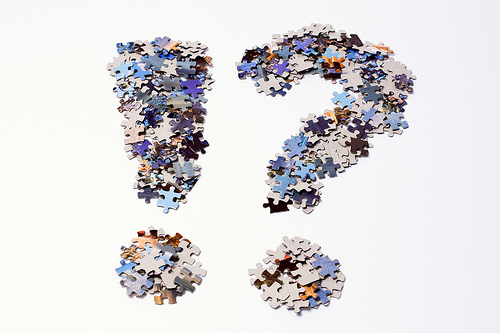
I've always liked the chess marks "!?" and "?!" and wondered why they weren't used in standard English. The former refers to a startling move which is uncertain in merit and the latter refers to a dubious move which creates difficult to handle complications.
How would you respond?
Link | Image by flickr user Horia Varlan, used under Creative Commons license
A research team at Hebrew University in Israel has developed a computer program that can recognize sarcasm with about 77% accuracy:
To create such an algorithm, the team scanned 66,000 Amazon.com product reviews, with three different human annotators tagging sentences for sarcasm. The team then identified certain sarcastic patterns that emerged in the reviews and created a classification algorithm that puts each statement into a sarcastic class.
The algorithms were then trained on that seed set of 80 sentences from the collection of reviews. These annotated sentences helped the algorithm learn what sorts of words and patterns distinguish sarcastic remarks – those that mean the opposite of what they literally convey, or that convey a sentiment inconsistent with the literal reading.
http://www.popsci.com/technology/article/2010-05/computer-algorithm-can-recognize-sarcasm-which-soooo-cool | Image: Fox
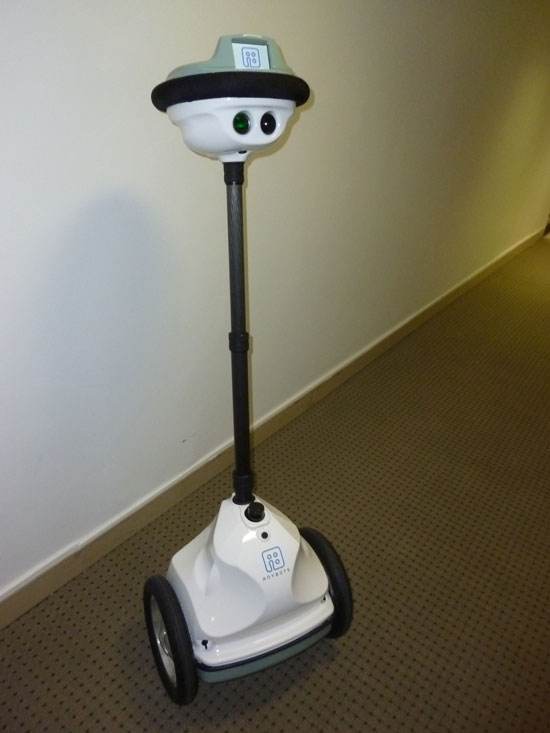
Robotics firm Anybots proposes that its robotic avatars could replace the physical presence of people at far away locations. In the future, you'll be able to attend workplace conferences and tour facilities remotely by controlling one of their robots:
You log in through the Internet and after a few keystrokes the 'bot, called QB, comes alive, leaving its charging station and ready to meet, brainstorm, greet visitors or just generally creep people out.[...]
The robot avatar isn't actually meant to replace videoconferencing, but the idea is to be able to participate in more than just meetings. With QB, you can observe a workplace, participate more directly in tasks, or just be there for those casual conversations — all from thousands of miles away.
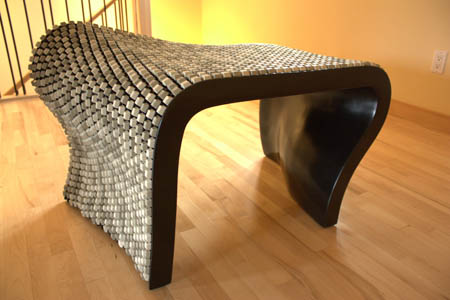
Designer Nolan Herbut made a bench out of keyboard keys:
The Wolfgang keyboard bench is made up of 2000 keys imbedded into a layered Baltic birch wood. Each key is pressable and actually makes a clicking sound when pressed. The tactile effect of the bench also makes a playful interaction with the bench because you engage with the piece of furniture in a very up close and intimate manner while pressing in the keys.
This way you can get the sensation of sitting on a keyboard without damaging your computer peripherals.
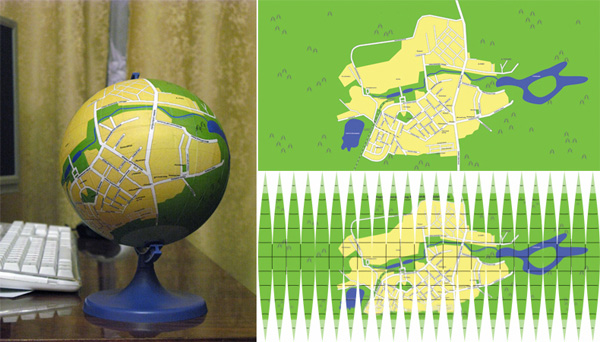
English Russia is a marvelous blog filled with pictures of strange and inventive things from Russia. One offering in its archives is a post about "local globes" -- the practice of taking local maps and fitting them around globes so that one locality is imagined as a whole world:
In Russia and other post Soviet countries there were a real craze on independence after they finally got it with USSR collapse. Sometimes this took some weird forms like, for example, making the globes of their own country. Yes, those were just like regular globes we used to see on geography classes but instead the whole world only their own country was mapped on it.
These things were officially on sale and still you can buy something like “the globe of Ukraine” in shops of Kiev.
So then people went further and decided to make the globes of their local cities or even villages.
At the link, you can find instructions on how to make your own.
Link via Make | Image: Collage by Sean Michael Ragan of Make
Gabriella Nagy of Toronto is suing Rogers Wireless, her cell phone provider, for breaking up her marriage. She argues that the company disclosed her call history to her husband, which revealed her secret affair. He left her. Now Nagy wants $600,000:
In 2007, Gabriella Nagy had a cellphone account with Rogers which sent the monthly bill to her home address in her maiden name. Her husband was the account holder for the family's cable TV service at the same address. Around June 4, 2007, he called Rogers to add internet and home phone.
The following month, Rogers mailed a “global” invoice for all of its services to the matrimonial home that included an itemized bill for Nagy's cellular service, according to the statement of claim filed in Ontario Superior Court of Justice.
When Nagy’s husband opened the Rogers invoice, he saw several hour-long phone calls to a single phone number.
Link via Geekosystem | Photo: US Nuclear Regulatory Commission
The elaborate one-shotmusic videos by the band OK Go have been an Internet sensation -- particularly their Rube Goldberg machine video for the song "This Too Shall Pass." The comedy troupe The Station responded by creating this video lampooning the children's game Mousetrap, which consists of building a Rube Goldberg machine as gameplay advances. It's called "Mousetrap Never Works."
A robot called the I-Fairy presided over the wedding of Satoko Inoue and Tomohiro Shibata in Tokyo:
The nuptials at this ceremony were led by "I-Fairy," a 4-foot (1.5-meter) tall seated robot with flashing eyes and plastic pigtails. Sunday's wedding was the first time a marriage had been led by a robot, according to manufacturer Kokoro Co.
"Please lift the bride's veil," the robot said in a tinny voice, waving its arms in the air as the newlyweds kissed in front of about 50 guests.
The wedding took place at a restaurant in Hibiya Park in central Tokyo, where the I-Fairy wore a wreath of flowers and directed a rooftop ceremony. Wires led out from beneath it to a black curtain a few feet (meters) away, where a man crouched and clicked commands into a computer.
http://www.google.com/hostednews/ap/article/ALeqM5jD8QFNdqGR97enD1iCdvMI4x7AWgD9FNQT4O0 via The Presurfer
Denis Smith is a photographer who makes light graffiti -- time lapse photography that allows artists to insert lights into spaces so that they appear to be free-floating. Smith has created a set of images depicting the travels of a ball of light through a darkened world.
http://www.denissmith.com.au/Portfolio/Pages/Ball_of_Light.html via DudeCraft
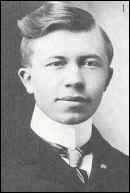
Amanda Greene of Woman's Day has compiled a list of fifteen strange diet fads, including a 1928 proposal by arctic explorer Vilhjalmur Stefansson (left). He proposed eating only meat in imitation of the Inuit:
Arctic explorer Vilhjalmur Stefansson proposed a weight-loss plan that’s like an extreme version of the Atkins diet. After living in the northern tundra, Stefansson was amazed at how healthy the Inuit people were despite living off caribou, raw fish and whale blubber, and consuming hardly any fruits or vegetables. Stefansson was so intrigued by this diet—and claimed he had lived on it himself––that to prove its effectiveness he checked into New York's Bellevue Hospital, where doctors monitored his health for several months. After observations, he was declared healthy.
Greene also describes less successful diets, including "slimming soap", tapeworms, and cotton balls.
http://www.womansday.com/Articles/Health/15-Most-Bizarre-Diets-in-History.html via Ace of Spades HQ | Photo: Stefansson Arctic Institute
The Balancing Cube is a robot that can remain balanced on any one of its corners, even when pushed. Six motorized weights quickly move to keep the robot's weight balanced whenever it is in danger of falling over:
The Balancing Cube is an example of a distributed control platform. Each module....is a self-contained unit with a computer, battery, motor, and inertial sensors (a tri-axis accelerometer and tri-axis rate gyro). So instead of relying on a centralized controller, the modules share their inertial data through a bus network. Then each module combines its own data with the shared data to determine the orientation of the cube -- and command its motor accordingly.
Sometimes it's better to just walk away from an argument. Or something like that.
A 23-year-old man jumped from a moving vehicle Thursday evening after his wife refused to "shut up," according to a Montgomery County Sheriff's Office report.
The report by Deputy Blake Neblett says the man, who was traveling with his wife and three children to Clarksville on Guthrie Highway, was arguing with his wife and told her to shut up.
When she refused, the man jumped from the moving vehicle
http://www.theleafchronicle.com/article/20100514/NEWS01/100514025/Husband%20bails%20from%20moving%20vehicle%20after%20wife%20refuses%20to%20%E2%80%98shut%20up via reddit | Photo (unrelated) from the US Department of Energy