Cardboard Warfare is a short film by Clinton Jones that depicts an extended combat scene with cardboard weapons. They look like rifles, grenades, and tanks made out of cardboard boxes, but nifty special effects make them deadly. Production involved:
- 254 program crashes - 427 manual frames to rotoscope - 59 layers of sound effects - a BUTTLOAD of cardboard and box cutters - and a katamari
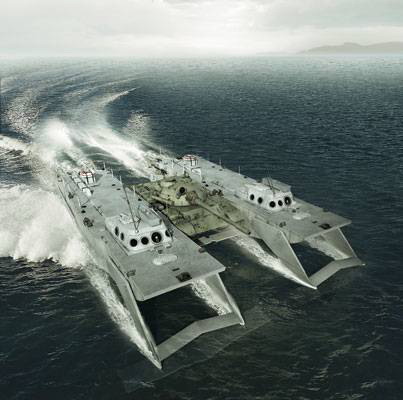
English Russia reports that during the 1950s, the Soviet Union developed floating tanks. Engineers attached pontoons to T-54 tanks and drove them into the water:
PST-U consisted of five pontoons that were filled with plastic foam. Total weight of the device was 10 tonnes. Buoyancy reserve (with T-54 tank) was 40%. Maximum speed of tank with the floating device was 19 km/h ashore and 12 km/h afloat. The floating device was equipped with its own fuel tanks with a capacity of 500 litres; equal to coverage of 60-80 kilometers distance without any tank’s fuel consumption.
At the link, you can find more pictures and diagrams.
We've previously posted the wonderful murals and stop-motion animation of the artist Blu. This video is his depiction of the Big Bang and the evolution of life. The story is told with moving murals that sprawl over an urban landscape.
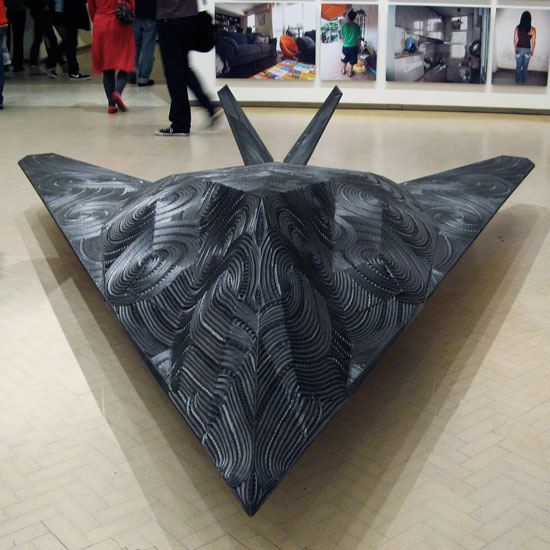
Brett Graham is a Maori artist who explores the intersection of Western art and that of his tribe, the Ngati Koroki. In an exhibition in Sydney entitled "Weapons of Mass Destruction", he recreated Western weapons using steel, medium density fiberboard, and rubber tires. Pictured above is "Te Hokioi", modeled after the Lockheed F-117 stealth fighter and inscribed with Maori symbols.
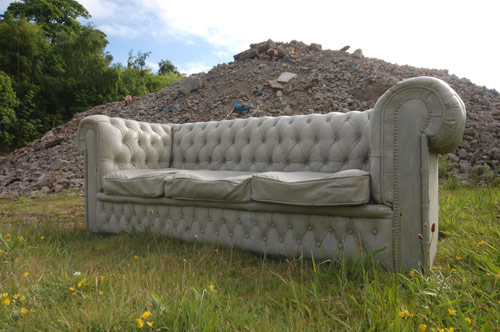
This couch is a solid block of concrete. It was made by the British firm Grey Concrete as a demonstration of their new, precise molding techniques:
The sofa is made by taking a mold from a real Chesterfield, which is then used to make a glass textile reinforced casting. The cushions are a part of the casting. Before making the mold, the padding inside the cushions was replaced with a rigid foam which was modeled to make “bum prints.” The molding techniques used by Gray Concrete pick up detail really well so the concrete sofa really looks leathery. There’s even a concrete 50p piece stuck down behind one of the cushions to complete the realistic effect.
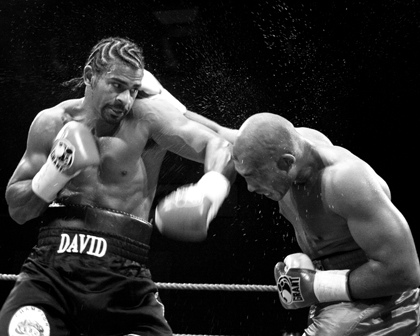
In a 2007 article in The Independent (UK), sports historian Nicholas Hobbes explains that gloves were introduced to make competitions bloodier and briefer. Gloves distribute a blow, but they also add weight to a punch, making it more destructive:
The Marquess of Queensberry rules took off not because society viewed the new sport as more civilised than the old, but because fights conducted under the new guidelines attracted more spectators. Audiences wanted to see repeated blows to the head and dramatic knockouts.
By contrast, the last bare-knuckle heavyweight contest in the US in 1897 dragged on into the 75th round. Since gloves spread the impact of a blow, the recipient of a punch is less likely to be blinded, have their teeth knocked out or their jaw broken. However, gloves do not lessen the force applied to the brain as it rattles inside the skull from a heavy blow. In fact, they make matters worse by adding 10oz to the weight of the fist.
A full-force punch to the head is comparable to being hit with a 12lb padded wooden mallet travelling at 20mph.[...]
As the bare-knuckle campaigner Dr Alan J Ryan pointed out: "In 100 years of bare-knuckle fighting in the United States, which terminated around 1897 with a John L Sullivan heavyweight championship fight, there wasn't a single ring fatality." Today, there are three or four every year in the US, and around 15 per cent of professional fighters suffer some form of permanent brain damage during their career.
Link via Super Punch | Photo by Flickr user loura used under Creative Commons license
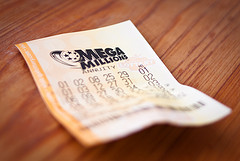
Joan Ginther of Bishop, Texas has won multi-million dollar lottery payouts four times. Most recently, she won $10 million:
Each of Ginther's triumphs has netted her a seven-figure sum of money and her winnings now top $20 million.
Her first success was in 1993, when she won half of an $11 million Texas Lottery jackpot. She then had something of a dry stretch, going a whole 13 years without another win. Then, in 2006, she won $2 million with a scratch–off ticket.
In 2008 it was $3 million prize from a scratch card. On Monday, she claimed her biggest win yet in the Extreme Payout competition.
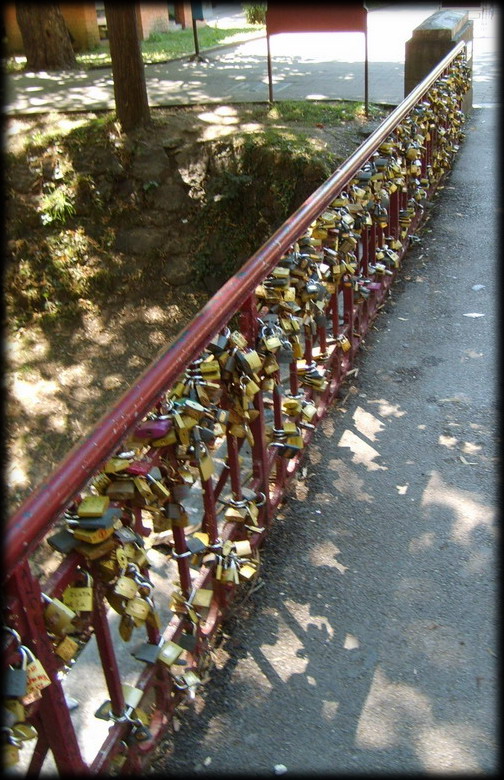
The Bridge of Love in Vrnjacka Banja, Serbia, is a place where young women traditionally go to affirm their ardor for their lovers. A woman will write the name of her beloved on the lock, attach it to the railing, and then toss the key into the river. From a travel website:
If not for the padlocks that cover its railings, you might not even notice the Bridge of Love in the center of Banja. Though it is just one of 15 bridges in Vrnjacka Banja this bridge with a sad story has become the symbol of the city.
Locals tell the story of Relja and Nada, two young lovers who would meet here every night before WWI. Once the war broke out, Relja, who was an officer in the Royal Army, went off to war and never came back. He moved to Greece, married, and forgot all about Nada. Heartbroken, Nada waited for him on the Bridge of Love until her dying day. To avoid reliving Nada’s bitter love story, local love struck girls started coming to the bridge every night to secretly “lock up” their boyfriends’ hearts with padlocks. They did this with the hope of holding on their love for all eternity.
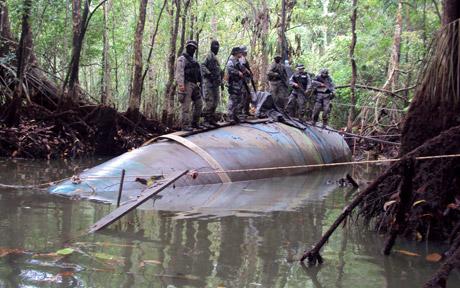
Law enforcement agents in Ecuador discovered a fairly modern, long-range submarine built by narcotics smugglers. It was about to launch for a trip to North America:
The sophisticated camouflaged vessel has a conning tower, periscope and air-conditioning system. It measured about nine feet high from the deck plates to the ceiling and stretched nearly a 100 feet long. The DEA says it was built for transoceanic drug trafficking.
"The submarine's nautical range, payload capacity, and quantum leap in stealth have raised the stakes for the counter-drug forces and the national security community alike," said DEA Andean Regional Director Jay Bergman.
It is unclear how far the camouflage-painted submarine could have traveled, but it is believed to be sophisticated enough to cover thousands of miles — and certainly to make it to the North American coast.
Clay Shirky is a tech pundit and a professor of new media at New York University. In this video, he argues that lolcats represent human progress because they are a demonstration of "cognitive surplus" -- excess time that people have to be creative. Shirky reasons that the simplistic creative act of making a lolcat is superior to any merely passive interaction with media, and is therefore progressive. Do you agree?
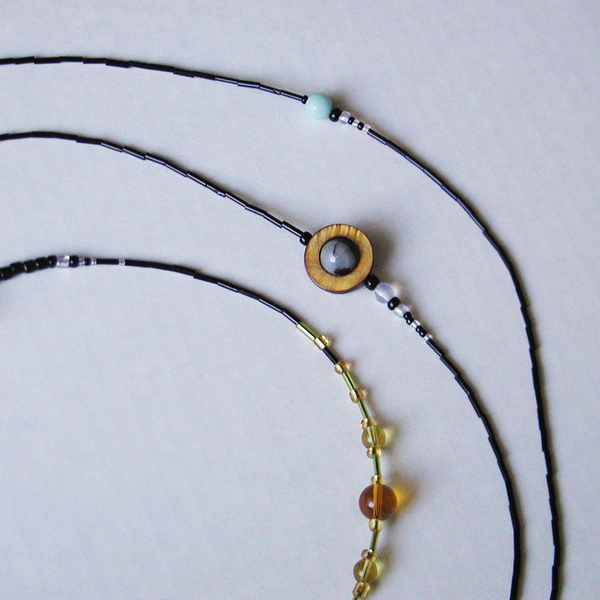
Laura Cesari made a set of beaded necklaces that are patterned after the orbits of our solar system. Each one shows either the entire solar system or a planet and the orbits of its moons in proportionate distances:
Years ago, I discovered a particularly nice piece of agate in a friend's bead shop that reminded me of Jupiter, and created a "Jupiter necklace" with other beads orbiting around it like moons. In the Solar System design, I decided to "zoom out" and focus on using small beads to measure the proportional distances between the planets. It took some calculations, a few abstractions, and a couple of prototypes: the first version was 75 inches long, made with 7-millimeter tubular glass bugle beads, each bead representing about 20 million miles. This Solar System Necklace design seemed like a good way to translate the mind-boggling distances of space into something tangible, something that people can measure physically with familiar objects.
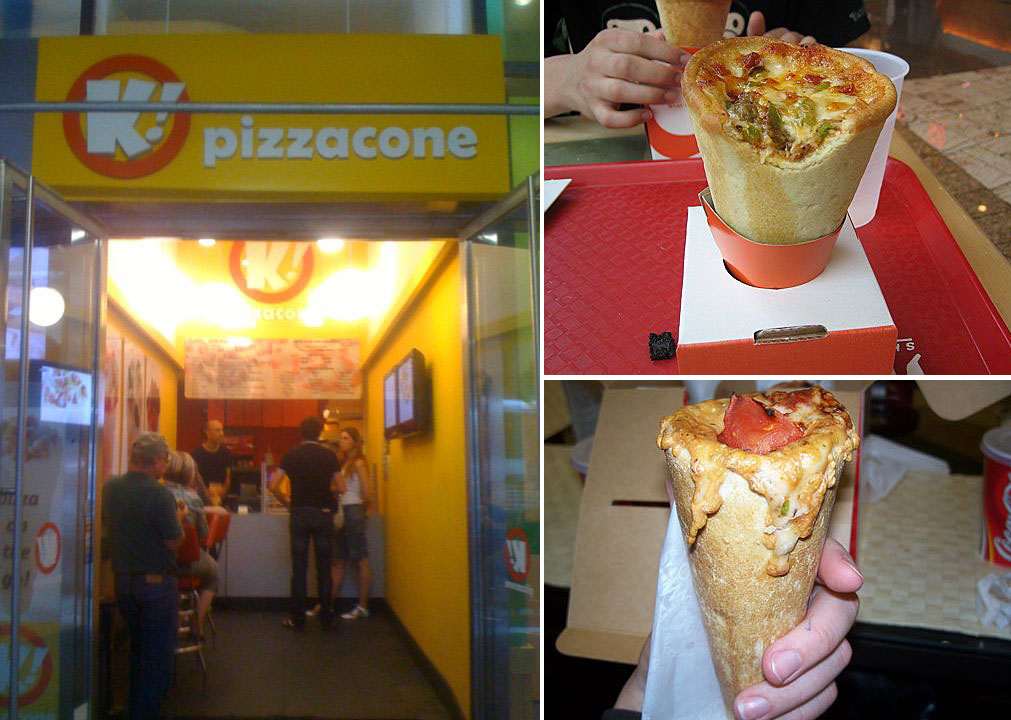
Pizzacone is a new Manhattan restaurant where you can buy the contents of a pizza stuffed into a cone:
The dough cones are shipped to Pinto daily from a Connecticut bakery, and each Pizzacone is made to order at the counter; you tell them what ingredients to add, and then it's cooked in the oven for five minutes. The result, according to one early guinea pig, is as convenient as it is delicious. "Tastes like a pizza," Victor Nelli, a TV producer, tells the Daily News. "You can totally walk with it, and you don't have the oil dripping all over you."
What say you, Neatoramanauts: awesome or disgusting? Or both?
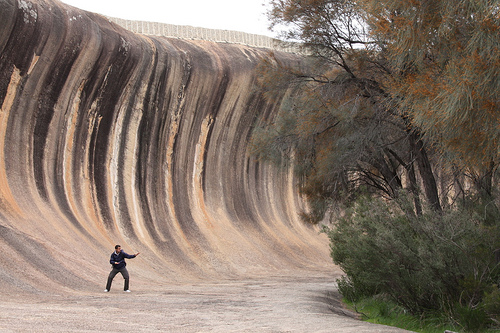
Wave Rock is an unusual landform in southwestern Australia. It looks like a giant wave of water that is about to crash. This feature was caused by the erosion of soft rock below the harder top. It measures 14 meters high and 110 meters long.
http://www.waverock.com.au/rock.htm via The Presurfer | Photo by Flickr user tostao meravigliao used under Creative Commons license
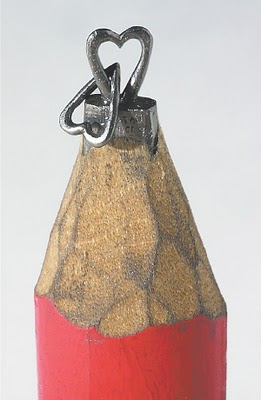
Artist Dalton Ghetti sculpts pencil leads. The work is very challenging, and he often works on multiple projects, so it can take him a decade to finish a single piece. From a 2007 article about him in The New York Times:
“The pencil tip is great; it’s like a pure, very homogenous material,” he said. “It cuts in the same direction, not like wood, which has a grain. But when I tell people how long it takes, that’s when they don’t believe it. That’s what amazes people more, the patience. Because everything nowadays has to be fast, fast, fast.”