John Farrier's Blog Posts

Man Robs Bank with Bouquet of Flowers

A man in New York City successfully robbed a bank. His weapon of choice was a bunch of flowers:

A security camera photo published by the police showed the suspect standing at the cashier's window holding the bouquet while handing over the note, which reportedly read: "Give me all your hundreds, fifties, don't be a hero."

The man fled the scene after the teller handed over $440 (£288).

The New York Post reported that it was the second known bank heist by the suspect, who last week robbed a different New York bank armed with a potted houseplant.


Link | Photo (unrelated) by Flickr user kimubert used under Creative Commons license

Projector Ring


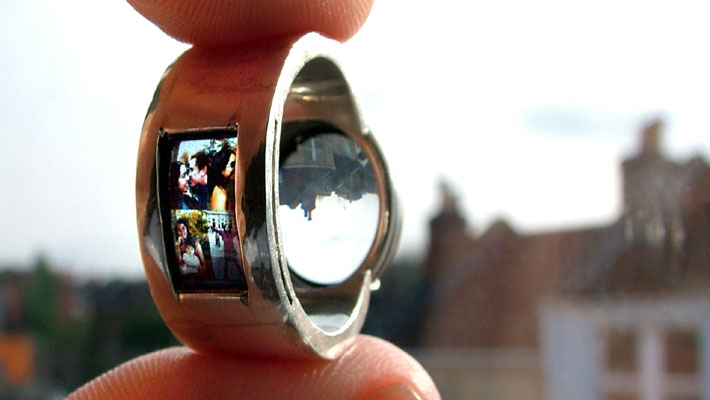
We've previously featured Luke Jerram's glass sculptures of deadly viruses. On a more pleasant note, Jerram is getting married. He worked with jeweler Tamrakar to make his own wedding ring. It contains tiny slides that, with a bit of light, project images of Jerram and his bride, Shelina Nanji:

In a darkened room, light from a candle or LED passes through the ring to project a series of portraits. A selection of miniature slides were made of different family portraits and inserted into the edge of the ring for projection. The ring was inspired by 19th Century Standhopes.


http://www.lukejerram.com/projects/portrait_projecting_ring via DVICE | Photo: Luke Jerram

Teenager Uses Craigslist to Swap Cell Phone for Porsche

Steven Ortiz, a 17-year old boy, used Craigslist to trade his old cell phone for an iPod Touch. He traded that gadget for something better, which he then traded for something even better. After a total of fourteen trades, starting with a cell phone, he had a Porsche Boxster:

Steven started his lucrative journey when his friend gave him an old cell phone - the sort most people would throw away or shove into a junk drawer.

He traded that phone for a better phone, which he then traded for an i-Pod touch. He traded that for a series of dirt bikes, a MacBook Pro, and a 1987 Toyota 4Runner.

At the time, Steven was just 15 and unable to drive his new acquisition. So he quickly swapped it out for a souped-up off-road golf
cart, another more valuable dirt bike, a streetbike, then a series of cars ending with a 1975 Ford Bronco. He spent a few months enjoying each acquisition before determining he was looking for something else.

It was that Bronco that got him the Porsche. Because some older Broncos are considered collectibles, Steven estimated his was worth $15,000.

He got offered all manner of trades - including a locksmith business - for the Bronco. The Porsche, worth about $9,000, was actually a trade down.


http://www.whittierdailynews.com/ci_15535695 via Jalopnik | Photo (unrelated) by Flickr user The Car Spy used under Creative Commons license
Mirror Makes Wall Look Like a Door Opening


It looks like a door opening in a concrete wall, right? It's not. This is a flat mirror designed by Sarah Dayo that creates that optical illusion. She writes:

Sometimes we cannot help but to try and catch a glimpse of the otherside.

Passing through the everyday spaces we inhibit, the door half opened always stirs up a sense of seduction and curiosity within us. Inspired by these ordinary yet inexplicable moments in our daily lives, I designed a mirror that gives an illusion of a door opening on any given surface.


Link via Make | Photo: Sarah Dayo

Japanese Wooden Tub Racing

200 people in Ito City, Japan, raced small wooden tubs down a 1,300 foot river. Rowing with rice paddles, participants tried to move quickly without tipping over the tubs. This unusual sport is a local tradition, and Ito City has held this competition annually for 54 years. At the link, you can watch a video (preceded by a commercial) from CBS News on the race.

Link via Urlesque | Photo: CBS News | Previously: Crossing the Sea of Japan in a Bathtub

The Solar Powered Aircraft That Could Stay Aloft for 14 Days


We've previously mentioned that the solar powered aircraft Solar Impulse was able to remain in the air for a full day. The similarly powered Zephyr, designed by the company QinetiQ, has now stayed in the air for more than a full week. Its engineers plan to continue its flight for at least another week in order to test its abilities. From QinetiQ's press release:

Launched by hand, the aircraft flies by day on solar power delivered by amorphous silicon solar arrays no thicker than sheets of paper that cover the aircraft's wings. These are also used to recharge the lithium-sulphur batteries, supplied by Sion Power Inc, which are used to power the aircraft by night. Together they provide an extremely high power to weight ratio on a continuous day/night cycle, thereby delivering persistent on-station capabilities.


Link via CrunchGear | Photo: QinetiQ

Snakes in a MRI Machine

Two scientists placed human subjects and snakes inside a MRI machine to measure how the human body responds to fear. Scientific American reports how they did it, and why:

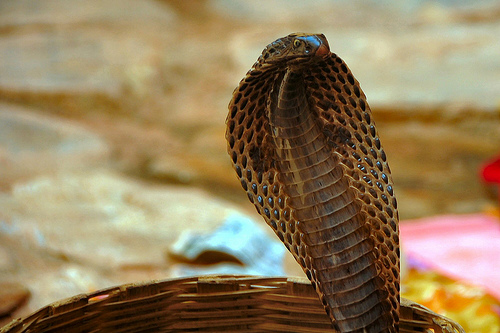
You are in an MRI machine. Your head is fixed in a round cage. Your body is rolled into a narrow tube. Magnetic pulses are beamed into your brain. A meter-and-a-half-long snake is strapped with Velcro atop a small box on a conveyor belt just inches behind your head. Your eyes meet the snake’s beady gaze through a tiny mirror above your head. You can’t move.

Why would Uri Nili and Yadin Dudai, two scientists from the Weizmann Institute of Science in Rehovot, Israel, want to put a snake in the MRI scanner with you? Obviously, not to scan the snake’s brain (although this might be an interesting possibility). They wanted to scan your brain while you perform an act of courage. They wanted to push research on fear one step further – from understanding how we passively react to fear, through actively avoiding it, to actually confronting it.


The subject could choose to move the snake closer or farther away in increments that the researchers called "snake-advance units". As the subject altered the relative position of the snake, instruments examined changes in his/her body.

Link | Video (self-starting) | Photo by Flickr user RussBowling used under Creative Commons license

The Mysterious Numerical Radio Stations

In some recesses of the radio spectrum, you can listen to strange broadcasts that consist entirely of people reading numbers. For years, people have speculated about the purpose of these unlicensed, unidentified radio stations. The most obvious possibility is espionage. NPR consulted Mark Stout, a spycraft historian, on the subject:

He tells NPR's Guy Raz that the stations are unlicensed, which makes it hard to figure out where they're broadcasting from. And the mystery only deepens: No government has ever officially admitted to using numbers stations. No one's really sure when the stations began broadcasting, though they're most likely a Cold War-era invention.

And, Stout says, no matter how advanced modern computer cryptography is, good old shortwave is often the best option for getting messages to spies in the field.

"Because [a message] can be broadcast over such an enormous area, you can be transmitting to an agent who may be thousands of miles away," he says. And, he adds, computer communications almost always leave traces.

"It's really hard to erase data out of your hard drive or off a memory stick," he says. "But all you need here is a shortwave radio and pencil and paper."


http://www.npr.org/templates/story/story.php?storyId=128586766 via reddit | Photo by Flickr user maliciousmonkey used under Creative Commons license
The People Who Filter the Internet

Many websites, such as YouTube, let users flag grotesque or illegal images that violate the hosts' terms of service agreements. But that's a lot of nasty content. Every wonder who actually checks everything that gets flagged? It turns out that some people, as a job, spend all day looking at horrifying images from the bowels of the Internet. In The New York Times, Brad Stone writes:

Ricky Bess spends eight hours a day in front of a computer near Orlando, Fla., viewing some of the worst depravities harbored on the Internet. He has seen photographs of graphic gang killings, animal abuse and twisted forms of pornography. One recent sighting was a photo of two teenage boys gleefully pointing guns at another boy, who is crying.

An Internet content reviewer, Mr. Bess sifts through photographs that people upload to a big social networking site and keeps the illicit material — and there is plenty of it — from being posted.[...]

The surge in Internet screening services has brought a growing awareness that the jobs can have mental health consequences for the reviewers, some of whom are drawn to the low-paying work by the simple prospect of making money while looking at pornography.

“You have 20-year-old kids who get hired to do content review, and who get excited because they think they are going to see adult porn,” said Hemanshu Nigam, the former chief security officer at MySpace. “They have no idea that some of the despicable and illegal images they will see can haunt them for the rest of their lives.”


What has been seen, cannot be unseen.

Link via Gizmodo | Photo (unrelated) via Flickr user TheMuuj used under Creative Commons license
New Vaginal Gel Reduces HIV Infection Rates by 54%

A trial of a powerful new microbicidal vaginal gel reduced the HIV infection rate of test subjects by 54%. The gel is a 1% solution of the antiretroviral drug tenofovir, which stops HIV replication. At Scientific American, Katherine Harmon writes:

A reliable HIV-prevention method for women has thus far proved hard to come by, leaving many millions of at-risk women subject to their partner's decision about condoms.

But a gel that can be applied discretely could severely cut back on HIV, a disease that currently infects an estimated 33 million people worldwide. Researchers involved in the new study calculated that if about a third of women in South Africa could use this gel, in the next 20 years, 1.3 million HIV infections—and 820,000 HIV-related deaths—could be prevented in that country alone.


Link | Image: NIH

New Anti-Aircraft, Anti-Missile Laser


The US defense company Raytheon debuted its new anti-aircraft and anti-missile laser system at the Farnborough Airshow in the UK. It will function as a supplement to the ship-mounted Phalanx system, an automated Gatling gun that fires at missiles and aircraft approaching a naval vessel. Raytheon representative Mike Booen said:

"It functions as the last line of defence, so if you can fit a laser onto it, you have a longer reach and an unlimited magazine, cause it keeps on throwing out photons," he added.

Two problems that have dogged laser weapon development for some time are weather conditions and the target itself. Damp maritime air can absorb the laser energy before it reaches the target and - as developers discovered in the 1960s when trying to target Russian Mig aircraft - a reflective surface can negate much of the laser's effectiveness.

Mr Booen acknowledges this, but said that these problems could be overcome.

"Every material reflects, but you can overcome this with power; once you get over a certain threshold - measured in multiple kilowatts - then the laser does what it is designed to do," he said.

Mr Booen said that once a material started getting hot, it affected the reflective ability, making the target absorb more energy and eventually leading to its destruction.


At the link, you can view a video of an unmanned drone getting shot down by the system.

Link via Fast Company | Image (artist's conception) courtesy of Raytheon

Salt Shaker/Dandruff Shampoo Ad


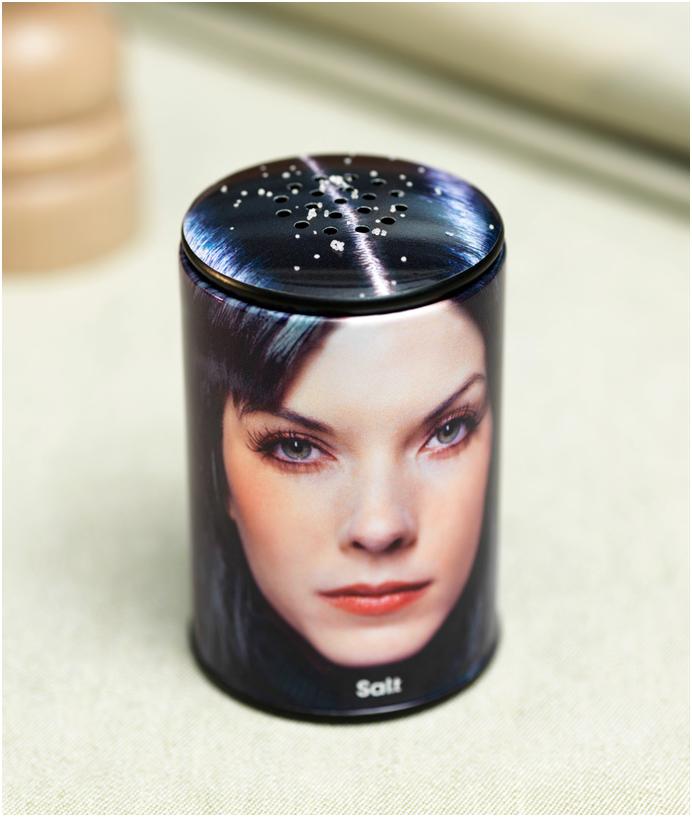
The advertising agency of Grey G2/Group in Düsseldorf, Germany made this salt shaker as a promotional item for a line of anti-dandruff shampoo by Pantene. When salt remains on the top, it looks like the model has dandruff.

Link via Super Punch | Photo: Björn Giesbrecht

How Close Could a Person Get to the Sun and Survive?

How close could you get to the sun before burning up? Alessandra Calderin of Popular Science asked NASA engineer Ralph McNutt:

The sun is about 93 million miles away from Earth, and if we think of that distance as a football field, a person starting at one end zone could get about 95 yards before burning up.

That said, an astronaut so close to the sun is way, way out of position. “The technology in our current space suits really isn’t designed to withstand deep space,” says Ralph McNutt, an engineer working on the heat shielding for NASA’s Messenger, a new robotic Mercury probe. The standard space suit will keep an astronaut relatively comfortable at external temperatures reaching up to 248°. Heat coming off the sun dissipates over distance, but a person drifting in space would begin encountering that kind of heat (the five-yard line) some three million miles from the sun. “It would then be a matter of time before the astronaut died,” McNutt says.


The space shuttle, however, has greater heat resistance than a spacesuit, so it could get to the two-yard line before cooking its crew.

http://www.popsci.com/science/article/2010-07/how-close-could-person-get-sun-and-survive | Photo: the Sun seen from Skylab, courtesy of NASA

Photographing the Elements


Wikipedia user alchemist-hp is on a quest to take beautiful color photographs of every naturally occurring element. Pictured above is bismuth. At the link, you can view his German-language clickable periodic table of images.

Link via Make

The Buddha's Hand


The Buddha's Hand is an unusual fruit rarely found in American grocery stores, but common to parts of China and India. It's so named because its fingers are said to represent the hands of the Buddha praying:

In China the fruit is often carried in the hand or simply placed on a table in the home to bring those who live their good luck, happiness and long life. Its Chinese name, fo-shou, means exactly that when it is written alongside other characters. As well as culinary and household use the fruit, before maturity, is often prescribed as a tonic.


Link via The Presurfer | Photo by Flickr user gumdropgas used under Creative Commons license

Email This Post to a Friend
""

Separate multiple emails with a comma. Limit 5.


Success! Your email has been sent!

close window

Page 1,157 of 1,332     first | prev | next | last

Profile for John Farrier

  • Member Since 2012/08/04


Statistics

Blog Posts

  • Posts Written 19,973
  • Comments Received 52,525
  • Post Views 31,886,875
  • Unique Visitors 26,165,481
  • Likes Received 29,425

Comments

  • Threads Started 3,801
  • Replies Posted 2,325
  • Likes Received 1,744
X

This website uses cookies.

This website uses cookies to improve user experience. By using this website you consent to all cookies in accordance with our Privacy Policy.

I agree
 
Learn More