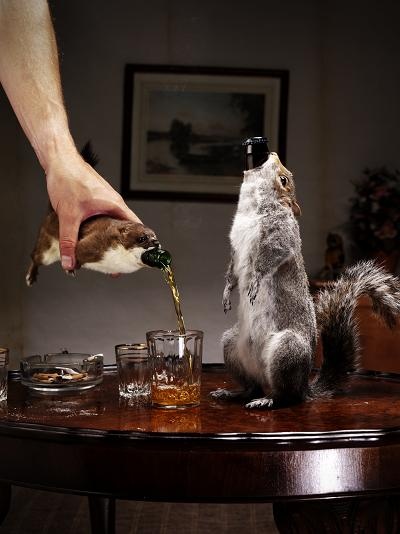
British brewery BrewDog, noted for its quest to make the world's strongestbeer, is now selling bottles of beer in the prepared bodies of dead squirrels and stoats. Because, you know, that's what people want. The product is called "The End of History", and is 55% alcohol:
The name derives from the famous work of philosopher Francis Fukuyama, this is to beer what democracy is to history. Fukuyama defined history as the evolution of the political system and traced this through the ages until we got the Western Democratic paradigm. For Fukuyama this was the end point of man’s political evolution and consequently the end of history. The beer is the last high abv beer we are going to brew, the end point of our research into how far the can push the boundaries of extreme brewing, the end of beer.
Tom Broadbent, a student at De Montfort University in Leicester, UK, built a machine that harvests the kinetic energy of water that is flushed down a toilet. It's called HighDro Power and can save about £926 in a seven-storey building:
He added: “HighDro Power works by using the water discharged from appliances such as showers, toilets and sinks in high-rise apartments. The water goes down the pipe and hits four turbine blades that drive one generator.
“The whole thing was influenced by traditional waterwheels to ensure that any solids passing through had limited effects on whether they could function.”
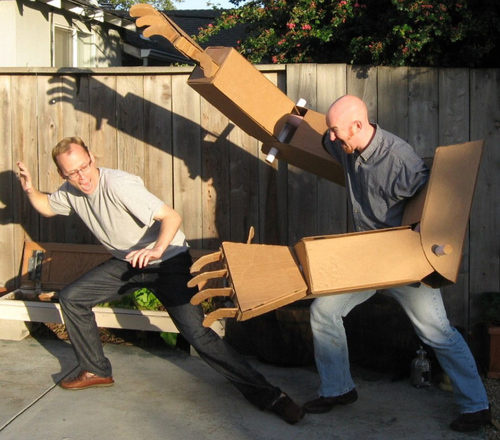
Would you like to have giant robot arms with which to crush your enemies? Okay, that's a dumb question. Of course you would! Etsy seller giantcardboardrobots makes them:
Each arm is approximately 5' 6" in length (about 3 feet longer from where your hands will grab), 9" x 9" in width. The arms allow for both 90° bending motion in the elbows as well as 360° rotation of the wrist. The arms break down into easily assembled component parts. Disassembled, both arms fit into a 30" x 18" x 6" box.
This time-lapse video shows the changing moods of people in America over the course of a day, as ascertained by emotional keywords that they use on Twitter. It was created by computer scientist Alan Mislove at Northeastern University in Boston:
Mislove speculates that a signal shines though because the sheer abundance of data means that occasional misinterpretations are lost in the crowd. Bryan Routledge at Carnegie Mellon University in Pittsburgh, Pennsylvania, agrees. With colleagues, he recently used a similarly simple analysis of words in tweets to determine whether Twitter mirrors conventional opinion polls. "The volume is massive, so the subtle stuff kind of washes out," he says.
Because Twitter data is publicly available, Routledge says mood can be sampled more quickly, simply and cheaply than using traditional polling tools – albeit more crudely.
Steven Gray at University College London, who also crowdsources data through Twitter, agrees. For all of the problems with decoding the data, "Twitter offers researchers a unique, live data set that changes by the minute", he says.
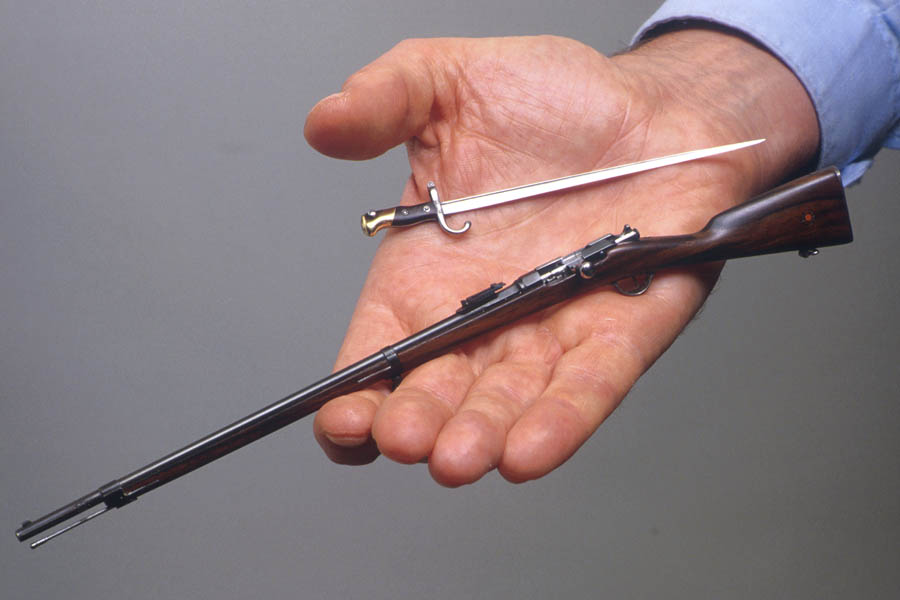
Michel Lefaivre is a gunsmith who makes miniature, functional firearms. Pictured above is one example of his work, a 1/4 scale Gras rifle model 1874. Lefaivre writes about how he does it:
Each part starts from a raw piece of material, reduced in size with a milling machine or a precision lathe. The biggest part of the work is made with a file in the fitting vice. At a quality of manufacture and finish equal to the full size, it is more difficult to make a functioning piece reduced to 1/3 scale. The more minute the detail, the more time it takes, and the more risk of making a mistake. Few pieces were successful the first time round. All those not strictly in conformity were scrapped without pity.
To perfect the work and to give it its final touch, the best specialist of our country have been called upon for the engraving, inlaying, gilding, checkering and the wood carving.
Mandatory tooling includes a toolmaker’s lathe, a clockmaker’s lathe, a precision milling machine and hundreds of needle files of all shapes and grades. Burrs and polishing tools of all shapes, pertaining to clockmakers, jewellers, dentists, chisellers and sculptors are used. Very good eyesight and an infinite reserve of patience, tenacity and elbow grease are also required.
Potsdam University in Germany is offering formal instruction in flirting to IT graduate students:
The 440 students enrolled in the master's degree course will learn how to write flirtatious text messages and emails, impress people at parties and cope with rejection.
Philip von Senftleben, an author and radio presenter who will teach the course, summed up his job as teaching how to "get someone else's heart beating fast while yours stays calm."
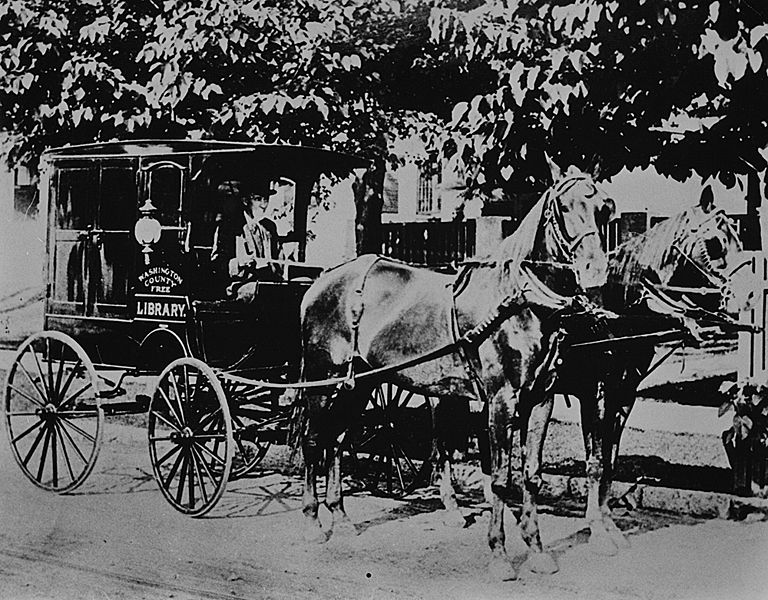
This is a photograph of what is alleged to be the first American bookmobile. It was built in 1905 by the public library of Washington County, Maryland. Mary Titcomb, the librarian responsible for its creation, described its importance:
Would not a Library Wagon, the outward and visible signs of the service for which the Library stood, do much more in cementing friendship? Would the upkeep of the wagon after the first cost be much more than the present method? Is not Washington County with its good roads especially well adapted for testing an experiment of this kind, for the geography of the County is such that it could be comfortably covered by well planned routes? These and other aspects of the plan were laid before the Board of Trustees - who approved of the idea, and forthwith the librarian began interviewing wagon makers and trying to elucidate her ideas with pen and pencil. The first wagon, when finished with shelves on the outside and a place for storage of cases in the center resembled somewhat a cross between a grocer's delivery wagon and the tin peddlers cart of by gone New England days. Filled with an attractive collection of books and drawn by two horses, with Mr. Thomas the janitor both holding the reins and dispensing the books, it started on its travels in April 1905.
No better method has ever been devised for reaching the dweller in the country. The book goes to the man, not waiting for the man to come to the book. Psychologically too the wagon is the thing. As well try to resist the pack of a peddler from the Orient as the shelf full of books when the doors of the wagon are opened by Miss Chrissinger at one's gateway.
The original wagon was hit and destroyed by a train in 1910, and replaced with a motorized version two years later.
London-based designer Chambers Judd modified the floppy disk drive pictured above. Normally it lies flat, but the moment that it comes in contact with a liquid, little legs raise it up out of danger. Video at the link.
Researchers led by Paul Crowther, professor of Astrophysics at the University of Sheffield, UK, have discovered a cluster of young stars that are about twice as big as the maximum size that astrophysicists thought could exist. Each is about 300 times the size of our sun:
In the study, the researchers estimated the maximum possible mass for stars within the two clusters, and the relative number of the most massive stars. Their findings have caused them to reevaluate current estimates for how large these stars can be.
"The smallest stars are limited to more than about 80 times more than Jupiter, below which they are 'failed stars' or brown dwarfs," said Olivier Schnurr, a research team member from the Astrophysikalisches Institut Potsdam in Germany. "Our new finding supports the previous view that there is also an upper limit to how big stars can get, although it raises the limit by a factor of two, to about 300 solar masses."
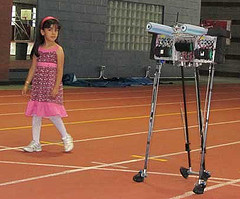
Ranger, a robot built by researchers at Cornell University, broke a walking record for an untethered robot when it walked more than fourteen miles in eleven hours without recharging:
Guided by students with a remote control, Ranger navigated 108.5 times around the Barton Hall indoor track, about 212 meters per lap, and made about 70,000 steps before it had to stop and recharge. The 14.3-mile record beats the former world record set by Boston Dynamics' BigDog, which had claimed the record at 12.8 miles
What I find most impressive is the robot's remarkably human appearance, as you can see from the photo provided by Cornell University.
http://www.technewsdaily.com/walking-robot-breaks-distance-walking-record-0884/ via Geekologie
This short film is an instructional video on how to bathe a cat. It's roughly based on Bud Herron's essay "Cat Bathing as a Martial Art" and provides sound warnings on the dangers of wet, enraged cats.
http://www.lifestorywriting.com/2009/01/cat-bathing-as-a-martial-art/ via The Presurfer
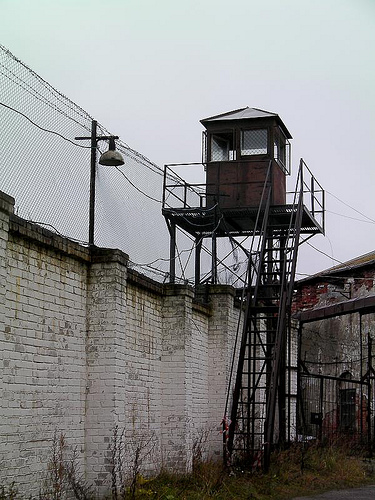
Police in Argentina are on the lookout for two escaped prisoners. Due to a manpower shortage, only two of the fifteen guard towers at a prison were manned. One had a crudely-made dummy inside which did not fool the prisoners:
A prison source said: "We've made a dummy out of a football and a prison officer's cap, so that the prisoner see its shadow and think they're being watched."
"We named him Wilson, like in the film Cast Away, and put him in one of the towers," the man told the Diario Rio Negro newspaper, referring to the Tom Hanks film in which his character invents a volleyball character for company.
Link | Photo (unrelated) by Flickr user tm-tm used under Creative Commons license
We've previously mentioned that engineers in various firms have been developing cars that can drive themselves. A group of Italian engineers is putting their automated car to a rather rigorous test: driving from Italy to Shanghai without direct human guidance.
Two bright orange vehicles, equipped with laser scanners and cameras that work in concert to detect and help avoid obstacles, are to brave the traffic of Moscow, the summer heat of Siberia and the bitter cold of the Gobi desert before the planned arrival in Shanghai at the end of October.
"What we are trying to do is stress our systems and see if they can work in a real environment, with real weather, real traffic and crazy people who cross the road in front of you and a vehicle that cuts you off," said project leader Alberto Broggi.
The road trip consists of two pairs of vehicles, each with a driven lead van followed by a driverless vehicle occupied by two technicians, whose job is to fix glitches and take over the wheel in case of an emergency.
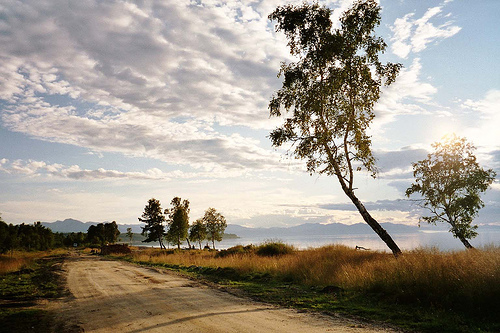
http://www.npr.org/templates/story/story.php?storyId=128639246&ft=1&f=1004 via Popular Science | Photo of unrelated Siberian road by Flickr user vladislav.bezrukov used under Creative Commons license
This video demonstrates a physical motion simulation program developed by the start-up company Lagoa Technologies. It shows columns of dirt smashing into the ground and scattering, as well as other effects that could make future video games even more awesome.
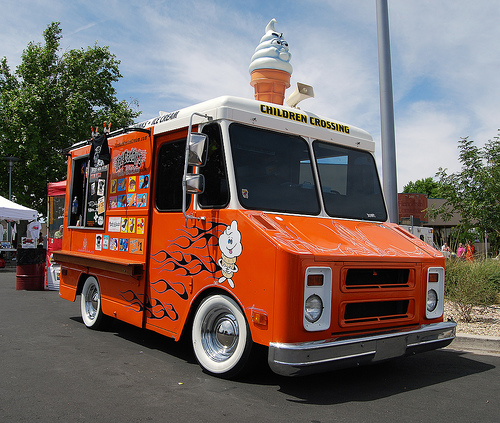
A new business in Britain sells ice cream to dogs from a truck. The K99 Van travels around, plays the Scooby Doo theme, and selling ice cream that is safe for dogs to consume:
Head chef behind the K99's recipes Ceric Nale said: 'When it came to designing the recipes for the K99s, we wanted to make sure we had the most exciting flavour and texture combinations.
'After a lot of research, a gammon and chicken ice cream and a mixed dog biscuit ice cream were the clear winners, and we hope they'll be flavours dogs simply can't refuse.'