John Farrier's Blog Posts

Lie-Detecting MRI Used in Court

Brooklyn attorney David Zevin plans to submit an MRI scan as evidence in a sexual discrimination suit. This will mark the first time that a lie-detecting MRI has been used in a US court other than for the sentencing phase of a criminal trial:

So, Zevin had the coworker undergo an fMRI brain scan by the company Cephos, which claims to provide “independent, scientific validation that someone is telling the truth.”

Laboratory studies using fMRI, which measures blood-oxygen levels in the brain, have suggested that when someone lies, the brain sends more blood to the ventrolateral area of the prefrontal cortex. In a very small number of studies, researchers have identified lying in study subjects (.pdf) with accuracy ranging from 76 percent to over 90 percent. But some scientists and lawyers like New York University neuroscientist Elizabeth Phelps doubts those results can be applied outside the lab.

“The data in their studies don’t appear to be reliable enough to use in a court of law,” Phelps said. “There is just no reason to think that this is going to be a good measure of whether someone is telling the truth.


Link via Popular Science | Photo: NIH

Tea and Cannolis with Mike Tyson


(YouTube Link)


In this surreal video, comedian Reese Waters sits down for morning tea with boxer Mike Tyson. They discuss their preferences among teas, opinions on cannolis, and the finer points of wedding etiquette.

via Urlesque

The Self-Landscapes of Levi van Veluw


Dutch artist Levi van Veluw uses his own head as a canvas, as he did in his 2008 series "Landscapes", pictured above. He doesn't accept help, but decorates his head completely by himself. At the link, you can see more examples of his work and a video of the artist decorated as a country landscape with a functional model train circling his head.

Link via Jules Crittenden | Interview | Photo: Levi van Veluw

Laser Suit


Taiwanese designer Wei-Chieh Shih put two hundred laser diodes on a nylon jacket. When he spins around, it looks all swirly. More pictures at the link.

http://www.behance.net/Gallery/200-ld-stage-suit/493017 via DudeCraft | Designer's Website | Photo: Wei-Chieh Shih

Robots Playing Soccer


(YouTube Link)

The RoboCup is an annual worldwide competition of soccer-playing robots. It's a challenge that encourages roboticists to create intelligent, fast, and accurate machines. The above video is from a demonstration by Japan's national team. via CrunchGear | Official Website


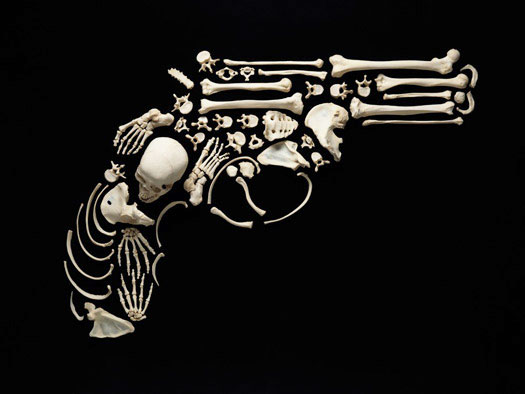
The Bone Sculptures of Francois Robert


Photographer Francois Robert created a series of pictures in which he arranged human bones into sculptures. It's entitled "Stop the Violence", and serves as a warning against the human propensity to kill and destroy. In an interview about his work, Robert explained:

I always have been fascinated with skulls (In my home town in Switzerland, my parents and I were living above a Natural Museum). As I mentioned, I photographed over 140 skulls of animals from the Field Museum in Chicago, and it become a traveling exhibition across the U.S. for 8 years (sponsored by the Museum). In the mid-90’s, during an auction from an old school, I purchased 3 metal lockers and to my surprise one of them held a real, full size articulated skeleton. For years I had it displayed in one of the rooms in my studio and I often wondered what else I could do with it. Finally the idea came to me to explore the idea of disassembling the skeleton and rearranging the bones, and from that process came the series “Stop the Violence”.


Link via Geekologie | Artist's Website | Interview

Aircraft Designed to Fly Like Maple Seeds


(YouTube Link)


Researchers at the University of Maryland's Department of Aerospace Engineering designed unmanned aerial vehicles with the aerodynamic properties of maple seeds. The team then started a company and is selling the product:

X-Naves has produced new prototype vehicles of an entirely different flight configuration, which have demonstrated the capability to carry a payload two times their weight or ten times the amount of their counterparts for longer durations. The prototypes have utilized an understanding of the aerodynamics of a falling maple seed to create a vehicle both naturally stable and extremely efficient. An inventor and founder of X-Naves has patented and built approximately one hundred working prototypes.


Link (warning: sound when you click on an internal link) via Make

Anthropologist: Cooking Made Humans More Intelligent, Sociable

Harvard anthropologist Richard Wrangham argues that the ability to cook food contributed to human evolution:

“Cooked food does many familiar things,” he observes. “It makes our food safer, creates rich and delicious tastes and reduces spoilage. Heating can allow us to open, cut or mash tough foods. But none of these advantages is as important as a little-appreciated aspect: cooking increases the amount of energy our bodies obtain from food.”

He continues: “The extra energy gave the first cooks biological advantages. They survived and reproduced better than before. Their genes spread. Their bodies responded by biologically adapting to cooked food, shaped by natural selection to take maximum advantage of the new diet. There were changes in anatomy, physiology, ecology, life history, psychology and society.” Put simply, Mr. Wrangham writes that eating cooked food — whether meat or plants or both —made digestion easier, and thus our guts could grow smaller. The energy that we formerly spent on digestion (and digestion requires far more energy than you might imagine) was freed up, enabling our brains, which also consume enormous amounts of energy, to grow larger. The warmth provided by fire enabled us to shed our body hair, so we could run farther and hunt more without overheating. Because we stopped eating on the spot as we foraged and instead gathered around a fire, we had to learn to socialize, and our temperaments grew calmer.


Wrangham also asserts that cooking strengthened the bonds within early hominid communities and established lasting gender roles.

Link via Choice | Photo: flickr user flowcomm, used under Creative Commons license

Woman Born with No Arms or Kneecaps Prepares for Black Belt Test

Sheila Radziewicz of Massachusetts was born without arms or kneecaps. But she hasn't let that prevent her from accomplishing her goals, including getting a black belt in Taekwondo:

Sheila Radziewicz was scheduled to take her test next month at Bruce McCorry's Martial Arts in Peabody. The 32-year-old brown belt, who was born with thrombocytopenia-absent radius, or TAR syndrome, told The Salem News she's been training in martial arts for three years. [...]

The Salem resident, who works as an advocate for victims of domestic violence, said she has never let her disability stop her. At 23, Radziewicz earned her driver's license. She uses a car that she controls with her feet.


Link | Photo: AP

Meta Meme: Keyboard Cat Goes to the Dentist


(YouTube Link)


The latest meme is to mix two or more memes together. The result is exponentially more amusing or annoying, depending on your perspective. This video combines Keyboard Cat with David After Dentist. It was made by Charlie Schmidt, the original creator of Keyboard Cat.

via Urlesque

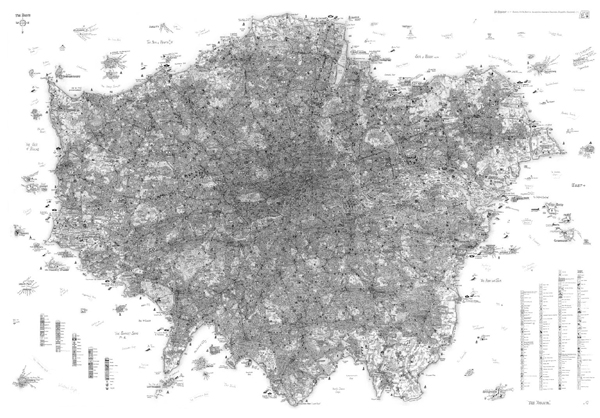
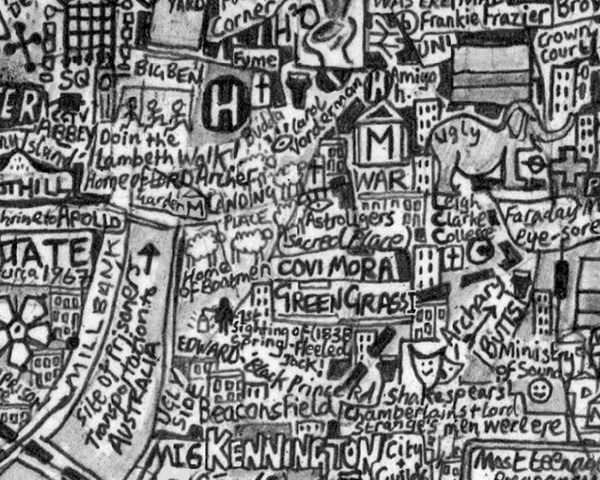
Detailed, Hand-Drawn Map of London


Artist Stephen Walter made an enormous, detailed, hand-drawn map of London. It's called "The Island" and is a satire of Londoners' alleged view that their city is independent of the rest of the UK. In an interview about his work, Walter said:

Discoveries such as the First Earl of Salisbury having honeymooned, in 1589, in what is now a dodgy part of Edmonton caused much amusement. The map charts the birthplaces of famous people such as Alfred Hitchcock, Samuel Palmer, Noel Edmonds and Phyllis Pearsall (the originator of the London A-Z). It notes where Winston Churchill went to school, the gymnasium where Arnold Schwarzenegger trained, where the speed of sound was first recorded, the place where Oliver Twist was taught to thieve, the hotel where Hendrix died, sites of old palaces and prisons and the main encampments of the peasant revolts …


Link via Make | Artist's Website | Interview

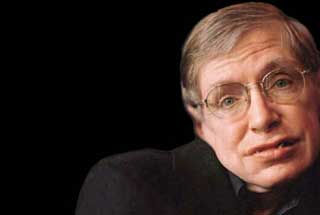
Stephen Hawking Says Time Travel May Be Possible

In The Daily Mail, Stephen Hawking writes that time travel may be possible. Since time and space are "wrinkled", people might use these wrinkles as shortcuts in time:

Nothing is flat or solid. If you look closely enough at anything you'll find holes and wrinkles in it. It's a basic physical principle, and it even applies to time. Even something as smooth as a pool ball has tiny crevices, wrinkles and voids. Now it's easy to show that this is true in the first three dimensions. But trust me, it's also true of the fourth dimension. There are tiny crevices, wrinkles and voids in time. Down at the smallest of scales, smaller even than molecules, smaller than atoms, we get to a place called the quantum foam. This is where wormholes exist. Tiny tunnels or shortcuts through space and time constantly form, disappear, and reform within this quantum world. And they actually link two separate places and two different times. [...]

Given enough power and advanced technology, perhaps a giant wormhole could even be constructed in space. I'm not saying it can be done, but if it could be, it would be a truly remarkable device. One end could be here near Earth, and the other far, far away, near some distant planet.

Theoretically, a time tunnel or wormhole could do even more than take us to other planets. If both ends were in the same place, and separated by time instead of distance, a ship could fly in and come out still near Earth, but in the distant past. Maybe dinosaurs would witness the ship coming in for a landing.


Link via Geekologie | Image: NASA

Couple Renovates Abandoned Public Bathroom into House

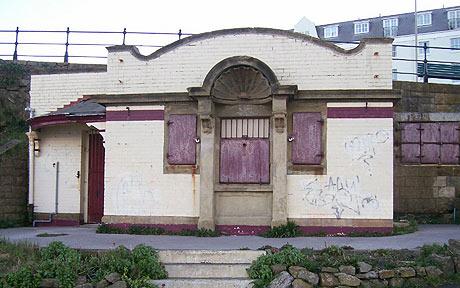
Tracy Woodhouse and Graham Peck found a century-old abandoned public bathroom on the shore of Scarborough, UK and decided to turn it into a home:

The £35,000 project is now finished and the couple have settled down in their new home, which they have named The Lookout. Their television is situated where the men's urinals used to be, and their bathroom is in the former ladies' toilets. [...]

Metal gates at the separate entrances for Gentlemen and Ladies are signs of the building's original use as well as the bay window – which used to be the toilet's kiosk, but once they started digging much of its past was revealed.

The couple filled six skips with maroon glazed earthenware bricks and dug out the drains of the old urinals and a dozen cubicle


http://www.telegraph.co.uk/property/propertynews/7674061/Couple-set-up-home-in-disused-public-lavatory-with-sea-view.html | Photo: Ross Parry/Daily Telegraph

New Technique Keeps Heart Alive 10 Days After Removed from Body


(YouTube Link)


Most organs that are removed from bodies for transplants can last only four to eight hours before they become useless. But Harvard researcher Hemant Thatte and his team have developed what they call "Somah" -- a chemical mix that can preserve organs. The above video shows a pig heart being revived using this process a day after it was removed from the pig.

The researchers harvested hearts from female pigs, stored them in one of the two solutions, then biopsied them at several points over the next four hours. They observed the function of the cardiomyocyte and endothelial cells--both of which must be preserved in order for the transplanted heart to survive over the long term. By measuring key proteins, they determined that the rate of cell death was significantly slower in the Somah-preserved hearts than it was in those stored with Celsior. Their experiments in pigs suggest that Somah keeps hearts and livers viable for at least 10 days. By contrast, solutions such as Celsior can only be counted on to preserve hearts and livers for about four and 12 hours, respectively.


Link via Popular Science

Carved Guitar Body


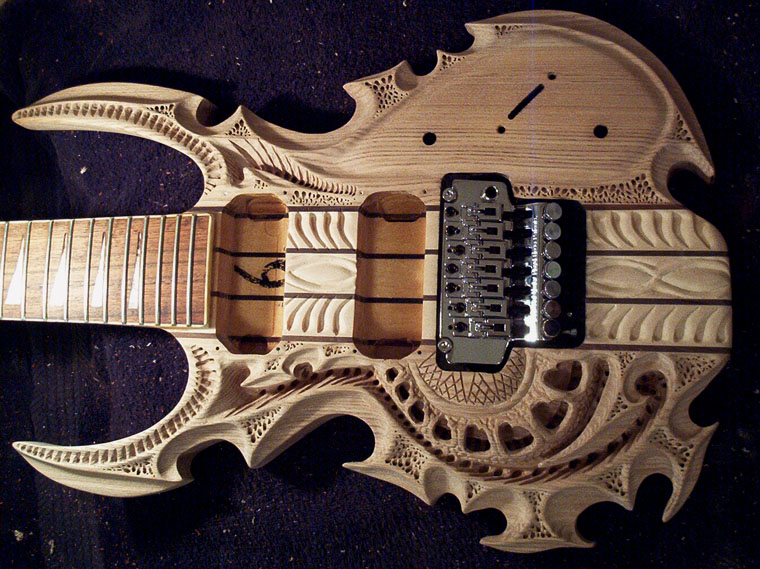
Grey Van Kuilenburg is a custom guitar builder. Pictured above is a body for a seven-string guitar that he carved and assembled from ash, bubinga, and rock maple. In an interview about his work, Kuilenburg described how involved is carving a guitar body that is not only beautiful, but functional:

The process is a long one, but the readers digest version is you select the tone wood, find the centerline, route out the cavities for the pickups, electronics, and the neck pocket (lot's of slow caution there. it needs to be as perfect, as straight, and as tight as possible. This is where a great deal of tone is either lost or gained.) Do whatever drilling is necessary for the bridge you're using, I do a lot of mock ups with the parts to make sure everything fits and has room. You cannot measure enough times, or be careful enough!!! Then shape it, and break out the chisels. After its finished, I do a great deal of sanding, then finish it or send it to the paint shop depending on the piece. In this case I went with a three part oil finish that I like to use. It's very protective, but it feels like raw wood so it plays fast and feels more natural.


Link | Interview

Email This Post to a Friend
""

Separate multiple emails with a comma. Limit 5.


Success! Your email has been sent!

close window

Page 1,178 of 1,332     first | prev | next | last

Profile for John Farrier

  • Member Since 2012/08/04


Statistics

Blog Posts

  • Posts Written 19,968
  • Comments Received 52,520
  • Post Views 31,882,540
  • Unique Visitors 26,161,505
  • Likes Received 29,425

Comments

  • Threads Started 3,801
  • Replies Posted 2,324
  • Likes Received 1,744
X

This website uses cookies.

This website uses cookies to improve user experience. By using this website you consent to all cookies in accordance with our Privacy Policy.

I agree
 
Learn More