
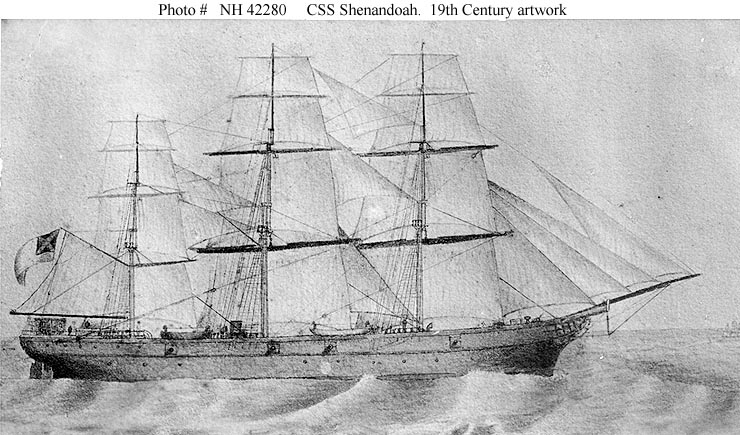
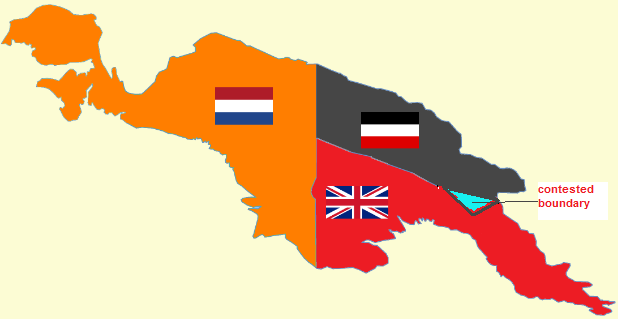
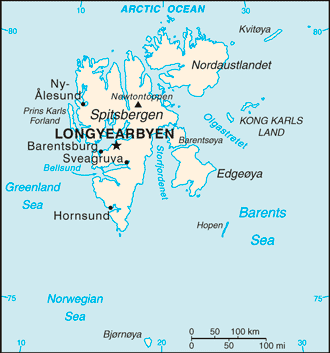
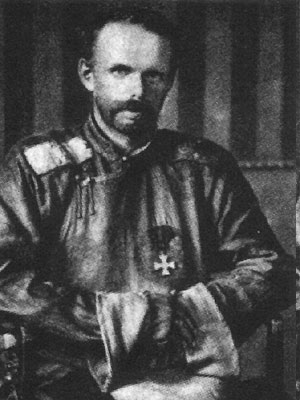
You may have heard of the Japanese holdouts -- soldiers of Imperial Japan that did not surrender at the end of World War II -- but continued to hide in jungles through the 1950s, 60s, and 70s. Although their endurance was remarkable, they weren't the only people to keep fighting long after they had lost wars. Let's take a look at some of the men who were the last to surrender throughout military history. Attun Paladin, sometimes referred to as Teruo Nakamura, was the last Japanese soldier to surrender in World War II.* He wasn’t ethnically Japanese, but a Taiwanese native who was conscripted into an auxiliary unit of the Imperial Japanese Army. In 1944, his unit was sent to the island of Morotai, Indonesia. When Japan surrendered the following year, Paladin and other stragglers hid in the jungle until 1954. After a dispute with them, he struck out on his own. Paladin built a hut, planted a garden, and did not see another human being for twenty years. An airplane pilot, however, did see Paladin from the sky and reported his presence to Indonesian authorities. On 18 December 1974, a unit of Indonesian Army troops trained for this mission surrounded his hut and began singing the Kimigayo -- the Japanese national anthem. Paladin did not resist arrest and returned with the soldiers to a military base. Now the hard question: Taiwan was no longer a Japanese colony, so to what country should he be repatriated? Paladin clearly identified with Japan, but had never been to Japan itself and was certainly not ethnically Japanese. After some brief debate in Japan about what it meant to be truly Japanese, he was repatriated to Taiwan on 8 January 1975 to greet a son he had never met and a wife who had remarried twenty years previously. Bitter and confused, Paladin died of lung cancer five years later. The CSS Shenandoah was a British-built merchant steamship converted into a commerce raider by the Confederacy during the American Civil War. It set sail late in 1864 from the Maderia Islands under Lt. Cdr. James Iredell Waddell. It captured or sunk dozens of US merchant vessels in the Atlantic, Indian, and Pacific Oceans, as well as the Sea of Japan, Okhotsk Sea, and Bering Sea. Waddell’s primary objective was to greatly damange the US North Pacific whaling fleet, and he was largely successful. The Shenandoah was welcomed in Australia, where it was repaired in dry dock and reprovisioned. Waddell needed additional crewmen, but could not legally recruit them in Australia, so he enlisted the 42 men that had stowed away and discovered by him immediately after leaving Australian waters. By June 1865, Waddell received word from men on a captured ship that the Confederacy had surrendered. Disbelieving the report, he carried on his attacks on American shipping in the Pacific. That August, he encountered a British captain who confirmed the devastating news. Waddell accepted the report as true and decided to sail back to Britain. He hauled down the Confederate ensign, ignored all further encounters with US merchant vessels, and anchored the Shenandoah in the Mersey River. Waddell, after a journey of 58,000 miles and 38 captured vessels, distributed the prize money and released the crew. The American Civil War was now well and truly over. When World War I broke out in 1914, the northeastern part of New Guinea was a German colony. But Germany lacked the naval forces in the Pacific necessary to protect its territories in that region, and they rapidly fell into Allied hands. Captain Hermann Dentzer, an army surveyor assigned to German New Guinea at the time, decided against surrendering to the large Australian forces occupying the colony. He and the small force under his command sojourned out into the Saruwaged Mountains of the Huon Peninsula, exploring the area, raiding the Australians, and perhaps becoming the first outsider to see the central high grasslands of the island. The Australians never caught him, and it was only after learning of the 11 November 1918 armistice that Dentzer decided to surrender. In January of 1919, he put on his well-preserved dress uniform and, raising the flag of the German Empire, marched his force into an Australian base. When he returned to Germany, Dentzer was hailed as a national hero. His book about his adventures, Four Years Among the Cannibals, was a bestseller. You can read a German-language version of that book here. Svalbard is a frozen archipelago in the Arctic Ocean north of Norway, and under the sovereignty of that nation. Although Germany conquered Norway in April 1940, it was unable to immediately take Svalbard, which had an abundance of coal and was in a strategically useful location for gathering weather data. Moreover, after Hitler’s 1941 invasion of the Soviet Union, the islands gained even greater significance as they lay over the convoy routes to the beleaguered Soviet Union. So, that summer, British, Canadian, and Norwegian troops occupied the islands to keep them from German control. However, the winters there are so harsh that the Allied troops left for the winter. When they returned in the Spring of 1942, they found that the Germans had set up several weather monitoring stations around the archipelago. The Allies drove them out after suffering heavy casualties. Two German battleships raided Svalbard the following the year, devastating the settlements, including setting on fire one mine that continued to burn until the 1960s. The Germans demonstrated little interest in the islands until 1944, when they set up a single station at Nordaustlandet under the command of Wilhelm Dege. Trapped by the ice, it remained in service after the official surrender of German forces from 7-9 May, 1945. At that point, Dege, recognizing that all nations need sound weather information, began broadcasting his data openly instead of encoded. It was not until four months later, in September, that Norwegian forces arrived at the station in a converted fishing vessel to accept the surrender of Dege and his ten soldiers. War North of 80: The Last German Arctic Weather Station of World War II is his memoir of the mission. Baron Ungern von Sternberg -- “The Bloody Baron” -- was the last Tsarist general active in the Russian Civil War. Born in Graz, Austria, he came from an Estonian German family that had served the Tsars for 200 years. Von Sternberg spoke six languages and worked in various military assignments throughout the vast Russian Empire, starting in the Russo-Japanese War when he developed a fascination with East Asia. During the chaos of the Russian Revolution in 1917, he was in Central Asia. Von Sternberg developed a mysticism that synthesized Christianity and Mongolian Buddhism. He envisioned that a new order would come over Russia from the East -- and that he would lead it. In October 1920, as the Bolsheviks consolidated their hold over western Russia, von Sternberg led his cobbled army of Buriat, Mongolian, and White Russian forces into Mongolia. He captured Ulan Bator and declared himself, in the name of the Buddha, the successor of Genghis Khan. Many of the inhabitants viewed him as a god, and von Sternberg agreed. He surrounded himself with shamans who fed his growing megalomania and took the Mongolian name “Great Star Mountain”. Von Sternberg was brutal to his enemies, who were variously fed to wolves, torn apart by horses, or burned at the stake. This was too much for the few remaining White leaders in eastern Russia, and von Sternberg became increasingly isolated. Financial support from the Japanese, who hoped to use von Sternberg to divide and weaken Russia, was not enough to keep him in power. After a year in power and the growing advance of Red forces across the east, von Sternberg was betrayed by his own lieutenants and handed over to the Bolsheviks. When, at the beginning of an interrogation, he was addressed as “Ungern”, he corrected the interrogator’s over-familiarity by bellowing out “Baron Ungern von Sternberg!” He was later executed at Nowo-Nicolajevsk. *Internet rumor identifies a Captain Fumio Nakahira as the last Japanese holdout. He is said to have surrendered on Mindoro Island in 1980, but I have been unable to confirm this tale with what I would call reliable sources. Images: Valca.cz, Wikimedia Commons, University of Texas
John Farrier's Blog Posts

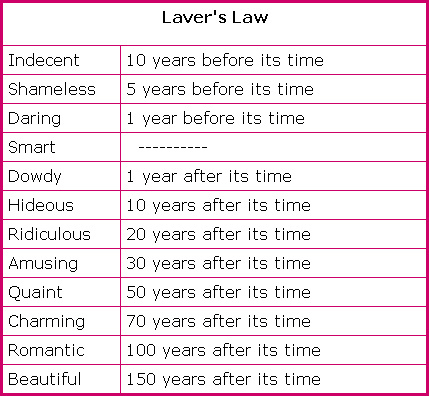
James Laver (1899-1975) was a British historian of art and fashion design. He composed the above model to depict the changing social perceptions of women's fashion. In his 1937 work Tastes and Fashion: From the French Revolution Until Today, Laver wrote:
The modern young man can contemplate without emotion the entire area of the female leg and a considerable portion of the stomach. In the nineteen-twenties, for the first time in many hundreds of years, the female leg was exposed to general view. The bust, however, also for the first time in many centuries, was not supposed to exist at all, and women who did not mind in the least exposing their lower limbs would have been embarrassed if called upon to wear a deep decolletage.
In short, the female body consists of a series of sterilized zones, which are those exposed by the fashion just going out, and an erogenous zone, which will be the point of interest for the fashion which is just coming in. This erogenous zone is always shifting, and it is the business of fashion to pursue it, without ever actually catching up. It is obvious that if you ever really catch it up you are immediately arrested for indecent exposure. If you almost catch it up you are celebrated as a leader of fashion.
Do you agree with Laver's model?
Link via Geekosystem | Image: Fashion Era
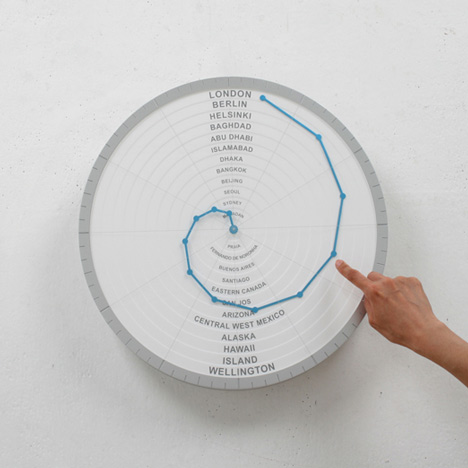
We've previously featured a minimalist clock design by Giha Woo and Shingoeun. Another clock that they've built uses a staggered hour hand to indicate the time in multiple time zones. It's called "Bent Hands".
Link via CrunchGear | Photo: Dezeen
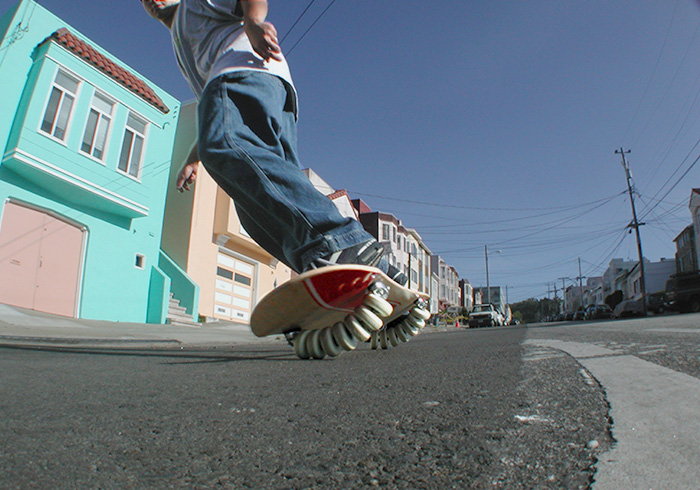
Industrial designers Mike Simonian and Pieter Schouten made this skateboard in order to add the flexibility of snowboarding movements to skateboarding:
The Flowlab Skateboard allows you to surf without waves and ride without snow. Years of experimentation resulted in the geometry that allows a device with no moving parts to simulate the fluid motion of snowboarding or surfing on land. The arced axles let you carve to 45 degree angles with no resistance and fluid transitions edge-to-edge.
You can view a technical drawing of the design at the link.
Link via DVICE | Photo: Mike & Maaike

In order to promote Black Flag anti-insect spray, the Cleveland-based ad agency Marcus Thomas projected ants crawling over a building. At the link, you can view a video of the ants in motion.
Link via Super Punch | Screenshot: Super Punch
Scientists in East Timor have discovered the skeleton of a rat three times larger than any rat living today:
Rodents of unusual size? I don't think they exist.
Link via io9 | Photo: Ken Aplin/CSIRO.

The new species was three times heavier -- about six kilograms (13 pounds) -- than the biggest rats known to exist today, which are found in the tropical forests of the Philippines and New Guinea.[...]
Researchers found 13 more rat specimens in caves on Timor and other islands, 11 of which are completely new to science.
Aplin said that some of those new species may still be alive today and have simply eluded detection by scientists.
Rodents of unusual size? I don't think they exist.
Link via io9 | Photo: Ken Aplin/CSIRO.
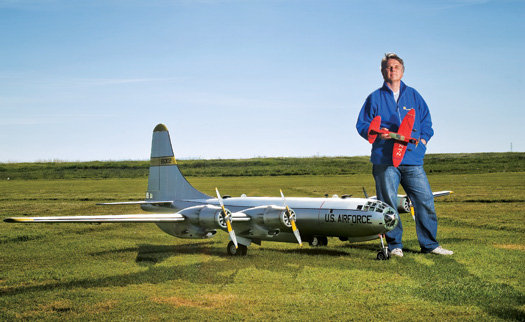
Tony Nijhuis built this functional model of the Boeing B-50 bomber, a postwar variant of the B-29:
The real bomber had four engines, so he hunted down four of the biggest electric motors he could find. He created 2-D sketches of the body, wings and tail using AutoCAD and commissioned a laser-cutting company to handle the more than 300 custom segments he needed.
To make the plastic nose and gun canopies, Nijhuis first had to hand-carve wooden molds of each one. For the retractable landing gear, he hooked an off-the-shelf pneumatic system up to pressurized air tanks made from plastic Coke bottles. He also skinned the balsa-wood-ribbed fuselage with laminate wood composite and fiberglass.
To make his model more realistic, Nijhuis added speakers that play the sound that the engines from the actual B-50 made. The entire project took two years and cost $9,000.
http://www.popsci.com/diy/article/2010-07/backyard-b-50-bomber | Photo: Jonathan Worth

Two years ago, we featured the creative furniture of Cuban art group Los Carpinteros. Here's one of their recent works called "La Montaña Rusa", which Google Translator says means "Roller Coaster".
http://www.loscarpinteros.net/index/photo-thumb/cama/ via Make | Photo: Los Carpinteros
The Plastiki is a ship made from plastic bottles. It was built from this frequently wasted product in order to promote recycling. Last March it left California, heading for Australia. Today, it docked in Sydney, completing a 8,000-mile voyage. The captain, David de Rothschild, described the journey:
http://www.npr.org/templates/story/story.php?storyId=128765142 via Gizmodo | Photo: Design Boom
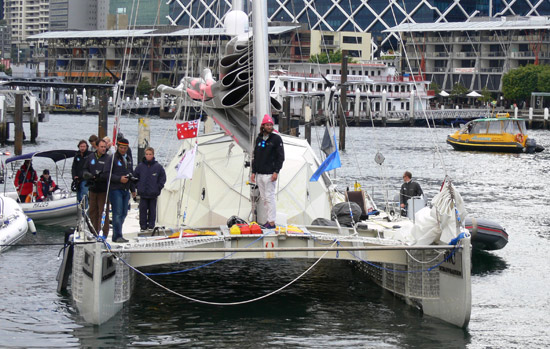
De Rothschild, 31, said the idea for the journey came to him after he read a United Nations report in 2006 that said pollution — and particularly plastic waste — was seriously threatening the world's oceans.
He figured a good way to prove that trash can be effectively reused was to use some of it to build a boat. The Plastiki — named after the 1947 Kon-Tiki raft sailed across the Pacific by explorer Thor Heyerdahl — is fully recyclable and gets its power from solar panels and windmills.
The boat is almost entirely made up of bottles, which are held together with an organic glue made of sugar cane and cashews, but includes other materials too. The mast, for instance, is recycled aluminum irrigation pipe.
http://www.npr.org/templates/story/story.php?storyId=128765142 via Gizmodo | Photo: Design Boom

This crocheted bicycle cozy was recently spotted in New York City's Lower East Side.
via Make | Photo: Apothekemedia | Previously: Crocheted Car Cozy
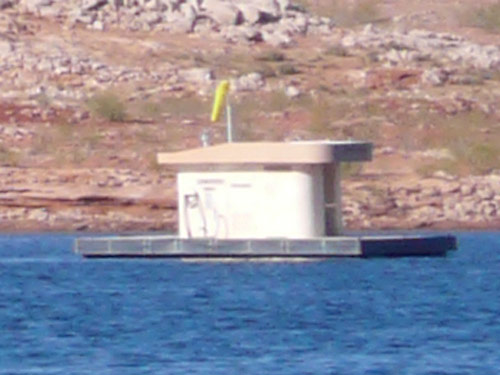
Popular Mechanics has a slideshow of 18 oddities in bathroom design. Pictured above is a floating bathroom that the US National Park Service installed in Lake Powell (UT/AZ) to persuade people there not to simply relieve themselves in the water. The official website confirms that there are, in fact, six such floating facilities.
Link via Digg | Photo by Flickr user Niels van Eck used under Creative Commons license
(Video Link)
This video presents Chuck Palahniuk's novel Fight Club as a Regency romance written by Jane Austen.
Ladies, welcome to Fight Club. The first rule of Fight Club is one never mentions Fight Club. No corsets, no hat pins, and no crying. If this is your first invitation to Fight Club, you must fight.
via reddit

O. Ray Courtney was a designer from the 1930s-1950s who applied Art Deco stylistic principles to motorcycles. Pictured above is a 1936 motorcycle that he built in that style from a 1930 Henderson, carefully restored by its owner, Frank Westfall. You can view more pictures of this beauty at the link.
Link via Make | Photo: Knucklebuster
(Video Link)
If you were hoping that, after the Robopocalypse, you could earn your soylent green by flipping pancakes for our robot overlords, you're out of luck. Human researchers at the Italian Institute of Technology have taught a robot how to do it. No, they didn't refine it's programming; the robot learned how to complete the task:
The video shows a Barrett WAM 7 DOFs manipulator learning to flip pancakes by reinforcement learning. The motion is encoded in a mixture of basis force fields through an extension of Dynamic Movement Primitives (DMP) that represents the synergies across the different variables through stiffness matrices. An Inverse Dynamics controller with variable stiffness is used for reproduction.
The skill is first demonstrated via kinesthetic teaching, and then refined by Policy learning by Weighting Exploration with the Returns (PoWER) algorithm. Compared to policy-gradient approaches, the reward is treated as a pseudo-probability, which allows Reinforcement Learning to use probabilistic estimation methods such as Expectation-Maximization (EM).
After fifty attempts, the robot became a competent pancake-flipper.
via Popular Science | Previously: Rapid Pancake Sorting Robot
Canadian Air Force pilot Capt. Brian Bews experienced a breakdown while flying into Lethbridge County Airport in Lethbridge, Alberta. He safely ejected from his CF-18 Hornet immediately before it impacted on the ground. MSNBC has a set of amazing photos from the incident.
Link via Gizmodo | Photo: Ian Martens / Lethbridge Herald / CP via AP

Link via Gizmodo | Photo: Ian Martens / Lethbridge Herald / CP via AP
Email This Post to a Friend