The Monty Hall Problem is a common mathematical fallacy based on Monty Hall's game show Let's Make a Deal. It works like this:
It's counterintuitive to many people, but switching doors will double your chances of winning:
The bad news is that according to a scientific study, pigeons are better as this task than we are:
Link via The Presurfer | Photo: Library of Congress
Imagine that you’re in a game show and your host shows you three doors. Behind one of them is a shiny car and behind the others are far less lustrous goats. You pick one of the doors and get whatever lies within. After making your choice, your host opens one of the other two doors, which inevitably reveals a goat. He then asks you if you want to stick with your original pick, or swap to the other remaining door. What do you do?
It's counterintuitive to many people, but switching doors will double your chances of winning:
The problem is that most people assume that with two doors left, the odds of a car lying behind each one are 50/50. But that’s not the case – the actions of the host beforehand have shifted the odds, and engineered it so that the chosen door is half as likely to hide the car.
At the very start, the contestant has a one in three chance of picking the right door. If that’s the case, they should stick. They also have a two in three chance of picking a goat door. In these situations, the host, not wanting to reveal the car, will always pick the other goat door. The final door hides the car, so the contestant should swap. This means that there are two trials when the contestant should swap for every one trial when they should stick. The best strategy is to always swap – that way they have a two in three chance of driving off, happy and goatless.
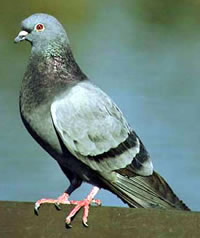
The bad news is that according to a scientific study, pigeons are better as this task than we are:
Each pigeon was faced with three lit keys, one of which could be pecked for food. At the first peck, all three keys switched off and after a second, two came back on including the bird’s first choice. The computer, playing the part of Monty Hall, had selected one of the unpecked keys to deactivate. If the pigeon pecked the right key of the remaining two, it earned some grain. On the first day of testing, the pigeons switched on just a third of the trials. But after a month, all six birds switched almost every time, earning virtually the maximum grainy reward.
Link via The Presurfer | Photo: Library of Congress