
Meet George Parrott, AKA "Big Nose George," an outlaw in Wyoming who was hanged by an angry mob in 1881 for attempted train robbery. As Parrott had no family to claim his corpse, a doctor named John Eugene Osborn took it as part of a study of the brains of criminals.
Alex Santoso's Blog Posts
Surely you've seen all those wonderful photos of planet Earth taken from the International Space Station - but have you ever wondered how astronauts take those pics?
With cameras, of course. Lots and lots of them.
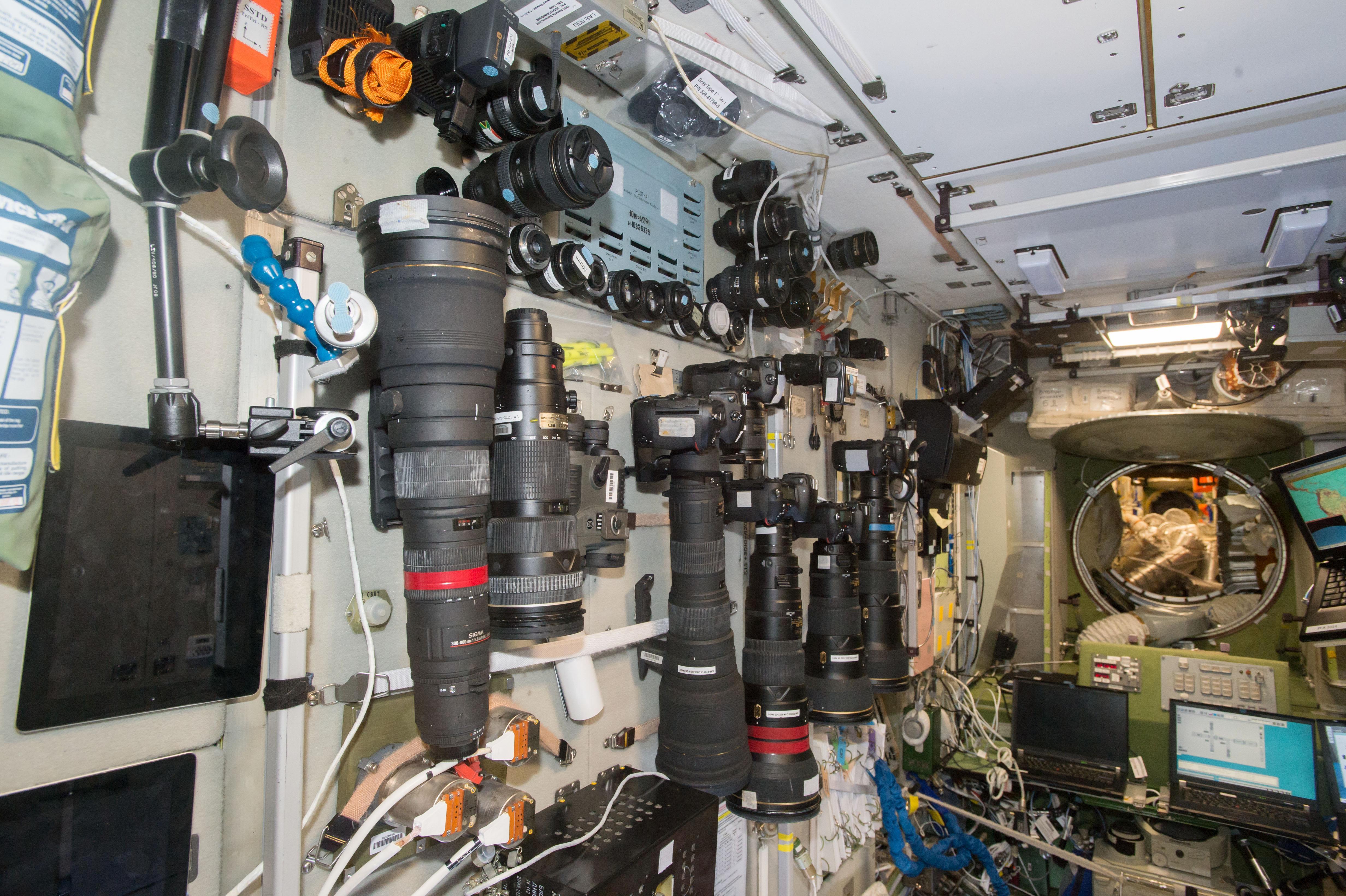
This NASA image shows a large selection of cameras and lenses that are available in the ISS for Crew Earth Observation, located in the Service Module part of the Russian segment and near one of the windows used to take photos of Earth.
Astronaut aboard the International Space Station took this mesmerizing photo of earth enveloped in an orange hue called airglow, a colorful band of light caused when nitrogen and oxygen in the atmosphere are energized by the UV radiation from the Sun.
Gorgeous!
American Architect Lebbeus Woods (1940-2012) wrote in his blog of a discovery of this an intricate pattern book of the Prague Castle. The book, dated from the early 1970s, contains paper patterns of buildings that you can cut out, then glue together to create three-dimensional paper models.
Woods wrote:
Designed and printed in the early 1970s, in Czechoslovakia, it is remarkable in several ways:
First: in that pre-computer era, all measurements of the actual architecture had to be made by hand—a formidable task in itself.
Second: the patterns of the scale buildings had to be calculated and drawn by hand. In engineering school, these patterns are called developments, and must take into account the actual dimensions of walls, roofs, and all other architectural surfaces, and therefore are not simply orthographic projections of plans and elevations of the buildings.
More pics of the gorgeous pattern book:
When they were working in Rome, Italy, physicists Andrey Varlamov and Andreas Glatz, as well as food anthropologist Sergio Grasso, decided to figure out how to make the perfect pizza, with a little help from science.
The end result is the thermodynamic equation above that describes the perfect baking time of a pizza Margherita.
LiveScience summed up the secret to the perfect pizza:
The secret ... was the physics of the brick oven. With a wood fire burning in one corner, heat radiates uniformly through the curved walls and stone floor of the oven, ensuring an even bake on all sides of the pie. Under ideal conditions, the authors wrote, a single pizza Margherita could be baked to perfection in precisely 2 minutes in a brick oven heated to 625 degrees Fahrenheit (330 degrees Celsius).
Don't have a brick oven? No problem, you can still make it in an electric oven:
Using a long thermodynamic equation ... the authors determined that a pizza cooked in an electric oven could meet similar conditions to a Roman brick oven by turning the heat down to 450 degrees F (230 degrees C) for 170 seconds. Crucially, the authors noted, aspiring pizzaiolos cooking toppings with higher water content (basically, any additional vegetables) may need to leave their pies in the oven longer, as the pizza will return more heat to the oven via evaporation.
The paper, titled "The Physics of Baking Good Pizza", was published in the preprint journal arXiv.
Twitter user Jenna (@goodgaljenjen) wrote:
"My cousin’s boyfriend proposed to her but she didn’t have her nails done lmao"
So what to do? What to do?
The solution is simple, of course! Borrow another hand ...
They look like restaurants - I mean, they have menus and they sell food that you can eat, but they're completely virtual with no physical address. You can't stop by to eat, because these restaurants don't actually exist.
Well, they don't exist as restaurants: they are basically kitchens that make food for deliveries via online food ordering services like Seamless, etc.
For Green Summit, which has an exclusive agreement with Seamless/Grubhub for delivery, there’s one major benefit to operating a virtual restaurant: You can’t beat the cheap rent. The company’s midtown Manhattan commissary at 146 East 44th Street has had a big advantage from the start: It doesn’t have to devote square footage to customer seating and waiting areas.
In a phone interview, Peter Schatzberg, Green Summit’s cofounder, says that a restaurant like Chipotle or Pret A Manger has to dedicate 75% of their space to seating, while 90% of their customers just grab and go. By comparison, a company such as Schatzberg’s can open inside a kitchen with as little as 200 square feet of space and operate a viable restaurant business with a minimal footprint.
Read the rest over at this article by Neal Ungerleider of Fast Company.
(Photo: Kate Zimmerman/Green Summit)
See it?
NASA posted this image, taken by NASA/ESA Hubble Space Telescope's Wide Field Camera 3, on social media recently. It shows a patch of space filled with galaxies of various sizes and shapes in the galaxy cluster SDSS J0952+3434.
From NASA:
Just below center is a formation of galaxies akin to a smiling face. Two yellow-hued blobs hang atop a sweeping arc of light. The lower, arc-shaped galaxy has the characteristic shape of a galaxy that has been gravitationally lensed — its light has passed near a massive object en route to us, causing it to become distorted and stretched out of shape.
Surely you've heard of Cthulhu fhpoopn, which rougly translates to "In his house at R'lyeh, dead Cthulhu waits pooping."
Check out this fantastically detailed Cthulhu tattoo by London Slade of Weirdsville Tattoo Emporium.
Thanks Daniel! Awesome tattoo!
See below to find out what Cthulhu's reading on the toilet:
3D chalk artist Chris Carlson drew this fantastic chalk drawing of the Mad Hatter from Alice in Wonderland.
Here's what it looked like from the side:
"It popped up out of nowhere," said astronomer Stephen Smartt, who first discovered the new supernova, and promptly named it "cow" according to the alphabetical protocol set by the International Astronomical Union (IAU).
The name might be fortuitous (I mean, we can all imagine astronomers yelling, "holy cow! a new supernova just popped out of nowhere!") but the heavenly event is a big deal in astronomy.
From this Nature news article by Davide Castelvecchi:
At first, Smartt discounted the effect as an unremarkable stellar flare in the Milky Way. But then, he realized that it was probably much farther off, in a galaxy called CGCG 137-068 known to be around 60 megaparsecs (200 million light years) away.
“It was 11 o’clock on a Sunday night, and I said to myself, ‘I better tell everybody about this.’” He sent out an alert through the Astronomer’s Telegram, a service for reporting and commenting on transient astronomical observations.
Immediate follow-ups confirmed that the object was a distant one, and so had to be stupendously bright. (It shone brightly enough that, despite its distance, a number of amateur astronomers were able to see it, too.)
And this was no ordinary supernova: it reached its peak brightness in days, not weeks. "Everybody put down what they were doing up to that point" and started following Cow, says Daniel Perley, an astrophysicist at Liverpool John Moores University, UK.
Initial data suggest that the supernova was caused either by a black hole tearing a star apart or a spinning neutron star.
(Image: ATLAS)
In the series titled Cryptozoology, contemporary Dutch artist Gurt Swanenberg took some of the world's most famous logos and turned them into mythical animals.
See more over intriguing art over at Swanenberg's website.
More examples of Swanenberg's Cryptozoology below:
This tiny and motherless kitten with sad eyes finally found happiness when Melinda Blain of Bottle Baby Fosters in Phoenix, Arizona, nursed her back to health.
Melinda continued round-the-clock feedings. As the kitten got stronger, she regained her appetite. "After her first week with me, she became so attached to me and constantly meowed at me for snuggles when she heard my voice."
Cherie had the saddest eyes and loudest cries. She didn't want to be alone and would cling to her foster mom until she fell asleep on her chest.
Find out the rest of the story over at this post by Amy Bojo over at Love Meow.
More pics of the cute (but sad looking) cat below:
No, sadly, those aren't aliens. Instead, the unusual lights over the Whitefish Bay in Lake Superior, were light pillars, which were caused by falling ice crystals.
Photographer Vincent Brady took the amazing photo. He wrote:
I was looking for auroras but was pleasantly surprised to see light pillars early Tuesday morning, October 16th. This is a shot north of Paradise, MI looking east over Whitefish Bay. The red lights are around the Canadian island Ile Parisienne and wind turbines.
See more of Brady's fantastic photos over at his Instagram - via APOD
Californians are usually worried about "The Big One", an anticipated mega-earthquake along the San Andreas Fault that could cause catastrophic damage.
But there's another natural disaster dubbed "The Slow One" that's happening right now. It's called that because it's a weird natural disaster that's unfolding slowly ...
Alejandra Reyes-Velarde and Rong-Gong Lin II from Los Angeles Times report:
A muddy spring mysteriously has begun to move at a faster pace through dry earth — first 60 feet over a few months, and then 60 feet in a single day, according to Imperial County officials. ...
Officials have been trying to drain water from the moving spring. Union Pacific built a 100-foot long wall of large boulders and steel more than 75 feet deep in the earth in an effort to protect the railroad.
But in October, the muddy spring sneaked underneath the wall, moving it ever closer to railroad tracks.
Overall, the pit, which produces a faint odor of rotten eggs, has moved more than 240 feet from where it was documented as being a decade ago. Based on publicly available satellite images, the spring hadn’t appeared to move much until roughly 2015, Hudnut said, but movement became particularly noticeable earlier this year.
Photo: Irfan Khan/LA Times
Email This Post to a Friend