Exuperist's Blog Posts

To Sleep or Not to Sleep?

For some of us, after a hard day's work whether in the office, at school, or at home, we deserve some much needed rest. Having good sleeping habits can do wonders for our physical, emotional, and mental well-being.

For others though, they might suffer from insomnia and have a difficult time falling asleep. No matter how much they force themselves, there seems to be that part of their mind that keeps them active.

On the other hand, sleep also allows us to see dreams, something that we still technically do not fully understand why we have them, how they randomly come about, and what goes in our consciousness when they happen.

Zoë Heller explores all these concepts related to sleep in her article on the New Yorker.

(Image credit: Adi Goldstein/Unsplash)


Lonesome George, The Key to Cancer and Anti-Aging?

Many efforts are being made to find a cure for a lot of currently incurable illnesses, one being cancer. In the quest to find a remedy or treatment that would effectively put cancer out, scientists look toward the genes of giant tortoises.

An international research team has discovered several variants in tortoise genomes that potentially affect six of the nine hallmarks of ageing. None of the variants has been previously associated with the ageing process.
They also found that giant tortoises have several expanded tumour suppressor genes, as well as alterations in two genes which are known to contribute to cancer.
This was something of a celebrity-tinged genome sequencing, because one of the two tortoises studied was the legendary Lonesome George, the last member of the Galapagos giant tortoise species from Pinta Island (Chelonoidis abingdoni). The other was an Aldabrachelys gigantea from the island of Aldabra in the Seychelles.

Do these tortoises hold the key to curing cancer? Only time will tell.

(Image credit: Wikimedia Commons)


Should We Be Worried About Our Smartphone Apps?

As developers continue to upgrade apps such that it would be more convenient, streamlines, and useful for consumers, the flip side to that is the fact that they gather our data and other information in order to make this possible. Moreover, since they have access to these data, they can send these information to various entities.

The millions of dots on the map trace highways, side streets and bike trails — each one following the path of an anonymous cellphone user.
One path tracks someone from a home outside Newark to a nearby Planned Parenthood, remaining there for more than an hour. Another represents a person who travels with the mayor of New York during the day and returns to Long Island at night.
Yet another leaves a house in upstate New York at 7 a.m. and travels to a middle school 14 miles away, staying until late afternoon each school day. Only one person makes that trip: Lisa Magrin, a 46-year-old math teacher. Her smartphone goes with her.
An app on the device gathered her location information, which was then sold without her knowledge.

Read more on The New York Times.

(Image credit: Intel Free Press/Wikimedia Commons)


Virtual Reconstruction of Pumapunku Temple Gives Insight Into Its History and Purpose

Many building and structures of the ancient world have already become ruins which tells us that there was something there but not really what it was about. Archaeological artifacts may give us clues but it would take time to show us the complete picture.

Now, scientists have been able to virtually reconstruct a pre-Incan temple that might tell us something about the building's purpose and history.

(Image credit: Casto Vocal)


Watch Comet 46P/Wirtanen As It Passes Through the Night Sky

In order to observe the stars and other celestial bodies clearly, you would usually need a telescope to magnify it. But Comet 46P/Wirtanen which will pass by the Earth mid-December may be visible even to the naked eye.

Astronomer Carl Wirtanen discovered his namesake comet in 1948. He was a skilled object hunter and used photos of the night sky to spot the quickly moving object, at least astronomically speaking.
Comet 46P/Wirtanen’s orbit keeps it pretty near to the sun. Its aphelion, or farthest point from the sun, is about 5.1 astronomical units (AU), which is just a tad bigger than Jupiter’s orbit. Its perihelion, or closest approach to the sun, is about 1 AU, just about the Earth’s distance from the sun. This path takes about 5.4 years to complete, meaning it comes back into view quite frequently compared to other famous comets.
Right now, it is approaching its perihelion. Its closest point to the sun will fall on Dec. 16 – which is why it will be brightest on this day.

(Image credit: Andy Roberts/Astronomy for Beginners via Wikimedia Commons)


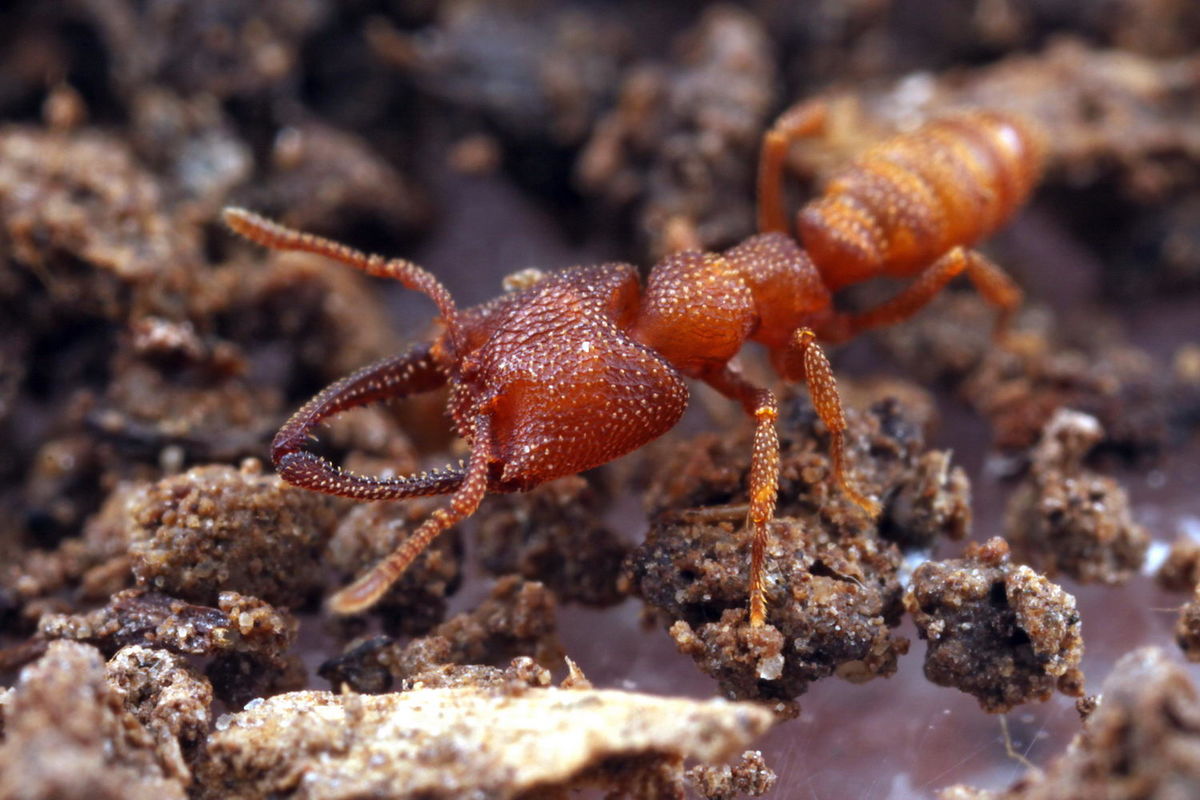
And the Fastest Jaws on the Planet Belong to... the Dracula Ant

They may be small but ants can pack a big punch. Getting bitten by one of them can feel like a needle pricking through your skin or like a burning, painful sensation.

Now, there is a genus of ants called Mystrium, also known as Dracula ants, that has the fastest jaws of all.

According to a new study, the Dracula ant, Mystrium camillae, can snap its mandibles at speeds of up to 90 meters per second (more than 200 mph), making it the fastest animal movement on record.

(Image credit: WikiSysop/Ant Wiki)


What the Sun Looks Like Up Close, Parker's First Look at the Corona

Parker Solar Probe made its journey to the sun about four months ago and it has now reached its destination:

One of the first images NASA’s Parker Solar Probe took during its close encounter with the sun shows a streamer of plasma in the outer solar atmosphere, or corona. The probe took this image November 8 at a distance of about 27 million kilometers from the sun’s surface. The bright dot below the streamer is Jupiter.

With this voyage, we will try to understand the nature of the solar atmosphere and the emissions coming out of the sun like solar flares among other things.

Read more about in on Science News.

(Image credit: Parker Solar Probe/NASA)


Why the AAA Banned Women from Motorsport: Joan Newton Cuneo's Wild Racing Streak

One of the first successful female racers, Joan Newton Cuneo had fallen in love with racing when her husband Andrew bought her a steam car which she traded in for a more powerful car and took to the race track.

She had competed in various races starting with the Glidden Tour and she continued to set speed records, attracting attention in the racing scene and even from media outlets.

Things were looking good. In 1908, Cuneo had completed the Glidden Tour with a perfect score, set even more speed records, and was on her way to the New Orleans Fair Grounds in early 1909 for the Mardi Gras races—intended to be a perfect way for Cuneo to grow her celebrity.
And she kicked ass. The Mardi Gras races were three jam-packed days of speed, and Cuneo was defeating a long list of popular drivers, like Ralph de Palma, Bob Burman, and George Robertson. The media went wild. A tiny woman behind the wheel of a powerful car seemed absurd—but the fact that she could absolutely demolish the top talents of the day? Joan Cuneo was a force to be reckoned with.

All was well and good except for one thing. She was banned by the AAA from participating in any sanctioned races:

That is, until the Contest Board of the American Automobile Association decided to ban women from any of their sanctioned competitions. Including Cuneo.

(Image credit: Bain News Service/Wikimedia Commons)


Benjamin Franklin's Electrical Experiments that Led to the Discovery of Turkey Tenderization

With the discovery of electricity, Benjamin Franklin experimented on it to understand its different uses and practical applications.

Franklin’s fascination with electricity spilled over to more elaborate parlor tricks. In the summer of 1749 he hosted an electrical feast, which began with Franklin electrocuting a turkey and then roasting it on a spit that was turned by an electrically powered jack.
Franklin’s experiments occasionally went awry. In some of his first attempts at turkey electrocution, the birds were merely stunned, arising a few minutes later after regaining consciousness.
On one memorable occasion, he electrocuted himself instead of the bird.

Despite the mishaps he faced while experimenting with electricity, Franklin never gave up.

Despite this blunder, Franklin continued his explorations in pursuit of a practical use for electricity. In particular, he theorized that electricity could be used to tenderize meat. By 1773 Franklin had not only a hypothesis but specific instructions.

(Image credit: American Philosophical Society)


Singles Who Get Cancer Are Less Likely To Get Chemotherapy or Other Aggressive Treatments, Here's Why

Nobody wants to hear from their doctors that they have detected some form of growth in their bodies especially because they would most likely be a prelude to cancer.

If ever somebody does get cancer, in order to remedy it, they obviously need the best possible treatment even if it requires them to undergo chemotherapy and other painful, aggressive treatments, so that their chances of remission would become higher.

But it is actually a different story for singles out there than for married adults. John DelFattore from the Washington Post writes:

We’ve often heard about studies showing that married adults are more likely to survive cancer than singles. But buried in those same studies is another finding that hasn’t made the headlines. When surgery or radiotherapy is the treatment of choice, patients with spouses are more likely to get it.
I had no idea that marital status might affect medical care until an oncologist, talking about what treatment to give me, asked if I have a spouse or children. When I said no to both, he looked genuinely concerned. “But how will you manage?” he asked.
He then proposed to give me only one mild drug, although the standard of care was a much harsher — and more effective — combination chemotherapy. When I tried to describe my strong network of friends and extended family, he talked right over me.

So why do singles get treated differently from married individuals?

(Image credit: Michael Woloschinow/The Washington Post)


Babies Learn about Their Bodies By Kicking and Punching in the Womb

Sometimes, when you touch a pregnant lady's belly, you might feel a small thud, a sign that the baby is kicking inside the womb. Researchers reveal that this happens as a way for babies to understand their bodies while in the womb.

Researchers measuring the brainwaves of newborn babies have discovered that a baby's kicks are likely a way for the infant to map and begin to understand its body. The study could help doctors develop better techniques for looking after premature babies.

Anthony Wood has more on these research findings on New Atlas.

(Image credit: Carlo Navarro/Unsplash)


The Risk of Weaponizing Facial Recognition

In a photo of a crowd, trying to find a particular person is like looking for a needle in a haystack. Nowadays, facial recognition has become a very useful tool at finding people without having to look through the haystack yourself.

It has other uses too in medicine and even in agriculture. But as with any new technology, it comes with some risks, particularly its applications can easily be weaponized.

David Owen explores the various uses of computerized facial recognition as well as the potential dangers that it poses.

(Image credit: US CBP)


Water Found on Asteroid by NASA Space Probe

Finding life on other planets or celestial bodies may be a little bit far off but recently, a NASA probe has detected evidence that water was on a distant asteroid. One might think asteroids are just hunks of rock floating in space so this new discovery would come as a surprise to many.

In a conference today, scientists announced that OSIRIS-REx has found evidence of hydrated minerals on the surface of Bennu using its on-board spectrometers — tools used to determine the exact chemical composition of a specific spot. That means “evidence of liquid water” in Bennu’s past, according to Amy Simon, the scientist overseeing OSIRIS-REx’s spectral analysis.
“To get hydrated minerals in the first place, to get clays, you have to have water interacting with regular minerals,” says Simon. “This is a great surprise.”

(Image credit: Goddard Space Flight Center/NASA)


An Afghan Woman's Story of Why She Set Herself on Fire

There are still various parts of the world where women's rights aren't being recognized or if they were, they are only secondary to tribal customs and laws that govern the society, and most of the time those laws trump the inherent rights of women.

This is the story of an Afghan woman who had enough and decided it was time to end her life.

(Illustration by: Anke Gladnick)


The Real Lesson of Y2K, 20 Years Later

What caused the global panic at the turn of the new millennia turned out to be a false alarm. No, computers didn't malfunction as a result of changing the year from 1999 to 2000. But there is an important lesson that the world probably missed in the wake of the misunderstanding.

The two narratives explaining the Y2K incident are somewhat in contrast with one another. Either it was simply a non-issue, that we had nothing to worry about with the machines that we built or it was because of the skilled programmers who averted the problem.

The two, combined, narratives of what transpired on Y2K — that it was strictly a non-event, or, that it was a non-event because of programmers were skilled enough to predict and avert it — actually bred something else: confidence.
Armed with this confidence, in the years since Y2K, we have created more and more complex networks and systems to enhance, guide, or even take over many facets of our daily lives.
Now, we’re discovering what a false sense of security we’ve created. Along with it should come the realization of just how little we understand about the programs that permeate our lives and the networks that link them. Unlike 20 years ago, we appear less and less capable of predicting what will go wrong, or of stopping it before it does.

(Image credit: Wikimedia Commons)


Email This Post to a Friend
""

Separate multiple emails with a comma. Limit 5.


Success! Your email has been sent!

close window

Page 140 of 148     first | prev | next | last

Profile for Exuperist

  • Member Since 2018/11/17


Statistics

Blog Posts

  • Posts Written 2,212
  • Comments Received 2,164
  • Post Views 517,045
  • Unique Visitors 446,410
  • Likes Received 0

Comments

  • Threads Started 42
  • Replies Posted 24
  • Likes Received 14
X

This website uses cookies.

This website uses cookies to improve user experience. By using this website you consent to all cookies in accordance with our Privacy Policy.

I agree
 
Learn More