Gallorette is a cow that, until recently, lived at Premier Longhorns ranch in Stillwater, Oklahoma. Her human has taught her to perform tricks in exchange for treats. She can bow and spin in a circle. Their interaction looks very similar to that of a person with a dog. I wonder if the training methods are the same.
What is it about cat videos that we love so much? They make up a substantial part of the internet, and a good one can make a cat into a famous celebrity and make its owner rich. Maria Bustillos wrote a thoughtful essay that gets to the heart of the matter.
Before we enter into the question of cat videos, we must talk about cats themselves. Cat videos are the crystallisation of all that human beings love about cats, the crux of which is centred in the fact that cats are both beautiful and absurd. Their natural beauty and majesty are eternally just one tiny slip away from total humiliation, and this precarious condition fills us with a sympathetic panic and delight, for it exactly mirrors our own.
She goes on to give specific examples.
Maru is so resplendently beautiful, so thickly furred and magnificent, and so utterly mellow that even watching mugumogu clean his ears with q-tips is an entirely relaxing and pleasurable experience. But Maru is also a kook, and it is this kookiness that is responsible for the love his legion of fans bears him. Maru is perfectly capable of making a fool of himself over a bit of string, and he can fall off a cat tree with the best of them – but it is his determination to inhabit every available box, no matter how small or inconveniently situated, that seals his greatness and ensures his immortality.
And then she explains the wonder of internet videos themselves, and how funny cat videos can lead to world peace, among other things. The essay called “Hope is a Thing with Fur” is from her book Cat Is Art Spelled Wrong. Read the rest of it at the BBC. -via Metafilter
The following is an article from The Annals of Improbable Research.
Investigators on the trail of murderous felines by Csikszentmihalyi Aeiou, Improbable Research staff
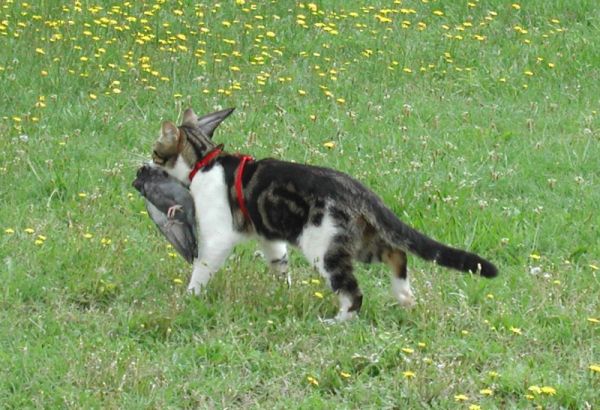
The UK has been especially prone to house scientists who study the hunting habits of domestic cats. Here are three studies that typify the effort.
Predation of Wildlife by Domestic Cats Felis catus in Great Britain “Predation of Wildlife by Domestic Cats Felis catus in Great Britain,” Michael Woods, Robbie A. Mcdonald, and Stephen Harris, Mammal Review, vol. 33, no. 2, June 2003, pp. 174–188. The authors, at The Mammal Society, London, the University of Bristol, and The Game Conservancy Trust, Forest in Teesdale, UK, report:
A questionnaire survey of the numbers of animals brought home by domestic cats Felis catus L. was conducted between 1 April and 31 August 1997. A total of 14,370 prey items were brought home by 986 cats living in 618 households. Mammals made up 69% of the items, birds 24%, amphibians 4%, reptiles 1%, fish < 1%, invertebrates 1%, and unidentified items 1%. A minimum of 44 species of wild bird, 20 species of wild mammal, four species of reptile, and three species of amphibian were recorded...
Of a sample of 696 individual cats, 634 (91%) brought home at least one item and the backtransformed mean number of items brought home was 11.3...
The number of mammals brought home per cat was significantly lower when cats were equipped with bells and when they were kept indoors at night.
Effect of Bells on Domestic Cats in an English Town
Last month, Tyler Balak was a few hundred feet out into the water at Buxton, North Carolina. He was enjoying a pleasant day surfing when he saw something moving in the water. At first, he thought it was a shark. Then, when he saw that it was a deer--a baby deer.
Balak picked up the fawn and carried her to shore. He and other people on the beach located a wildlife rescue center nearby and took the deer--which was clearly in shock--there. The Virginia Beach Pilot reports:
On the Internet, they discovered Hatteras Island Wildlife Rehabilitation, an animal rescue shelter 6 miles away in Frisco.
Lou Browning, president of the nonprofit, put the fawn in a padded room.
"It was coming out of its ocean shock at that point and ready to go ballistic," Browning said, adding that fawns can hurt themselves in captivity.
So Browning watched, and all signs pointed to a happy ending. The fawn had good muscle tone and no ticks around its eyes and ears. It moved well, could see and had no obvious injuries. A few hours after the deer arrived, Browning sedated it, took it back to Buxton and released it.
No one knows how it ended up so far out into the ocean.
This Manhattan rat knows full well how delicious the cheesy slices are in New York City. They're fold-and-eat heaven. That's why Pizza Rat isn't giving up his newfound slice just because he has a commute to get home. You may be slowed down when danger comes walking along, but keep your eye on the prize, little guy! Via Gawker
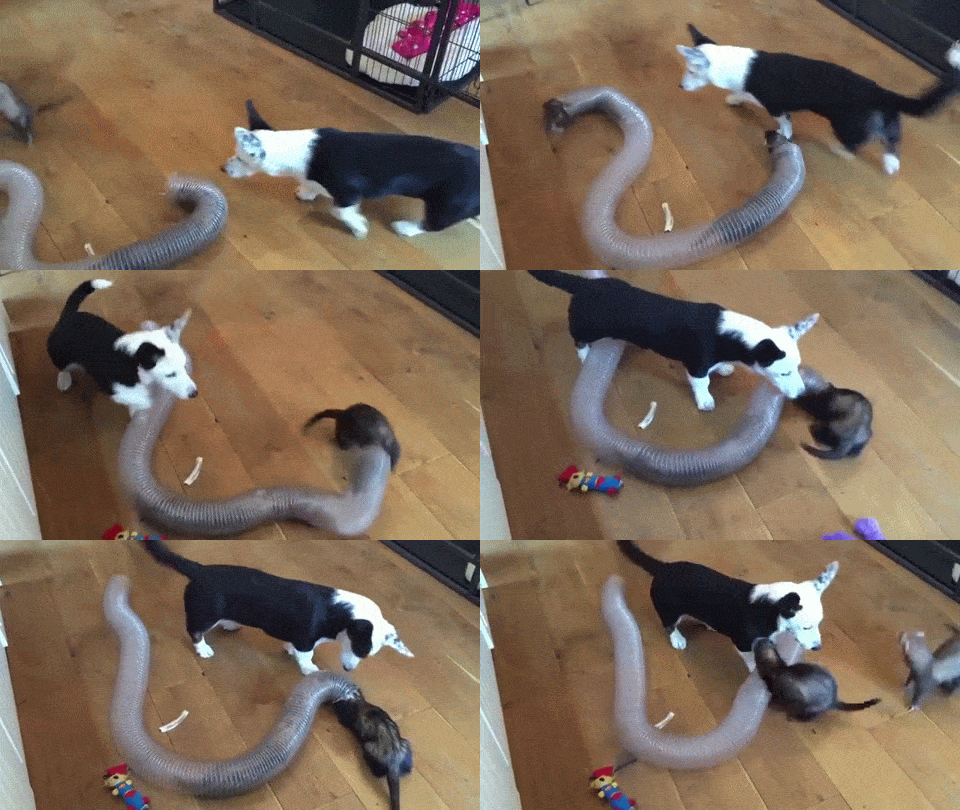
The corgi stalks his elusive prey: the tube ferrets. Or vice versa. It's not clear who's hunting whom, and who's winning this contest of wits. The dog has size, but the ferrets have maneuverability. Place your bets.
And it's clearly not an accident. The beluga lands a trick shot, spraying water out of his mouth, over the lip of the tank, and right on the boy's head.
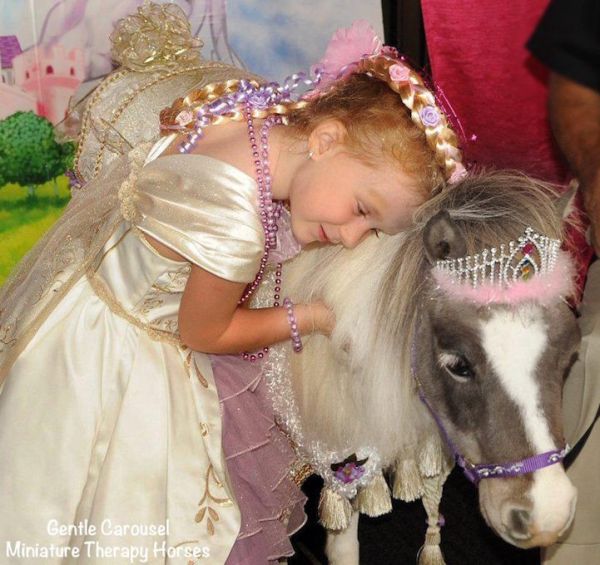
Gentle Carousel Miniature Therapy Horses is a non-profit organization based in Florida but operates wordwide, doing business in New York, California and as far away as Greece. The organization uses miniature horses to reach people of all ages who need healing, love and care, such as survivors of the Sandy Hook shooting, those displaced or injured by the 2013 Oklahoma tornadoes, the elderly in nursing homes and hospices and sick, disabled or hospitalized children.
The most famous horse at Gentle Carousel is Magic, a blue-eyed black mare. Magic was selected by Time magazine as one of the top ten heroic animals in history, for the following heartwarming story:
"Magic went to visit a patient who had lived in an assisted-living facility and hadn't spoken to anyone during her three years there. But the moment she laid eyes on Magic, she said, "Isn't she beautiful?" Those first words caused the staff to break out in tears, and she continued to communicate from that point onward."
Co-founder of Gentle Carousel Debbie Garcia-Bengochea elaborated:
"The activities director was so surprised to hear the woman speak that she began to cry. She told the woman that she loved her. 'I love you too,' was the answer, her first sentence to another person in all that time. Magic always seems to find the person in the room who needs her the most."
Don't miss the Gentle Carousel Facebook page, the perfect place to visit for anyone who needs a smile. It has precious pictures and stories of these beautiful animals and the people whose days they brighten.
Pup phenoms Jumpy and Dash (previously at Neatorama), a border terrier/blue heeler mix and a Jack Russell terrier, respectively, execute an impressive array of tricks in unison in this clip. (An unidentified doggie friend comes in late to the fun.) They have been trained with the use of a clicker, which their trainer can be heard using during the exercise.
The older video below, from October of '13, shows the pair skateboarding on a half pipe at a skate park, set to Halloween-ish music. It seems that there is little these intelligent canines can't be taught to perform.
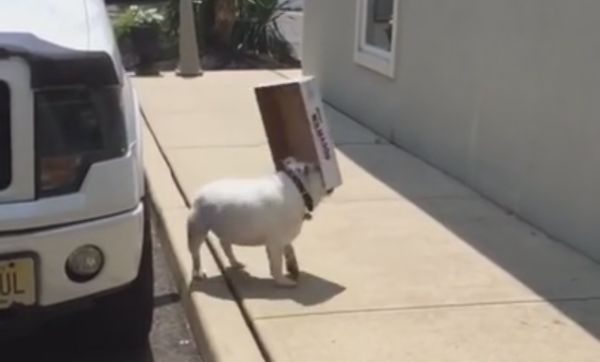
Diesel found a box, and doesn’t want to let go of it. It’s a nice box, but holding onto it is causing a problem. It’s turned him into a Roomba, bouncing off the barriers of his immediate environment. For three whole minutes.
The English bulldog cannot grasp that a little reorganization might make his task easier. He won’t even accept help from his humans. Bulldogs are stubborn, after all. -via reddit
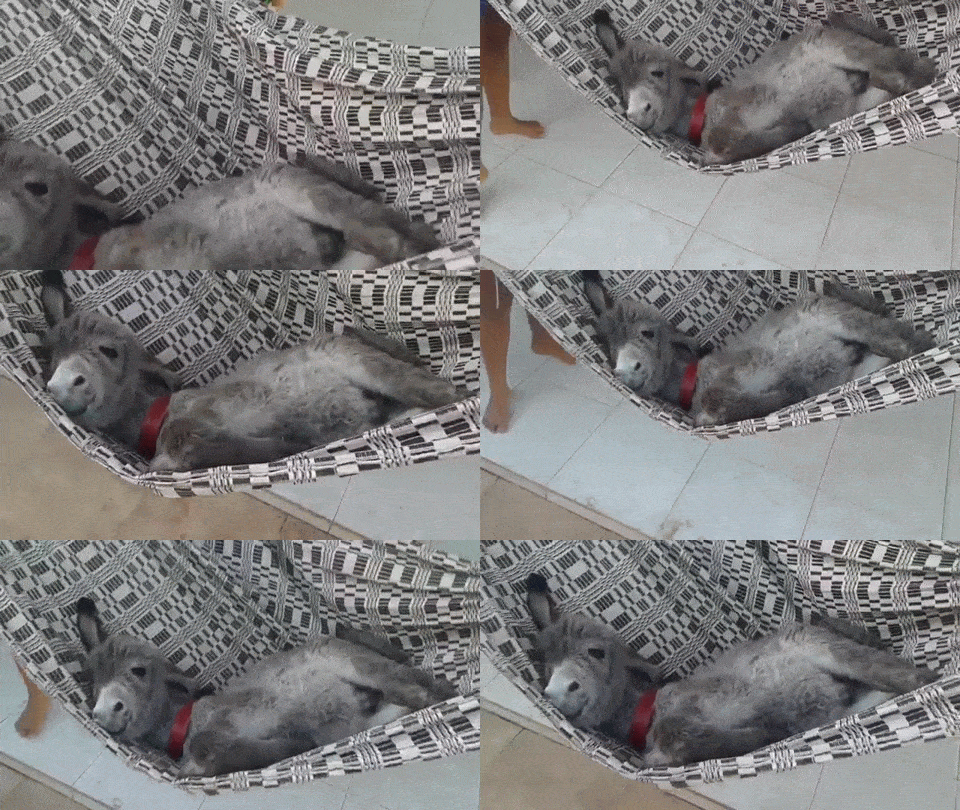
Surrounded by his human family, the baby donkey rocks peacefully in the hammock. At the end of the video, he pauses from this gentle swaying to receive belly rubs from his people. So I'm quitting my jobs and becoming a baby donkey because this girl knows how to live right.
Penny the Boston terrier puppy survived what was a near-fatal tumble in a dryer on its highest heat setting for thirty minutes. According to the owner Christine, her two-year-old daughter shut the puppy in the dryer and another daughter, age fourteen, unknowingly started the machine. The attending vet said it was miraculous that Penny lived through the ordeal. See Penny and hear her owner tell the story in this video clip. Read more on the story at The Western Daily Press. -via Nothing to do With Arbroath
In an uplifting tale of canine loyalty and compassion, Tillie the golden retriever refused to leave the side of her basset hound friend Phoebe when she was trapped in a hole in the ground, unable to escape. The pair, who live on the island of Vashon, Washington, never returned to their home after going out for a walk. Their owner, who searched and was unable to find them, enlisted the help of Amy Carey, a volunteer with the Vashon Island Pet Protectors. Carey said,
"We had been out looking for about a week when we heard from a farmer here who noticed a reddish dog on his property. She had quietly approached him, and when she got his attention, turned around and headed back toward this ravine nearby. I decided to go check it out."
As it turned out, the basset hound had fallen into a cistern that was too deep from which to escape. Carey continued,
"When I got there and looked down, Tillie saw me but didn't come running up. She just stayed near the edge of this cistern, pressed with her head as close as she could get. Had she run up, we might have never realized that Phoebe was down there. She just stayed put, making it so clear that I had to come to her so I would see her friend."
Pose the malefactor with a sign describing the depravity, take a photo, then post it online for everyone to see. This is modern online shaming. It’s how people express frustration with various creatures in their lives, including dogs, chickens, role-playing game dice, and librarians. Now it’s time for cats to get what’s coming to them. BuzzFeed has rounded up 26 cat criminals that are being called to account. The problem: cats may have a sense of pride, but no sense of shame.
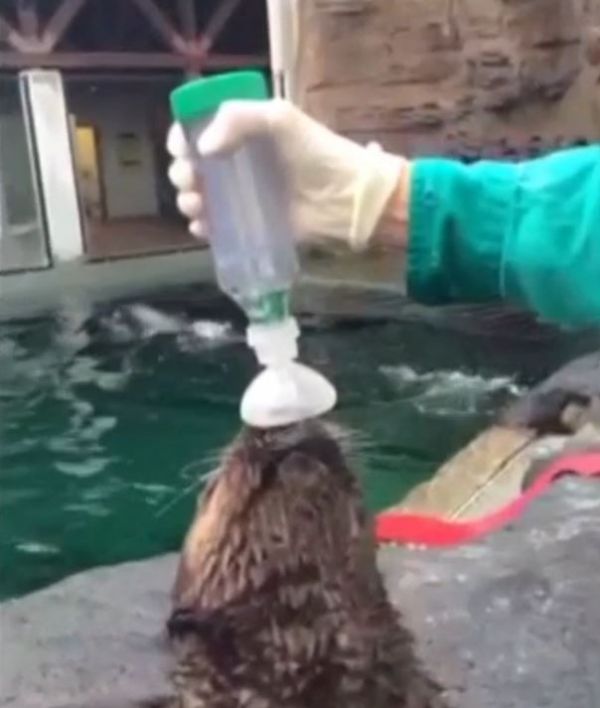
Mishka is a sea otter that lives at the Seattle Aquarium. She's the first sea otter ever diagnosed with asthma. Her caretakers at the aquarium have trained her to use an inhaler. It delivers to her lungs the same medicine that humans with asthma use.