Jully Nascimento from Brazil got this QR code inked on her arm. When scanned, it reads "hold on". That's the name of a song by Good Charlotte that was meaningful to her in her youth.
There's just something majestically beautiful about cement-filled Budweiser cans linked by a chain. This work by Brooklyn-based designers Chen Chen and Kai Tsien Williams is called "American Ninja".
Interviewing is a skill and not everyone has it -- but some surprising people do. Like William Shatner. Have you seen his Raw Nerve? Whatever faults he has, Shatner knows how to do a probing interview.
Where was I? Oh, yeah: Bert from Sesame Street is one of those people. "If you could be any sock from history, what would you be?" Brilliant. That's how you get inside someone's head.
There's not much information about this video, but, allegedly, it shows an explosion at the bottom of a water-filled quarry. There's enough 12-year old boy left in me to say that this is awesome.
Do you want to learn how to send a fun 330 volts of electricity into the back of your friend’s neck? Do you not want to have to deal with the awkwardness of ordering a professional taser for home use? Then this guide on how to create a homemade taser is for you.
If you’re like me you hate having to give a tip to the Bellboy for carrying your bags. Well now you won’t have to if you stay at New York City’s new futuristic Yotel Hotel.
Yobot, a direct descendant of the robots working in automobile-assembly plants, deftly grabs, lifts and stores baskets containing luggage, much to the delight of sidewalk onlookers at its street-level window. Guests needing to store luggage start Yobot with their room cards and then follow instructions on a video screen as the luggage hatchway opens and closes before Yobot goes to work. The large robot moves surprisingly smoothly for its size as it locates the proper drawer space for the luggage and puts it away.
The Cosby Sweater Project takes sweaters worn by Bill Cosby during episodes of The Cosby Show and creates unique art out of them. I’m not sure why this exists, but anything utilizing the love we have for Bill Cosby’s sweaters sounds pretty good to me.
The greatest, fastest most sophisticated ship created of al time… The Titanic II. What could go wrong? This faux sequel to the James Cameron smash hit was created by The Asylum, a movie production company infamous for making “mockbusters” – movies that blatantly rip off big budget Hollywood hits. Their marketing strategy seems to be hoping to confuse people into watching the wrong movie. However with lines like “Looks like history is repeating itself.” You’ll want to watch it for its epic cheese. Watch full trailer for the actual film at the link.
This is one of those things that everyone does, but no one ever talks about. You’re at a restaurant, you are about to order your food but must wait for the other people to finish their order. Everyone gets that really anticipatory look on their face, like they are about to go on stage and give a speech. To be fair, this can be a lot of pressure if you screw your order up like I usually do. Luckily this moment has been cataloged in photos by the website “It’s Almost My Turn To Order.” See the gallery at the link and submit your own photos.
Vaudeville makes a modern comeback! Tuesday's game between Clemson and Davidson was delayed by rain, so the players jumped into the gap to keep the fans amused. -via Metafilter
A litter of kittens was dumped at a concrete factory in Redruth, Cornwall, England. They were taken to an animal shelter named Cats Protection. The staff fed the kittens and washed them, but one is still stained pink -and will be until her fur grows out. So they named her Pink Panther!
She was rescued by workers along with her two sisters and a tom cat - called Clouseau, Dusty and Cerise. It is thought that they came into contact with red pigment used in concrete manufacturing which had caused their unusual appearance.
The dying is less obvious in three of the cats but Pink Panther has a creamy fur so she appears bright pink.
Attempts have been made to wash the dye out because different variations of red are seen as 'danger colours' to animals but they failed.
Instead, Cats Protection manager Claire Rowe says they will have to wait until the pink fur has grown out.
She said:'They are absolutely adorable, but Pink Panther is probably the pick of the bunch. It's amazing. Until we washed her we had no idea what her natural colour was.
When gasoline was rationed or nonexistent during World War II, many cars were converted to run on firewood. The trend is making a comeback of sorts as gas prices rise higher and higher. See some of these cars and find out how it's done at Low-Tech Magazine. Link -via the Presurfer
It is once again time for our collaboration with the always amusing What Is It? Blog. Do you know what this thing is? Can you take a wild guess?
Place your guess in the comment section below. One guess per comment, please, though you can enter as many as you'd like. Post no URLs or weblinks, as doing so will forfeit your entry. Two winners: the first correct guess and the funniest (albeit ultimately wrong) guess will each win a T-shirt from the NeatoShop.
Check out the What Is It? Blog for more pictures of this object. Let your imagination run wild, and good luck!
Update: Porkhurst was the first of many with the correct answer. This object is a lunar tong, designed for picking up moon rocks! However, he did not select a shirt. Swami won a t-shirt for the funniest answer:
If you are familiar with "Treasure Island", you will recall the luau when John Silver is barbecuing ribs and he almost burned off his beard rearranging the fire, that's what inspired him to invent the device pictured above: Long Tong Silvers.
Since the dawn of time, people have found nifty ways to clean up after the bathroom act. The most common solution was simply to grab what was at hand: coconuts, shells, snow, moss, hay, leaves, grass, corncobs, sheep’s wool—and, later, thanks to the printing press—newspapers, magazines, and pages of books. The ancient Greeks used clay and stone. The Romans, sponges and salt water. But the idea of a commercial product designed solely to wipe one’s bum? That started about 150 years ago, right here in the U.S.A. In less than a century, Uncle Sam’s marketing genius turned something disposable into something indispensable.
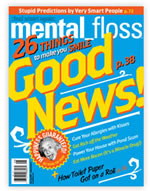
How Toilet Paper Got on a Roll
The first products designed specifically to wipe one’s nethers were aloe-infused sheets of manila hemp dispensed from Kleenex-like boxes. They were invented in 1857 by a New York entrepreneur named Joseph Gayetty, who claimed his sheets prevented hemorrhoids. Gayetty was so proud of his therapeutic bathroom paper that he had his name printed on each sheet. But his success was limited. Americans soon grew accustomed to wiping with the Sears Roebuck catalog, and they saw no need to spend money on something that came in the mail for free.
Toilet paper took its next leap forward in 1890, when two brothers named Clarence and E. Irvin Scott popularized the concept of toilet paper on a roll. The Scotts’ brand became more successful than Gayetty’s medicated wipes, in part because they built a steady trade selling toilet paper to hotels and drugstores. But it was still an uphill battle to get the public to openly buy the product, largely because Americans remained embarrassed by bodily functions. In fact, the Scott brothers were so ashamed of the nature of their work that they didn’t take proper credit for their innovation until 1902.
“No one wanted to ask for it by name,” says Dave Praeger, author of Poop Culture: How America Is Shaped by Its Grossest National Product. “It was so taboo that you couldn’t even talk about the product.” By 1930, the German paper company Hakle began using the tag line, “Ask for a roll of Hakle and you won’t have to say toilet paper!”
As time passed, toilet tissues slowly became an American staple. But widespread acceptance of the product didn’t officially occur until a new technology demanded it. At the end of the 19th century, more and more homes were being built with sit-down flush toilets tied to indoor plumbing systems. And because people required a product that could be flushed away with minimal damage to the pipes, corncobs and moss no longer cut it. In no time, toilet paper ads boasted that the product was recommended by both doctors and plumbers.
The Strength of Going Soft
In the early 1900s, toilet paper was still being marketed as a medicinal item. But in 1928, the Hoberg Paper Company tried a different tack. On the advice of its ad men, the company introduced a brand called Charmin and fitted the product with a feminine logo that depicted a beautiful woman. The genius of the campaign was that by evincing softness and femininity, the company could avoid talking about toilet paper’s actual purpose. Charmin was enormously successful, and the tactic helped the brand survive the Great Depression. (It also helped that, in 1932, Charmin began marketing economy-size packs of four rolls.) Decades later, the dainty ladies were replaced with babies and bear cubs—advertising vehicles that still stock the aisles today.
By the 1970s, America could no longer conceive of life without toilet paper. Case in point: In December 1973, Tonight Show host Johnny Carson joked about a toilet paper shortage during his opening monologue. But America didn’t laugh. Instead, TV watchers across the country ran out to their local grocery stores and bought up as much of the stuff as they could. In 1978, a TV Guide poll named Mr. Whipple—the affable grocer who implored customers, “Please don’t squeeze the Charmin”—the third best-known man in America, behind former President Richard Nixon and the Rev. Billy Graham.
Rolling the World
Currently, the United States spends more than $6 billion a year on toilet tissue—more than any other nation in the world. Americans, on average, use 57 squares a day and 50 lbs. a year. Even still, the toilet paper market in the United States has largely plateaued. The real growth in the industry is happening in developing countries. There, it’s booming. Toilet paper revenues in Brazil alone have more than doubled since 2004. The radical upswing in sales is believed to be driven by a combination of changing demographics, social expectations, and disposable income.
“The spread of globalization can kind of be measured by the spread of Western bathroom practices,” says Praeger. When average citizens in a country start buying toilet paper, wealth and consumerism have arrived. It signifies that people not only have extra cash to spend, but they’ve also come under the influence of Western marketing.
America Without Toilet Paper
Even as the markets boom in developing nations, toilet paper manufacturers find themselves needing to charge more per roll to make a profit. That’s because production costs are rising. During the past few years, pulp has become more expensive, energy costs are rising, and even water is becoming scarce. Toilet paper companies may need to keep hiking up their prices. The question is, if toilet paper becomes a luxury item, can Americans live without it?
The truth is that we did live without it, for a very long time. And even now, a lot of people do. In Japan, the Washlet—a toilet that comes equipped with a bidet and an air-blower—is growing increasingly popular. And all over the world, water remains one of the most common methods of self-cleaning. Many places in India, the Middle East, and Asia, for instance, still depend on a bucket and a spigot. But as our economy continues to circle the drain, will Americans part with their beloved toilet paper in order to adopt more money-saving measures? Or will we keep flushing our cash away? Praeger, for one, believes a toilet-paper apocalypse is hardly likely. After all, the American marketing machine is a powerful thing.
_______________________
The article above, written by Linda Rodriguez, is reprinted with permission from the Jul/Aug 2009 issue of mental_floss magazine.
Be sure to visit mental_floss' website and blog for more fun stuff!