Tracing the Mysterious “Turks” of South Carolina

Sumter County in South Carolina is the home of a family enclave that has baffled outsiders since the Revolutionary War. The several hundred people of the community claim Turkish Ottoman roots, as descendants of Joseph Benenhaley, who served under General Sumter and was granted land after the war. For over two centuries, they've kept to themselves, with six family names dominating the group.   

For many years the Turkish people’s origin story was usually considered no more than myth, a fable concocted to sustain an out-group through unpleasant realities of hard history. In 1973, a historian put it this way: “A stranger visiting Sumter County today may come across a baffling breed called ‘Turks’…. So meager are the facts relating to them that the wildest conjectures, based on what must surely be flight of fancy and geographical ignorance, have been advanced to support their origin.” Still, members of the group persisted in claiming Turkish descent, and now we—a political scientist and a Turkish descendant—have confirmed the group’s traditional narrative and beleaguered history, through original research and oral interviews.

The Turkish people didn’t fit cleanly into the broader black-versus-white paradigm in that part of South Carolina. They adhered to an ancestral understanding that they were “white people,” but outside the Dalzell area, where most lived, they were shunned. Like their black neighbors, they were subject to insults, intimidation and systemic oppression. The Turkish people had to go to federal court to be able to send their children to “white schools” during the 1950s, and only in the past few decades have they begun to enjoy things like getting good jobs in mainstream society, accessing health care at local hospitals, shopping at community businesses, or participating in Little League baseball, without being turned away or treated as second-class citizens.

Glen Browder and Terri Ann Ognibene took an interest in the enclave and did painstaking research into historical archives and DNA to tell the story the community's origins. Read a synopsis of their book South Carolina’s Turkish People: A History and Ethnology at Smithsonian.


An Honest Trailer for Solo: A Star Wars Story

Solo: A Star Wars Story is the first of all the Star Wars movies I didn't see during its theatrical run. People have said that if you try to forget that it's a Star Wars movie, then it's an okay film. Faint praise, indeed. Screen Junkies breaks that down into a quick but thorough critique in this Honest Trailer.


Who Needs Males? All-Female Termite Colony Reproduced Without Any Males

Alex

Biologist Toshihisa Yashiro of the University of Sydney and colleagues have discovered the first-known asexual termite colony in the world. But why get rid of the males?

So why did all-female populations evolve at all? To puzzle out the answer, Yashiro and his colleagues pitted the asexual and sexual termites head-to-head—literally. When they measured the noggins of soldier termites from the all-female and mixed-sex colonies, the researchers found that, unsurprisingly, those in female-only colonies looked a lot more alike. But in this case, uniformity wasn’t necessarily a bad thing.
With their relatively unarmored bodies, termites aren’t built for the offensive. Instead, when the colony is under attack, the insect’s main mode of defense often involves plugging the entrances to their nests with their own heads. A variety of head sizes could actually be a burden rather than a boon, meaning the loss of males may have actually empowered these female fighters to survive an assault.

Read the rest over at this article by Katherine Wu over at the Smithsonian

Photo: Mature termite queen surrounded by workers and soldiers. (CSIRO/CC BY 3.0)


Good Clean Fun

Lather. Rinse. Repeat. Rinse. Repeat. Rinse. Repeat. Rinse. Repeat. The shampoo prank goes on for quite some time before the victim realizes someone is messing with him, and even then he suspects the guy showering beside him. Stay for the visual punch line at the end. After all, that's a lot of soap! -via reddit


The Economies With the Most (and Least) Efficient Health Care

The United States dropped from 50th to a tie for 54th in the annual Bloomberg Health-Efficiency Index. The index tracks health costs and life expectancies, using the latest data available, which in this case is from 2015. The drop in ranking may be due to four countries being added to the index this year, all of which placed in the top 25. Read more about how the index was calculated, and see the stats for the top 56 countries at Bloomberg. -via Digg


Painting With Fire

While looking for YouTube videos on how to create flame patina on copper, I came across Czech metallurgic artist Ladislav Vlna. He creates distinctive portraits on a steel canvas using flame from blowtorches. Ladislav uses differing temperatures from the heat of the torches to create a range of colors on his artwork. The artist has been perfecting his technique for over 16 years. And his works have sold for up to $9,400 US.

To watch Ladislav at work on one of his masterpieces, Turkish Public Broadcasting has a YouTube video . Learn about about the artist's technique in an article by Reuters


Lucas Makes a Spider Web

Lucas, the adorable young spider animated by Joshua Slice, is a jumping spider. That's nice to know, but it turns out that jumping spiders do not spin webs. But don't tell Lucas that he can't do something. He'll show you!


Indonesian Teen Survived 49 Days Adrift at Sea

Alex

Eighteen-year-old teen Aldi Novel Adilang's job was to keep the lamps aboard a fishing hut lit to attract fish - but when heavy winds knocked the floating hut off its mooring, he was swept out to sea:

Aldi had what the Jakarta Post described as "one of the loneliest jobs in the world," as a lamp keeper for a floating fish aggregator called a "rompong." The vessel is compromised of a modest hut on top of a raft of logs. Aldi's job was to keep the lamps lit at night to attract fish for a period of six months.
Stationed 125 kilometers (77 miles) out to sea off the coast of Indonesia's North Sulawesi region, Aldi's only human contact was a weekly delivery of supplies or via a walkie-talkie.
But on July 14, strong winds unmoored the small vessel, which had no engine and no paddle on board, and blew it thousands of miles away from home toward the remote US island territory of Guam.
After his supplies ran out, Aldi began catching fish from the sea and burning small portions of the rompong's wooden base to cook them on.

Read the rest over at DW


Watch This 7-Year-Old Girl Rock the National Anthem

Alex

Seven-year-old Malea Emma Tjandrawidjaja sure can sing! Watch her rock the national anthem before a soccer match in California.


Tic Tac as Arranged by Adam Hillman

Alex

We've featured Adam Hillman before on Neatorama, but the self-described "object arranger" is back with many more creations. This one above is "TicStack", which I wish we could get for real at the supermarket.


How Rainbow Weevil Creates a Spectrum of Colors

Alex

Scientists from Yale-NUS College and the University of Fribourg have discovered a novel color-generating mechanism used by the iridescent rainbow weevil to create a spectrum of colors:

... the researchers determined that the scales of the insect were composed of a 3D photonic crystalline structure made from chitin, the main ingredient in insect exoskeletons. They further discovered that the vibrant rainbow colors on this weevil’s scales are caused by two factors: the size of the crystal structure that makes up each scale, and the volume of chitin used to form the crystal structure. Larger scales have a larger crystalline structure and use a larger volume of chitin to reflect red light; smaller scales have a smaller crystalline structure and use a smaller volume of chitin to reflect blue light.
“The ability to produce these structures, which are able to provide a high color fidelity regardless of the angle you view it from, will have applications in any industry which deals with color production,” said Yale-NUS professor Vinodkumar Saranathan. "We can use these structures in cosmetics and other pigmentations to ensure high-fidelity hues, or in digital displays in your phone or tablet, which will allow you to view it from any angle and see the same true image without any color distortion. We can even use them to make reflective cladding for optical fibers to minimize signal loss during transmission."

(Image: Dr. Bodo D. Wilts)


Make Your Own Hybrid Animal With the Hybridizer

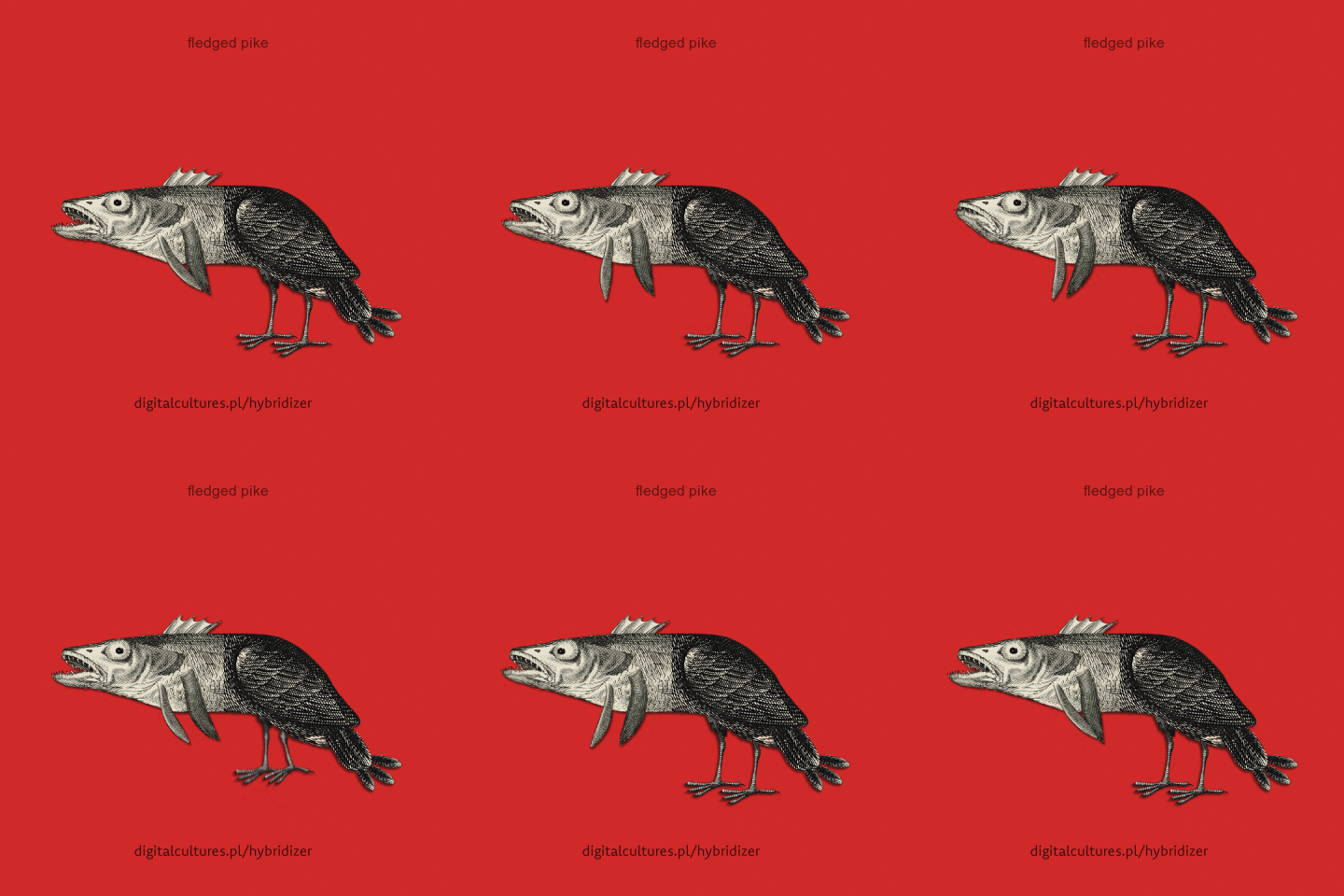
You know how naturalists of the Middle Ages described (or imagined) strange animals as combinations of known animals? You can make your own now! Kajetan Obarski and Igor Hardy made an online generator that combines two animals, illustrated by 17th century engraver Matthaus Merian, into a new animal. Try out the Hybridizer yourself, and see how weird a new creature you can create. -via Nag on the Lake


19 Restaurant Designs That Are Comically Bad

(Image source: redditor Nopeasuoli)

Can you read what this wall painting is supposed to say? The words are placed fairly randomly, and one is even split in two. The original saying is "May all who came as guests leave as friends," but those words were put into a jar and shaken before they were thrown at the wall. At least no one was expected to eat them.

(Image source: redditor peacelovinhippy)

And you have to wonder what the original purpose for this bowl was, since it does not hold food. These are just two examples of inexplicable attempts to make a restaurant memorable. Or maybe there was no real attempt at all. You'll find all 19 compiled at Buzzfeed.


How San Francisco Planned Its Own Housing Crisis

San Francisco is a lovely place to visit, offering tons of charm and history, but if you want to live there it's going to cost you dearly. The laws and regulations that made the city a struggle for lowly working people and their families go back to its early days as a seaport enriched by the Gold Rush. It began with zoning restrictions on boarding houses and laundries, supposedly to set decent living standards, but the desired effect was to drive out Chinese workers. That kind of "local control" continued into the 20th century to favor landowners over various immigrants, minority groups, and the poor. City officials introduced urban renewal projects to fight "blight," the federal government contributed redlining through the FHA, and neighborhoods had their own discriminatory covenants. San Francisco refined its land use and building codes over time, with both intended and unintended consequences that marginalized longtime residents without money or clout. It continued with a rezoning effort in 1978.

It’s clear that many San Franciscans were well aware this rezoning would lead the city toward a housing crisis. The planning commissioners, however, were not moved. Their testimony throughout the hearings made it clear they valued maintaining the city’s predominately suburban layout over affordability. In response to a homeowner who was unhappy that his property would be downzoned to allow fewer units, commissioner Sue Bierman gave a quintessential anti-growth response—countering that San Franciscans were concerned about parking, traffic, and sunlight reaching their backyards, embracing a shift toward zoning that would preserve “more comfortable neighborhoods.” Instead of listening to those folks worried about becoming homeless, the commissioners focused on the single-family homeowners worried about shadows on their yards and parking for their cars.

In the final minutes of the June 27, 1978, meeting, San Francisco’s planning commissioners prepared to approve the EIR, along with its damning final clause, which explained that the project would reduce the amount of housing that could legally be built in San Francisco. “As a result the cost of housing may increase, and that with increasing housing costs, some population groups may find it difficult to live in San Francisco. The proposed zoning will affect the low- and moderate-income households more than any other group and mitigation measures are proposed to help alleviate this impact.”

But commissioner Bierman said she was “troubled” by this statement, and commissioner Nakashima agreed, complaining that it wasn’t the solely the planning department’s fault if housing prices continued to rise. Commissioner Rosenblatt suggested removing the clause entirely—and that’s exactly what they did, erasing their acknowledgement of the plan’s disastrous effects from the document moments before approving it.

Read a substantial history of city planning that led to today's housing crisis in San Francisco at Collectors Weekly.


The First English Novel Was About Talking Cats

Literary scholars often trace the novel form back to 18th-century, although it depends on how you define "novel." A book called Beware the Cat, written by William Baldwin in 1553, appears to fill the bill.

Beware the Cat tells the tale of a talkative priest, Gregory Streamer, who determines to understand the language of cats after he is kept awake by a feline rabble on the rooftops. Turning for guidance to Albertus Magnus, a medieval alchemist and natural scientist roundly mocked in the Renaissance for his quackery, Streamer finds the spell he needs. Then, using various stomach-churning ingredients, including hedgehog’s fat and cat excrement, he cooks up the right potion.

And it turns out that cats don’t merely talk – they have a social hierarchy, a judicial system and carefully regulated laws governing sexual relations. With his witty beast fable, Baldwin is analysing an ancient question, and one in which the philosophical field of posthumanism still shows a keen interest: do birds and beasts have reason?

An intriguing read, no doubt, but the story behind the book is interesting, too. Baldwin, a printer's assistant who wrote other books, sat on Beware the Cat for ten years due to the politics of Tudor royalty. Now, 500 year later, the novel is being turned into a play. Read about Beware the Cat at The Conversation. -via Strange Company


Email This Post to a Friend
X

This website uses cookies.

This website uses cookies to improve user experience. By using this website you consent to all cookies in accordance with our Privacy Policy.

I agree
 
Learn More