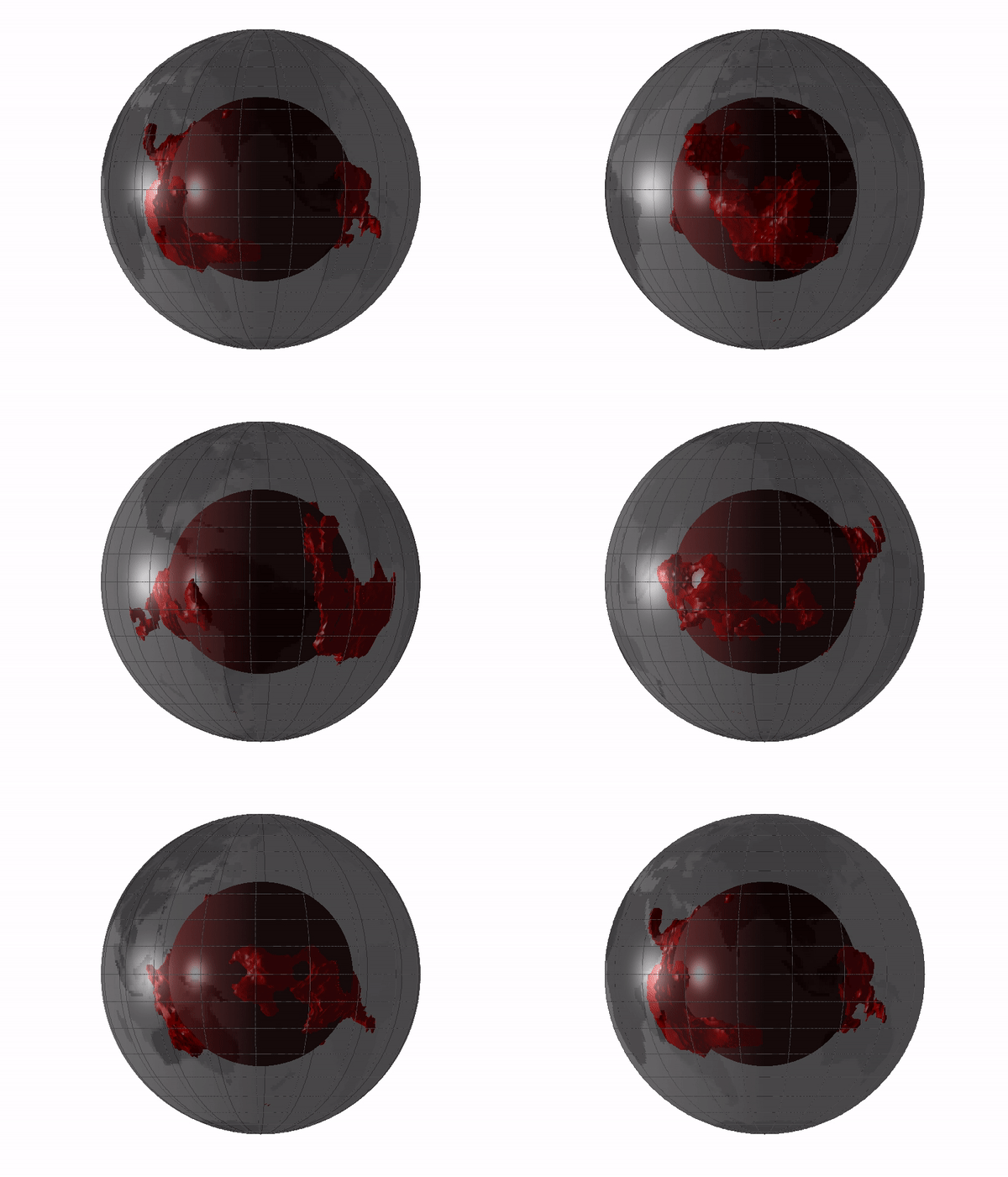
Continents of the Underworld

We learned in school that the earth is made of layers: the crust with tectonic plates and oceans, the mantle, and the hot liquid core. But wait, there's more! Deep beneath the surface, there are huge blobs of ...something. Scientists call them LLSVPs, or large low-shear-velocity provinces. But knowing they are there does not tell us what they are, or how they affect our world.  

Over the years, better maps kept showing the same bloblike features. One huddles under Africa; the other is beneath the Pacific. They lurk where the planet’s molten iron core meets its rocky mantle, floating like mega-continents in the underworld. Their highest points may measure over 100 times the height of Everest. And if you somehow brought them to the surface, God forbid, they contain enough material to cover the entire globe in a lava lake roughly 100 kilometers deep.

“It would be like having an object in the sky, and asking, ‘Is that the moon?’ And people are like, no. ‘Is that the sun?’ No. ‘What is it?’ We don’t know!” said Vedran Lekić, a seismologist at the University of Maryland. “And whatever it is, it is intimately tied to the evolution of the Earth.”

The first mystery of these hulking, hidden seismic features is whether they’re made of different stuff than the rest of the Earth’s mantle. The second: How do these patterns in the deep leave traces on our surface world?

While we don't have all the answers, we have a few possibilities and we have ongoing research. Read what we know about the massive blobs, er, LLSVPs, at Quanta magazine.  -via Metafilter, where you'll find more links.

(Image credit: Sanne.cottaar)


The Coded Couture of Antique Lacework

Lace was everywhere in the 17th century. Anyone could make it with time and practice. And that's how lacework illustrated the stratification of social classes. Common people had what they themselves made. As you went up the social ladder, more free time meant more intricate lace, and the aristocracy could afford to have lace custom-made by dedicated artisans, embedded with pearls and gems, with patterns that included mythical beasts, historic scenes, and meaningful personal symbols.

Threads of silk and precious metals were imported from the East, and lace making competitions and guilds were established. It transcended the space of domestic hobby, and became a way to flaunt your status; churches would commission “panel” pieces akin to antique comic books that played out biblical scenes, and it wasn’t uncommon to find lace embellishments on the coffins and chariots – as well as the cuffs – of aristocrats.

The art of lace never died, but it evolved. Read a history of lace and see some impressive examples at Messy Nessy Chic.

(Image credit: Metropolitan Museum of Art)


This Upcoming Indoor Dog Park Will Serve Beer and Wine

The problem with most dog parks these days is that people look at you funny or even make rude comments as you chug from your box of wine. They may ask intrusive questions such as "Do you even have a dog here?" or "Where are your pants?", creating an unwelcoming atmosphere.

The Pack Indoor Dog Park plans to resolve these problems when it opens in Comstock Park, Michigan in the summer. The Detroit Free Press tells us about this refined establishment:

Raechel Macqueen, co-owner of the forthcoming indoor dog park, said the 10,000-square-foot space will include open space for dogs to play and a seating area for their owners with food and drink. 
The idea began brewing for Macqueen in April 2019 shortly after she had her baby and struggled with the logistics of taking their dog to the dog park in terrain not suited for a stroller. 
"And I thought, 'Wouldn't it be so nice if there was somewhere that we could take our dog in Michigan that would be indoors and I could sit with her in one area and my husband could play with our dog in another area so he could get some exercise and attention?' Macqueen said.
[...]
The indoor park will include two main spaces, one just for dogs and adults and one for people to sit, eat, drink and hang out, with activities for children. Macqueen said they worked to make sure the space was open so people in the seating area could clearly see their dog. 

-via Dave Barry | Image: The Pack Indoor Dog Park


How Neurosurgeons Navigate Inside the Brain


Neurosurgeon Alex Alamri explains how he cuts into a living human brain to find a tumor without damaging the important parts we need to keep. There's some totally neat technology that helps him, which only makes us wonder how anyone ever dared to attempt brain surgery before this kind of mapping was available.


This Is How We Can Feed People Without Destroying The Environment

The EAT-Lancet Commission generated targets for a sustainable and nutritious planet-wide diet, aimed to preserve the world we are living in. The Commission, a team of 37 experts, aim to feed ten billion people by 2050 without destroying the environment. From doubling the consumption of fruits and nuts to reducing the amount of meat and sugar that we eat, National Geographic presents their worldwide diet plan in well-visualized infographics. 

image credit: screenshot via National Geographic


Are You Choosing The Right Environment-Friendly Phone?

In a time where we are getting more driven to preserve and protect the environment, we aim to reduce our carbon footprint, one action at a time. Using gadgets consume the environment’s resources, and some can do lasting damage to the planet. So what can we do, as consumers, to protect the environment and get to use a smartphone as well? Grist shares their tips on how to pick a environment-friendly phone. If we want to reduce our carbon footprint from using gadgets, the trick is to pick a phone that will use as long as possible: 

No two-year upgrade, no succumbing to the shiny new release, no giving up as soon as the screen is cracked. To that end, you also want to look for items you can fix when something goes wrong with them. A phone with glass on both sides is twice as likely to crack. A used phone or refurbished phone is going to be more eco-conscious than a new one, for obvious reasons. And a phone with a more efficient battery won’t need that battery replaced as often — assuming you can replace it.

image via wikimedia commons


Watch This 91-Year Old Veteran Do One-Handed Push-Ups

Eugene Andrews, 91, of Idaho Falls, Idaho served in the US Army during World War II. He still keeps his uniform in good condition. It fits him well, too. That's intentional, as Andrews wants to be ready to serve should he ever be recalled to duty. In this video, Andrews performs one-handed push-ups to demonstrate his physical fitness. East Idaho News tells us about his life:

Andrews was drafted into the United States Army and ended up traveling to Japan for the occupation in the Signal Corps.
“I consider that time in the military a blessing,” Andrews told EastIdahoNews.com earlier this week.
Andrews grew up in Idaho Falls during the Great Depression. He began working at a young age handling cattle before being drafted into the Army. After he returned, he found a job with Andrew Drilling, where he spent 25 years before opening his own insulation company.

-via Instapundit


10 Great Acid Westerns

The Western has always been a powerhouse American movie genre, allowing for the standard shoot-em-ups where the good guy always wins, and some very different takes set in the same wild west place and/or time. The "acid Western" arose in the 1960s and had its heyday in the '70s by putting a modern and artistic spin on the outlaw narrative. They don't always include drugs, but they certainly try to be mind-expanding.  

The term ‘acid western’ is an elusive one. First coined by Pauline Kael in her New Yorker review of Alejandro Jodorowsky’s El Topo (1970), it wasn’t until 2000 and the publication of his monograph on Jim Jarmusch’s Dead Man (1995) for the BFI Modern Classics series that critic Jonathan Rosenbaum would expand upon the terminology more specifically.

“What I partly mean by acid westerns,” wrote Rosenbaum, “are revisionist westerns in which American history is reinterpreted to make room for peyote visions and related hallucinogenic experiences, LSD trips in particular.” He distinguishes these from the “less radical… upheaval of generic norms” that colour “the influence of marijuana on the drifting, nonlinear aspects of the style of McCabe and Mrs Miller (1971),” setting the ‘acid western’ apart from what he calls the ‘pot western’.

You've probably seen some of the movies on this list, and you might want to give them a second look, or even find something new to watch. Every one of them is a product of its time, with some holding up better than others. See the synopses of ten movies at BFI. -via Boing Boing


How One Librarian Tried to Squash Goodnight Moon

The all-time list of the most checked-out books at the New York Public Library is out, and while it consists of mostly children's books, Goodnight Moon by Margaret Wise Brown is not among them. That's strange, because the book, published in 1947, is more popular now than it has ever been. But the NYPL didn't even have Goodnight Moon in its collection until 1972! The story of why the book was banned for so long goes back to one very powerful librarian, Anne Carroll Moore.  

As it turns out, this footnote on the NYPL’s anniversary list hints at a rich, surprising story of power, taste, educational philosophy, and the crumbling of traditional gatekeepers. Moore was appointed the NYPL’s first “superintendent of work with children” in 1906, at a time when the very idea of children even being allowed into libraries was brand-new. (Children who couldn’t read yet would gain nothing from a library, the theory went, and older children might be corrupted by all the trashy adult books.) Moore oversaw the beautiful Central Children’s Room in the library’s flagship building on Fifth Avenue. As Leonard S. Marcus writes in his biography of Margaret Wise Brown, Moore became perhaps the leading figure in popular children’s books in the first half of the century, and many of her methods seem strikingly modern. She scheduled scores of story hours for children; she encouraged any children who could sign their names to check out a book; she trained librarians drawn from a diverse range of backgrounds and then sent them out into a city of immigrant children, preaching the gospel of reading.

Moore's philosophy was very progressive in some areas, but she also wielded an iron hand. Read the story of how Moore's power shaped children's literature for a long time at Slate.  -via Digg


Eye Pixels Stop Motion

Cairo artist Dina Amin loves to deconstruct existing items to see how they work. For her latest art project, she needed a number of doll's eyes. She could have just ordered a bunch of parts, but instead, she collected used doll heads. The process of finding them and removing the eyes is as interesting as the final project itself. -via Metafilter


The 2020 Tokyo Olympic Posters


The Tokyo Olympic Committee has unveiled a series of posters to promote the 2020 Olympic games, which will be held July 24 through August 9, and the Paralympic games, August 25 through September 6. The theme comes off as "variety." Some posters actually feature athletes, others the city of Tokyo, but most are abstract. There are quite a few that channel manga, which is only appropriate in modern Japanese art.  

The call for official posters is part of an over century-long tradition. An artist selection committee of nine, ranging from museum professionals and journalists to practicing designers, chose a total of 20 fine artists, manga artists, graphic designers, calligraphers, and photographers from across Japan and beyond to bring their unique perspective to the Games. The inspired results are as diverse as the artists who created them.

See a gallery of the posters at Fast Company.


Small Models Of Big Tourist Attractions For The Visually Impaired

To help the visually-impaired to admire the huge tourist attractions, miniatures of these attractions are created. They are placed near the attractions themselves, including information in Braille to help more people read about the monuments or entire city centers. This wonderful addition helps the blind and the visually-challenged to appreciate tourist attractions better, as My Modern Met details: 

“When blind people finger their town for the first time it is a completely new experience for them,” Broerken writes. “Before they could feel the walls of the town but only the model gives them a chance to understand the dimension of the town they live in.”
By bringing architecture to life on a small scale, visitors can take a walk through the city using their fingertips and marvel at the incredible detail they might have otherwise missed. Of course, new technology like 3D printing has made scale models more affordable and so tactile models have become increasingly commonplace. So the next time you walk past one of these beautiful miniatures, take a moment to consider its important role in unlocking the details of the world’s greatest architecture.


image via My Modern Met


Predicting Injuries Based On Running Form: Is It Possible?

Physiologist and coach Jack Daniels once filmed a group of runners in stride. He then showed the footage to coaches and biomechanists to see if they could identify who was the most efficient.

“They couldn’t tell,” Daniels later recalled. “No way at all.” Famously awkward-looking runners like Paula Radcliffe and Alberto Salazar sometimes turn out to be extraordinarily efficient. Smooth-striding beauties sometimes finish at the back of the pack.

The act of running, it turns out, is a complicated subject. There are many factors that need to be considered, and these factors have endless variations.

So it’s a more or less hopeless task to simply watch someone run past and diagnose problems with their stride, whether it’s inefficiencies or vulnerabilities to certain types of injury. Amid the endless variables, we can’t possibly zero in on the ones that matter in real time.

More details about this over at Outside.

(Image Credit: skeeze/ Pixabay)


Omnipresent Plastic

It seems that plastic has become an almost-omnipresent being on our planet. It is now literally under our skin. Plastic pollution, as well as tiny plastic particles, or microplastics, have become ubiquitous in modern society.

These microplastics have been detected in the air, water and even in some foods, making their presence in our bodies essentially inevitable. 
“We definitely know we’re exposed, there’s no doubt,” says Chelsea Rochman, an ecologist at the University of Toronto in Canada, who studies human-made pollutants in fresh and saltwater environments. “We drink it, we breathe it, we eat it.”

Is plastic exposure bad for our health? Scientists do not know yet.

Check out Discover for more details about this topic.

(Image Credit: Hans/ Pixabay)


Advice For Bad Job Interviews

Alison Green has heard lots of stories about terrible job interviews, from an interviewer who demands to see what’s inside the candidate’s purse, interviewers who are insulting and hostile, and candidates being left to wait for hours, and many more. She has advice for people who might experience these in the future: walk away from them.

One common denominator in these stories is that when job candidates are subjected to rude behavior from employers, they mostly feel obligated to stick it out until the end of the interview. They don’t get up and leave. They sit politely, then walk out quietly stewing.
[...]
Why don’t more people walk out of bad interviews? These are just business meetings, after all; no one has been ordered to appear by subpoena.

Find out more about this over at Slate.

(Image Credit: Tumisu/ Pixabay)


Email This Post to a Friend
""

Separate multiple emails with a comma. Limit 5.


Success! Your email has been sent!

close window
X

This website uses cookies.

This website uses cookies to improve user experience. By using this website you consent to all cookies in accordance with our Privacy Policy.

I agree
 
Learn More