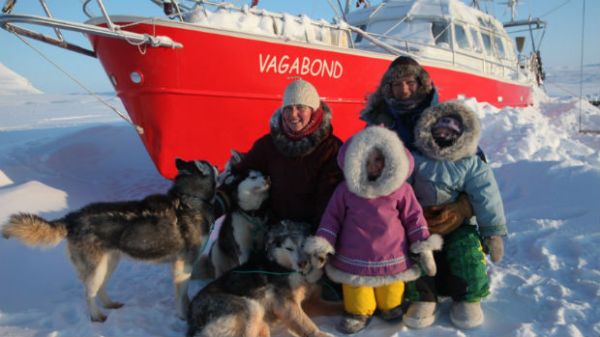
They had already spent five years on a boat in the Svalbard Islands north of Norway. That wasn't quite extreme enough for the Brossier family. For two years, they've lived on their 15-meter boat Vagabond in Grise Fiord in northern Canada. At the moment, the boat is ice-locked. But they can handle it:
This is the second year the family has spent in Grise Fiord, but Brossier and his family are no strangers to living on a boat in the Arctic. They also spent five years on a boat near Spitsbergen, which is an island near Norway. Brossier’s eldest daughter was only 12 days old when her parents first brought her on board.
“Our neighbours were really the polar bears. I think we saw 800 polar bears in five years so it was not many people,” he said. [...]
“We live here without any agenda and without any tight schedule. When you start something you have time to finish it,” he said. “Of course there are some things we cannot do. We miss mainly our families but we are already with our own little family… and it’s easier nowadays to keep in touch with Skype and the internet.”
Musician Coffey Anderson was upstaged big time when his 17-month-old son Ethan joined him on stage at a New Year's Eve show in Irvine, Texas. -via Daily of the Day
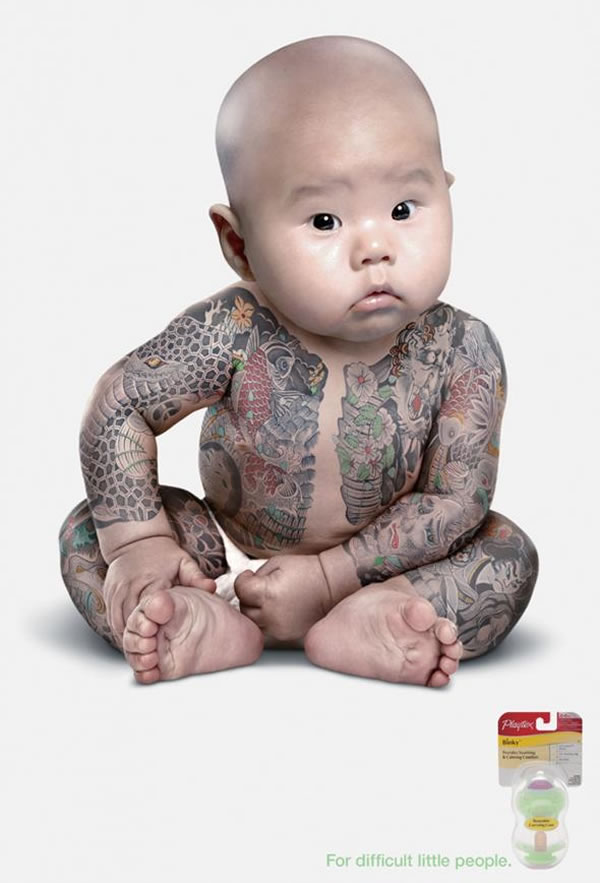
We're not sure of the connection between tattoos and "being difficult"
in this ad series for Playtext baby pacifiers, but don't let that interfere
with your enjoyment of these pics of tattooed babies.
And don't scowl either, Yakuza baby will probaby cut off your pinkie
or somethin'.
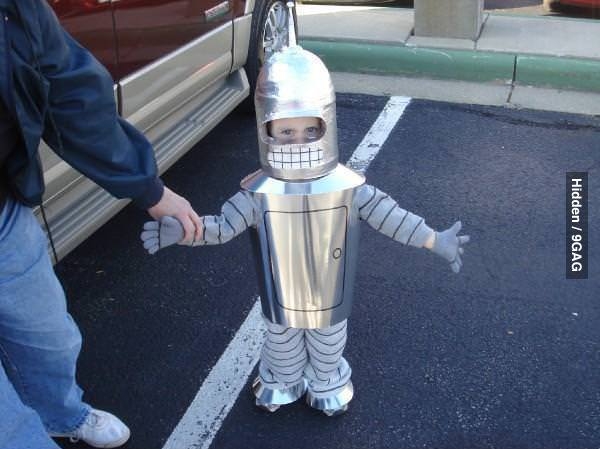
Baby Bender may just be learning to bend, but that doesn't mean he isn't the cutest little Bender around. Unfortunetly, his best friend Timmy actually dressed up too but failed to make it into the picture. He was left just off camera right, dressed up in a crab costume and as the picture was being taken he could be heard muttering "why not Zoidberg?" Okay, maybe not. But it could have happened, who knows?
The process of leading children from birth to adulthood is a long and complicated journey. Sometimes just civilizing a toddler enough to get him to preschool seems like moving a mountain. But are we really working with a blank slate? Research in infancy seems to point to a naturally-occurring knowledge of what's good and what's bad, even when the child is too young to guide his own behavior accordingly.
Infant morality studies are so new that the field’s grand dame is 29-year-old J. Kiley Hamlin, who was a graduate student at the Yale lab in the mid-2000s. She was spinning her wheels for a thesis project when she stumbled on animated presentations that one of her predecessors had made, in which a “climber” (say, a red circle with goggle eyes) attempted to mount a hill, and a “helper” (a triangle in some trials) assisted him, or a “hinderer” (a square) knocked him down. Previous infant research had focused on other aspects of the interaction, but Hamlin wondered if a baby observing the climber’s plight would prefer one interfering character over another.
“As adults, we like the helper and don’t like the hinderer,” says Hamlin, now an assistant professor at the University of British Columbia. “We didn’t think babies would do that too. It was just like, ‘Let’s give it a try because Kiley’s a first-year graduate student and she doesn’t know what she’s doing.’”
Wynn and her husband, the psychologist Paul Bloom, collaborated on much of Hamlin’s research, and Wynn remembers being a bit more optimistic: “Do babies have attitudes, render judgments? I just found that to be a very intuitively gripping question,” she says. “If we tend to think of babies being born and developing attitudes in the world as a result of their own experiences, then babies shouldn’t be responding [to the scenarios]. But maybe we are built to identify in the world that some things are good and some things are not, and some helpful and positive social interaction is to be approved of and admired.”
In fact, 6- and 10-month-old babies did seem to have strong natural opinions about the climbing scenarios: They passionately preferred the helper to the hinderer, as assessed by the amount of time they spent looking at the characters. This result “was totally surreal,” Hamlin says—so revolutionary that the researchers themselves didn’t quite trust it. They designed additional experiments with plush animal puppets helping and hindering each other; at the end babies got the chance to reach for the puppet of their choice. “Basically every single baby chose the nice puppet,” Hamlin remembers.
The same experiment on even younger babies showed that their gaze lingered longer on the "helpers," too. But that's just the beginning of the research going on with infants, and even on that oxymoron called "toddler altruism," that you'll see in a fascinating article at Smithsonian magazine. Link
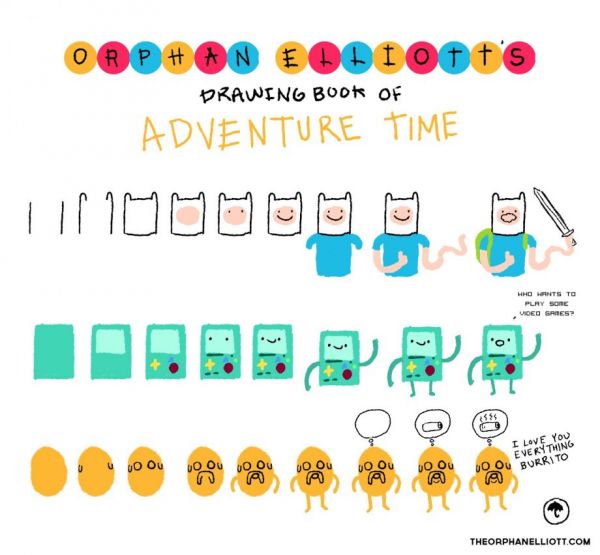
Ed Emberley's distinctive style of minimalist cartooning has been brought into the age of Adventure Time thanks to artist Orphan Elliott, who presents us with this super cute tutorial that shows kidults how to draw Finn, Jake and Bimo in eight or nine easy steps.
In true Emberley style Jake the dog can be started out with a thumbprint, and even Finn's face could be a sideways fingerprint if so desired.
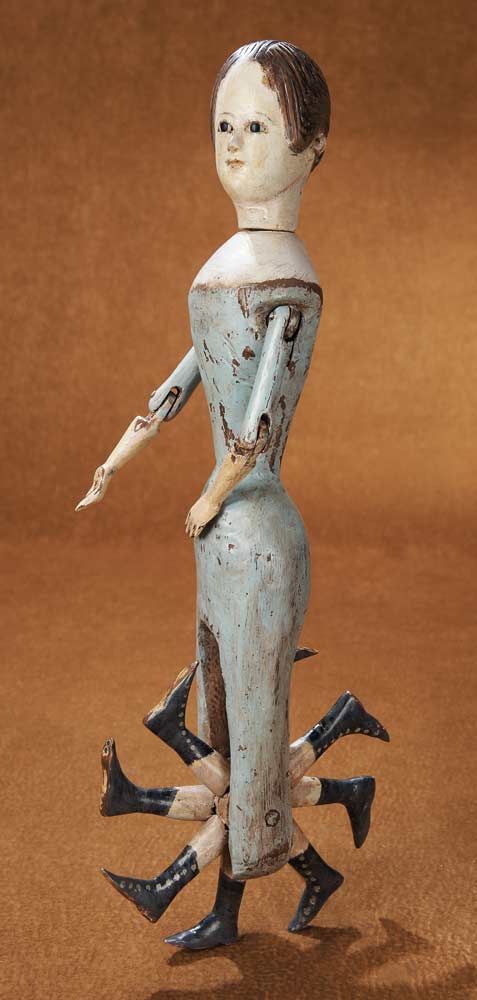
An action figure from a horror movie? No. Although it looks freakish without its dress, this antique doll dated to the early Nineteenth Century appeared to walk on two legs when properly clothed.
Never trust a "trust fall," especially if you don't really understand it. This illustrates a recurring theme in parenting, in that we have a hard time figuring out all the details we need to communicate when teaching a child something brand new. Sure, we know how it works, but there's so many ways to misunderstand when it's something you've never seen. -via Daily Picks and Flicks
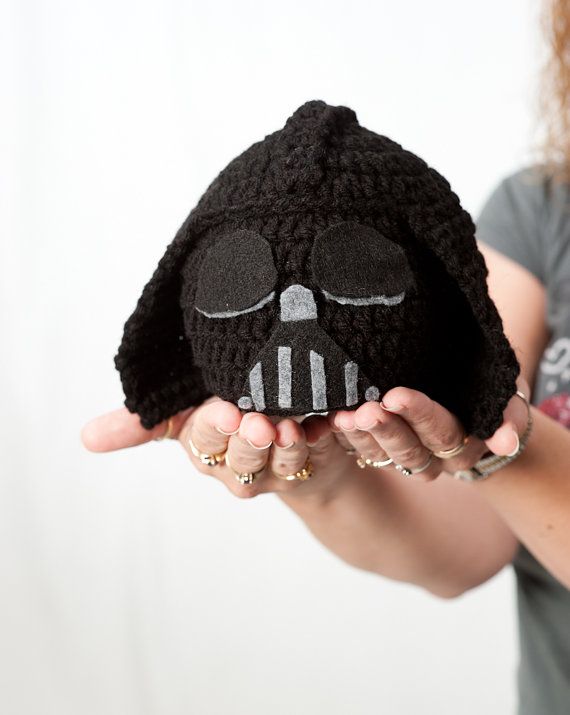
The only problem with this adorable little baby beanie is that you won't be able to see your little one's face. That's why it's best to slip in on while they're asleep and appriciate making jokes about how your baby is now "your father."
When you reveal to your kids that a trip to Disney World has been booked, and they'll soon be rubbing elbows with Mickey Mouse in the Magic Kingdom, they generally get excited, or at least kinda happy.
The two brothers in this video, however, clearly had their hearts set on a trip to Chicago, so a trip to Disney World has made their life a living hell.
Disney World- it ain't got nothin' on the Windy City folks!
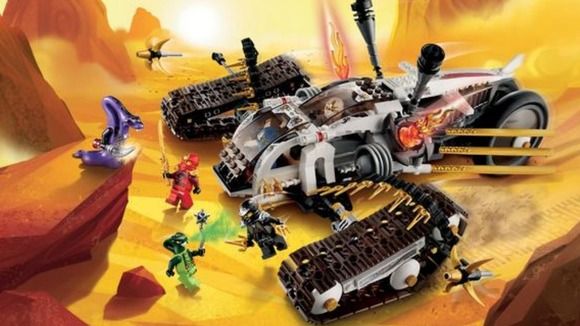
Seven-year-old Luka Apps used his Christmas money to buy the LEGO Ninjago Ultrasonic Raider set. Despite his father's warning, he put some of the minifigs in his pocket when they went out. And he lost one. So he emailed the LEGO company and asked for a replacement. Richard from LEGO replied, in part:
Luka, I told Sensei Wu that losing your Jay minifigure was purely an accident and that you would never ever ever let it happen ever again.
He told me to tell you, "Luka, your father seems like a very wise man. You must always protect your Ninjago minifigures like the dragons protect the Weapons of Spinjitzu!"
Sensei Wu also told me it was okay if I sent you a new Jay and told me it would be okay if I included something extra for you because anyone that saves their Christmas money to buy the Ultrasonic Raider must be a really big Ninjago fan.
Read Luka's letter and the entire response at ITV. Link -via @Marilyn_Res
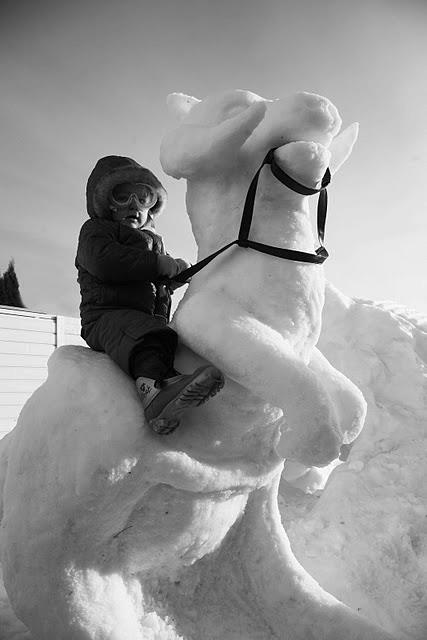
The tauntaun is a mysterious creature from the far reaches of the galaxy. Its Homeworld- Hoth, hair color- white, designation- non sentient, average adult height- 1.3 to 2 meters, and the amount of awesomeness derived from homemade snow-creature? Infinite.
It's hard to say who goes home with the Star Wars parenting award this year, but it really comes down to this post and one other- both including tauntauns.
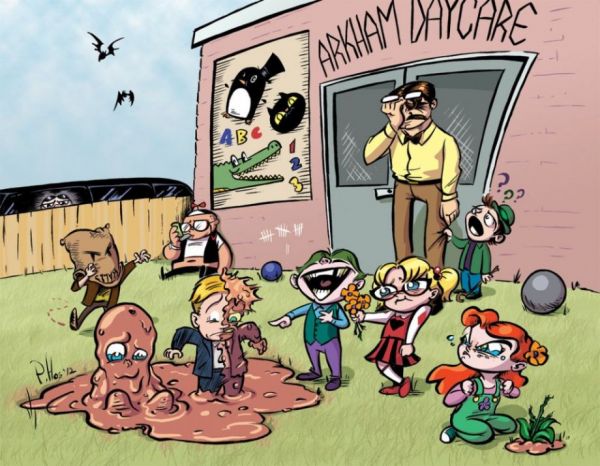
Gotham's baddies started out as small time hoods, and while young master Bruce was attending fancy parties with his ill fated parents Arkham's criminally insane were treating each other like dirt on the playground, according to illustrator Paul Hostetler.
They're so cute it's hard to imagine them as murderous adults, especially lil nerdy Harley!
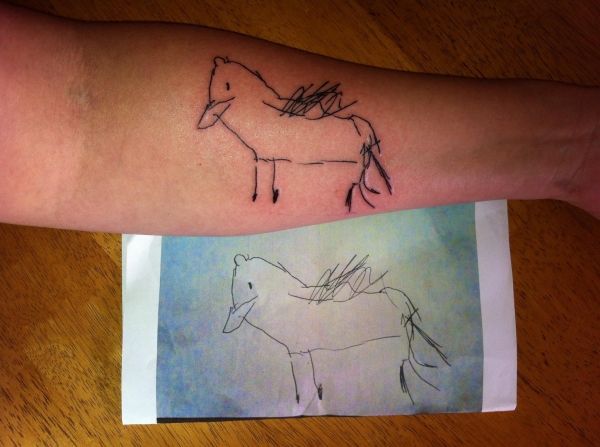
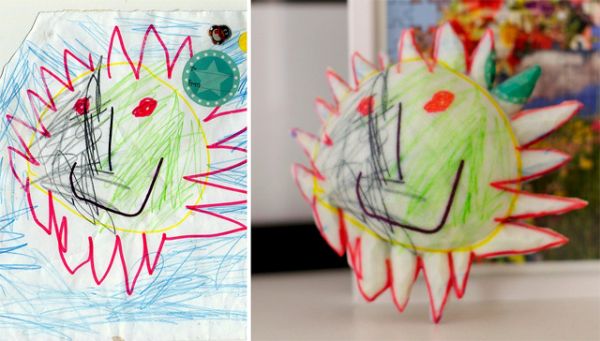
We've seen children's drawings turned into plush toys before, but Bernat Cuni goes even further. His project entitled Crayon Creatures does the same thing using a 3D printer to produce the final result in sandstone.