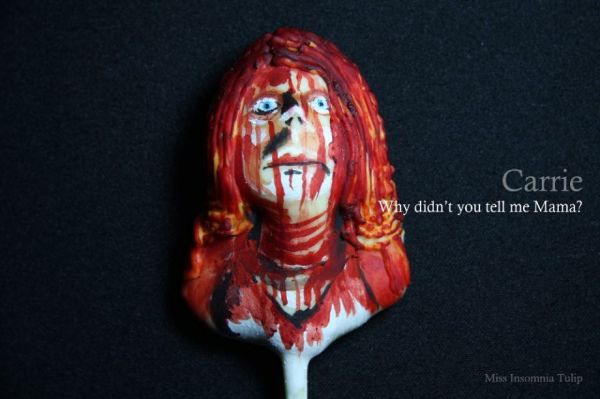
Miss Insomnia Tulip made cake pops that look like the female lead characters from Carrie, Misery, The Exorcist, and The Blair Witch Project. Awesome! This one is, of course, Carrie. See the rest at Eat Your Heart Out 2012. Link -via Boing Boing
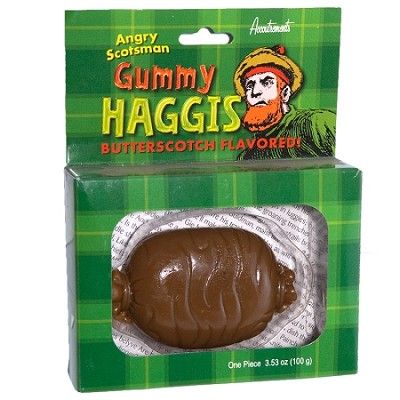
Did you read Jill Harness' list 12 Gross Candies Perfect For Trick or Treaters? Since that was written, candy manufacturers have been busy trying to out-gross themselves again, with new and disgusting ways to fashion and package Halloween candy. See the latest imaginative versions in Jill's new article at Inventor Spot. Link
Sales of Halloween masks based on U.S. Presidents, and presidential hopefuls, have served as an unofficial election poll that has proven right every time since Clinton Vs. Dole, 1996.
Does the fact that Obama mask sales far outnumber those of the Romney mask prove that he'll be re-elected come November? I guess we'll just have to wait and see...
Just look at this little construction worker all ready for trick-or-treat, complete with heavy equipment! This backhoe was lovingly built around the child's wheelchair. See lots of great wheelchair costume ideas that people have pulled off in spectacular fashion at Buzzfeed. Link
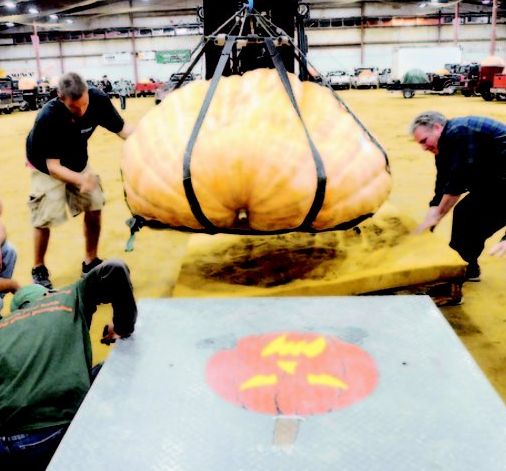
The Topsfield Fair, near Boston, Massachusetts, has an annual giant pumpkin weigh-off and has for years offered a $10,000 bonus for the first one-ton pumpkin. Ron Wallace of Greene, Rhode Island, has delivered that pumpkin. His entry weighed 2,009 pounds!
A throng of press and spectators gathered around as Wallace celebrated at the end of Friday night’s weigh-off. All night, people posed with the behemoth that sat at the far end of the fairground’s arena, with members of the New England Pumpkin Growers Association and others saying measurements were off the charts and foretold this could be the big one.
“It’s a great world record,” said the general manager of America’s oldest agricultural fair, James O’Brien. “Topsfield has had a lot of world records, but this one is special. This is absolutely one of the top sites in the country where you can come and weigh-off a pumpkin.” There have been seven world record giant pumpkins weighed at Topsfield in the last 15 years, O’Brien said.
The previous world record pumpkin was 1,843.5 pounds, set just a day before Wallace's weigh-in. Wallace won $5,500 for this year's competition and the $10,000 bonus, too. Link-Thanks, Sid Raisch!
Even in 1917 dressing in drag was a popular costume choice for Halloween, and since this was a year found smack dab in the middle of World War I dressing in military gear was also a popular choice.
However, the combination of drag and olive drab makes this one group you wouldn't want to run into while you're on shore leave.
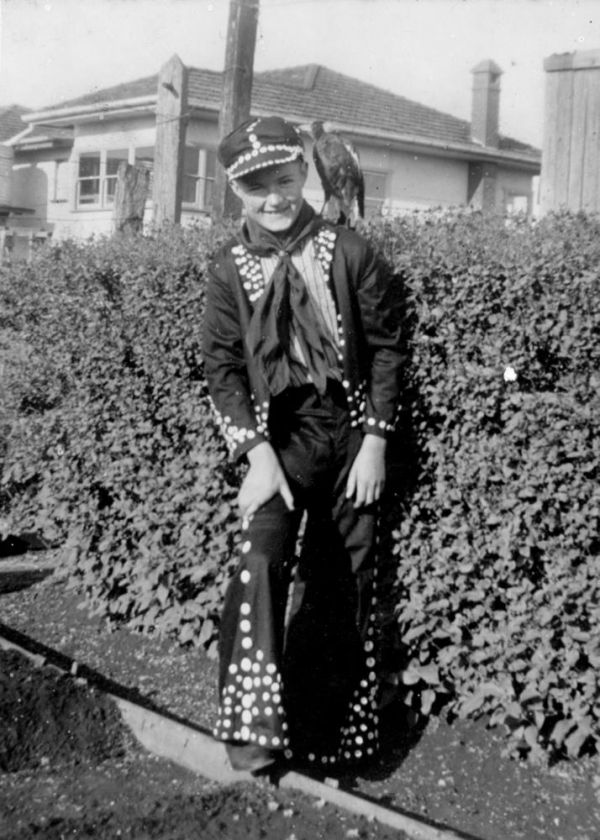
A little bunny girl captured on film way back in 1922 in Toowoomba, Queensland, Australia, and she looks like she's ready to have a hopping good time out on the town.
It's nice to see that DIY Halloween fashion hasn't changed much in the last 90 years.
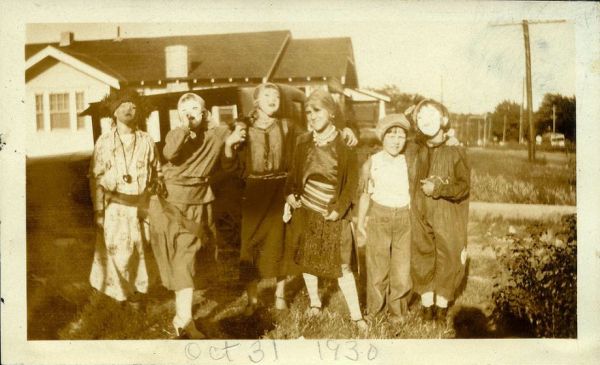
The band of gypsys shown here look like they're up to no good, and once again they prove that Halloween can be a real drag!
I hope these ne'er-do-wells don't drag their younger siblings down with them, or else 1930 is going to be the beginning of their careers as petty criminals...
A public school teacher from Waterdown, Ontario Canada decided to show her love of Halloween by wearing this festive ensemble- jester style hat, mask, striped scarf with pumpkin medallion and striped skirt to match.
My, don't you look like the cat's meow Miss Crabapple!
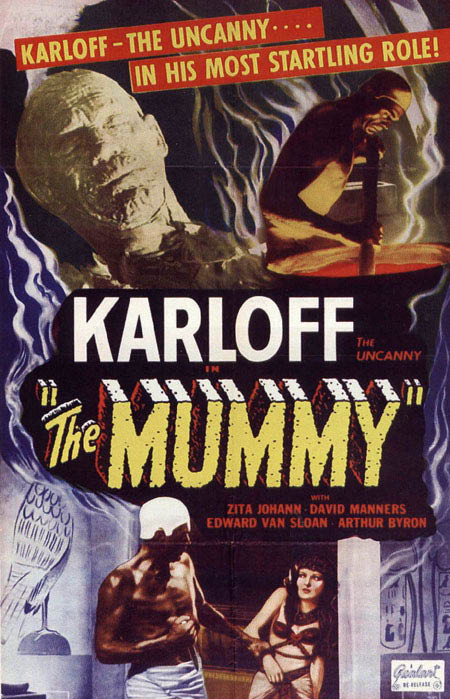
The medicinal uses of powdered mummy by A.S. Kaswell, Improbable Research staff
Nowadays, powdered mummy may not be everyone’s cup of tea, but for many years it was just what the doctor ordered. That’s one of the takeaway messages of Richard Sugg’s study “’Good Physic but Bad Food’: Early Modern Attitudes to Medicinal Cannibalism and its Suppliers.”
Dr. Sugg is a Research Fellow in Literature and Medicine at Durham University. He begins his monograph with an astute observation: “The subject of medicinal cannibalism in mainstream western medicine has received surprisingly little historical attention.”
Sugg tells us that mummy, generally in powdered form, “having originally been a natural mixture of pitch and asphalt, came in the twelfth century to be associated with preserved Egyptian corpses.” It then “emerged as a mainstream western medicine” and remained a standard-issue drug until “opinion began to turn against it in the eighteenth century.”
Physicians pre-scribed powdered mummy for diverse ailments. An English pharmacopeia published in 1721 specifies two ounces of mummy as the proper amount to make a “plaster against ruptures.” Ambroise Paré, royal surgeon to sixteenth century French kings, proclaimed mummy to be “the very first and last medicine of almost all our practitioners” against bruising.
Dr. Paré harbored doubts about the drug’s efficacy, lamenting that “wee are ... compelled both foolishly and cruelly to devoure the mangled and putride particles of the carcasses of the basest people of Egypt, or such as are hanged.” But Dr. Paré was an unusually driven doubting Thomas — he lamented having “tried mummy ‘an hundred times’ without success.”
The Sugg study explains that “mummy was an important commodity. It is often seen in long lists of merchants’ wares and prices.” The marketplace attracted counterfeiters. Sugg supplies an anecdote: “Tellingly, when Samuel Pepys saw a mummy it was in a merchant’s warehouse; while ‘the abuses of mummy dealers in selling inferior wares’ were especially widespread and notorious by the end of the seventeenth century.”
The best suppliers maintained high standards. The presumably admirable recipe used by 17th century German pharmacologist Johann Schroeder included: “the cadaver of a reddish man (because in such a man the blood is believed lighter and so the flesh is better), whole, fresh without blemish, of around twenty-four years of age, dead of a violent death (not of illness), exposed to the moon’s rays for one day and night, but with a clear sky. Cut the muscular flesh of this man and sprinkle it with powder of myrrh and at least a little bit of aloe, then soak it.” And so forth.
This study removes some, if not all, of the horror from the Stephen Sondheim musical “Sweeney Todd,” in which a London barber of yesteryear murders his customers and recycles them as stuffing for yummy meat pies. Thanks to Dr. Sugg’s research, the play’s main love song gains a soupçon of innocence, especially in its cheerful refrain: “The history of the world, my sweet, is who gets eaten and who gets to eat.”
Mummy Powder and Shakespeare
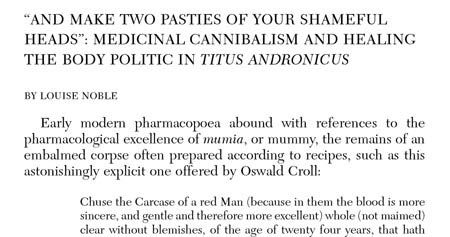
Louise Noble of the University of New England looked at how Shakespeare looked at mummy medicine. Her 2003 study “‘And Make Two Pasties of Your Shameful Heads’: Medicinal Cannibalism and Healing the Body Politic in Titus Andronicus” presents copious details and analysis.
Noble’s 2003 study about Shakespeare’s take on mummy powder.
Noble introduces her subject by reprinting this “astonishingly explicit” recipe from Oswald Croll’s 1609 book Bazilica Chymica and Praxis Chymiatricae or Royal and Practical Chymistry (translated by John Hartman in 1670), which no doubt inspired Dr. Schroeder:
Chuse the Carcase of a red Man (because in them the blood is more sincere, and gentle and therefore more excellent) whole (not maimed) clear without blemishes, of the age of twenty four years, that hath been Hanged, Broke upon a Wheel, or Thrust-through, having been for one day and night exposed to the open Air, in a serene time. This Mumy (that is, Musculous flesh, of the Thighs, Breasts, Armes, and other parts) from the two Luminaries, once illuminate and constellate, cut into small pieces or slices and sprinkle on them Powder of Myrrh, and of Aloes, but a very little (otherwise it will be too bitter) afterward by Macerating, Imbibe them for certain days in Spirit of Wine, hang them up a little, and again imbibe them, then hang them up to dry in the Air, this so dryed will be like Flesh hardned in Smoak, and be without stink.
At the end of her study—which after all centers on the play Titus Andronicus—Noble concludes that
The elaborate rhetorical juggling of medicine and cannibalism in the play is an inevitable consequence of a cultural behavior, wherein the socially accepted medical consumption of human bodies and the foreign, abjected, and forbidden act of eating human flesh are profoundly implicated in one another.
Acknowledgment
Thanks to the Chemical Heritage Foundation for bringing mummy powder to our attention.
References
“’Good Physic but Bad Food’: Early Modern Attitudes to Medicinal Cannibalism and its Suppliers,” Richard Sugg, Social History of Medicine, vol. 19, no. 2, 2006, pp. 225–40.
“’And Make Two Pasties of Your Shameful Heads’: Medicinal Cannibalism and Healing the Body Politic in Titus Andronicus,” Louise Noble, English Literary History, vol. 70, no. 3, Fall 2003, pp. 677–708.
_____________________
This article is republished with permission from the January-February 2009 issue of the Annals of Improbable Research. You can download or purchase back issues of the magazine, or subscribe to receive future issues. Or get a subscription for someone as a gift!
Visit their website for more research that makes people LAUGH and then THINK.
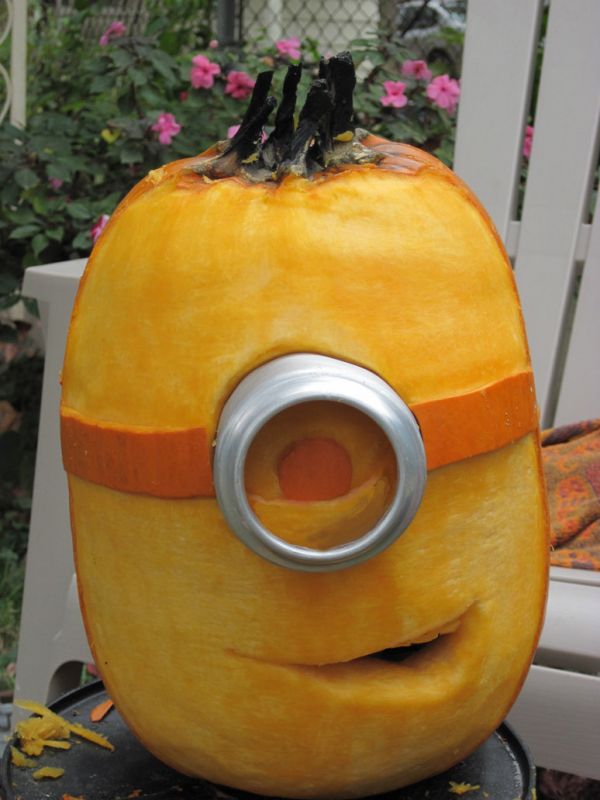
Admit it, when you watched Despicable Me, you couldn't help but want a few adorable minions of your own. Well, now you can -at least for a few days until they rot.
Sales of kid's Halloween costumes based on the hit TV drama Breaking Bad are expected to soar to an all time high this year, despite the fact that there aren't any officially licensed costumes being sold in stores.
Why is Walter White such a popular costume choice for kids? Because they've mistaken his blue meth for rock candy!
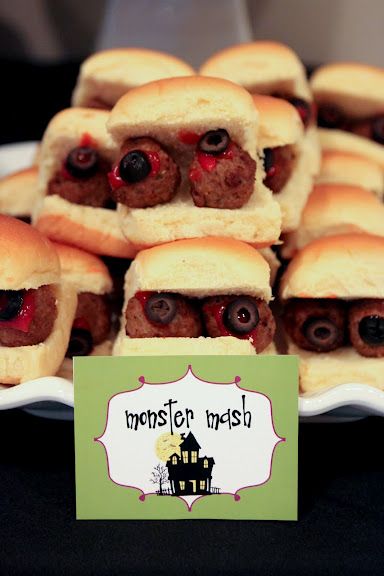
I've always been a big fan of meatball sandwiches with olives on them, but I had no idea that if you make the sandwiches small enough to only hold two meatballs and then put one olive on each that they quickly take on the appearance of eyeballs. Pure Joy has other great ideas including mummy pizzas and a few decorating tips as well.
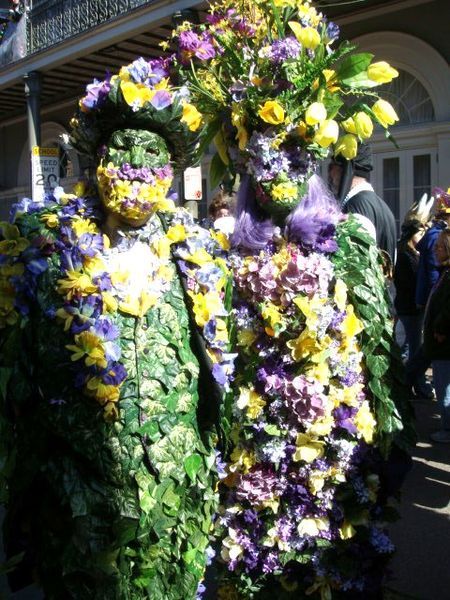
Wikimedia Commons contributor Mandy spotted these two late bloomers at Mardi Gras in 2010, and they seem like the kind of clever costume that would be equally great to wear on Halloween.
Purple, green and gold are the colors of Mardi Gras, but you can easily change the color choices up a bit and make the whole thing more sinister.
And a splash of blood, or some glow-in-the-dark paint here and there, and maybe some sharp teeth so you can warn people that these plants are carnivorous!
CollegeHumor is known for their crass sense of humor and hilarious videos, so you're probably asking yourself "what's up with the costumes?".
Well, CH hosts a Halloween costume contest every year they call the Costume Party, and you can see pics of the nine finalists from 2011 at the link below.
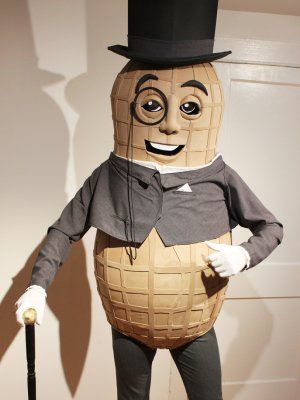
They're a fine looking group of costumed contestants, but don't take my word for it - ask Mr. Peanut!
Licensed costumes used to be pretty sad affairs- a cheap plastic mask, crappy sheet plastic or, if you were lucky, polyester suits and characters that have no place being represented on the trick-or-treat streets of Halloween (see Satan costume above).
We've come a long way in the world of Halloweening, but it sure is fun to take a look back at how bad things were back in the day!
Travel to the link below and you will see why you shouldn't take modern kids costumes for granted...