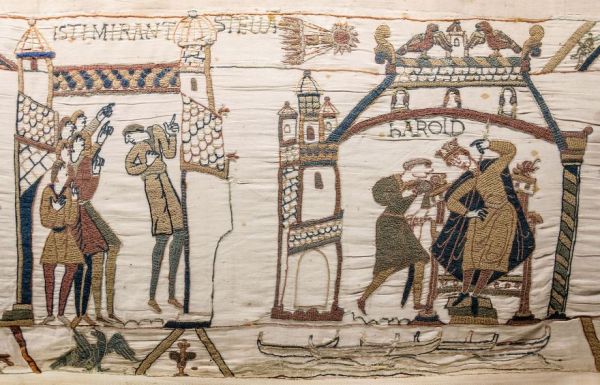
Halley's Comet returns every 75-77 years, and is named after English astronomer Edmond Halley because he was the first to figure out it was the same comet returning each time instead of a new comet. Knowing what we know now, we have documentation on the comet's appearance going back to 240 BC, and records of its observation in 164 BC, 87 BC, 12 BC, and every appearance since, although these records came from different parts of the world.
But was Halley really the first to document the return of the same comet? Recent research into the matter takes us back to the appearance of Halley's Comet in 1066, which was recorded on the Bayeaux Tapestry and was said to herald the death of King Harold II of England, which happened later that year at the Battle of Hastings. It was also that same year that an elderly monk known as Eilmer (or Æthelmær) of Malmesbury observed the comet and recognized it as the same comet he saw in his childhood, which would have been the year 989. Researchers have even suggested the comet be renamed for Eilmer. That's not likely to happen.
Why wasn't Eilmer given such credit earlier? Popular Science hints that Eilmer may have been considered somewhat of a crackpot because of his notable attempt to fly like Icarus and Daedalus from Greek mythology when he was much younger. Wikipedia goes into greater detail about that flight, which is now regarded as a possible milestone in the history of aviation.