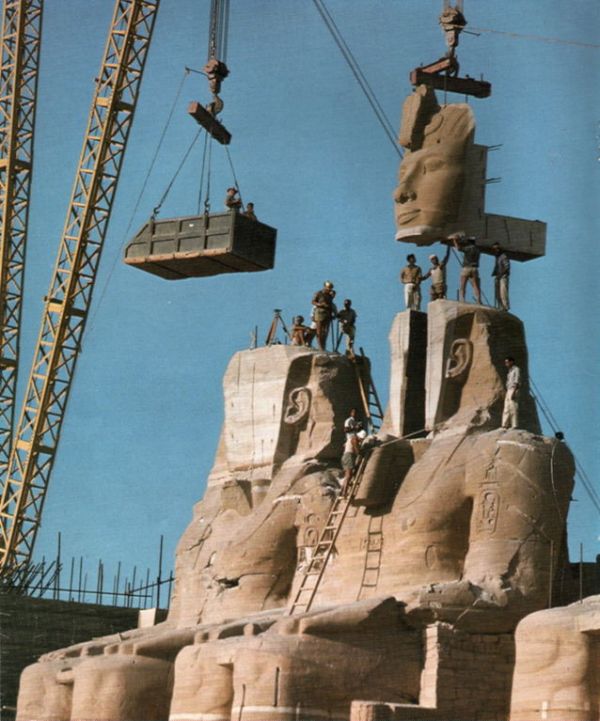
Ramesses II of Egypt left many architectural wonders behind, including two temples built into rock cliffs near the village of Abu Simbel. The problem was that these 3,300-year-old Egyptian treasures lay in what would become Lake Nasser when the Aswan High Dam was built. Egyptian authorities approached UNESCO for a plan to save the temples by moving them to a new location. Moving the massive solid-rock temples would not be simple.
Work began in November 1963. First, a cofferdam was erected around Abu Simbel in order to gain additional time in which to work on the temples while water was collecting in the Aswan dam’s reservoir. The greatest care was needed while cutting up the stones. Power saws could not be used because they made the cuts too wide—anything wider than 8 millimeters would have been visible when the blocks were put back together. Instead, hand saws and steel wires were used to slice up the rocks into blocks each 20 to 30 tons in weight. In the end, the larger temple yielded 807 blocks and the smaller one 235. Once cut, each block was coated to protect it against splitting and fracturing during transport.
The new site was located about 200 meters further inland and 65 meters higher up. Before reassembly could begin, an artificial hill was created using some 330,000 cubic meters of rock to resemble the natural stony hill against which the temples stood at the original site. Then the blocks were put back together with extreme precision, secured to one another with reinforcement bars and the joints filled with an artificial material. Care was taken to maintain the temple’s original alignment to the cardinal directions, so that the rays of the sun would continue to penetrate the sanctuary and illuminate the sculptures on the back wall during certain hours of the spring and autumn.
Read how the stone temples of Abu Simbel were cut, moved, and reassembled at their new home at Amusing Planet.
(Image credit: Per-Olow Anderson)