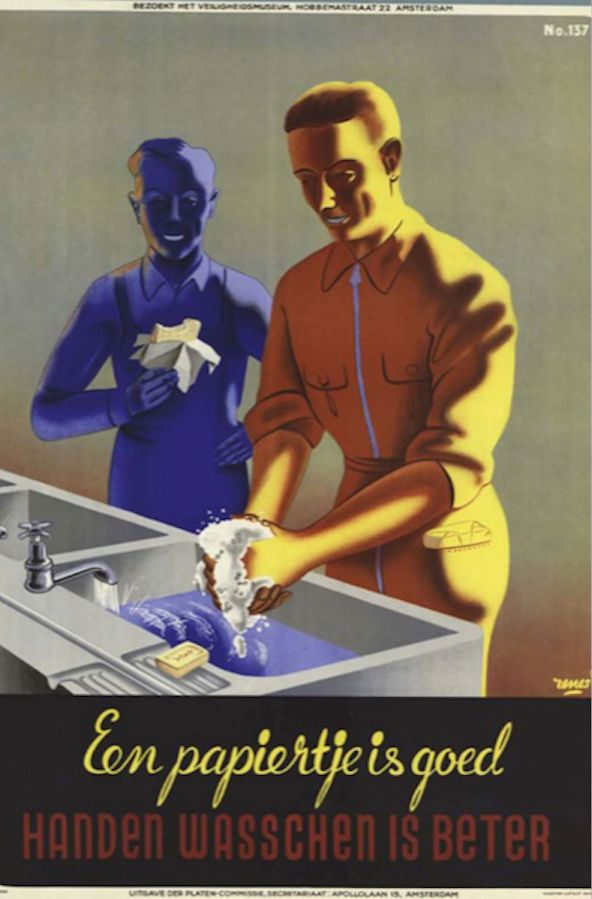
We know that washing our hands is the most powerful thing an individual can do to prevent the spread of pathogens. But it wasn't always that way. Up until close to the end of the 19th century, doctors went from patient to patient without washing their hands. Doctors were from the educated class, and therefore already cleaner than the patients they treated, and they had no reason to think otherwise.
Swimming against the tide, the first advocate of hand-washing, Hungarian doctor Ignaz Semmelweis [...] suffered the fate of many a pioneer—he was jeered at, ignored, and, finally, committed to an asylum at age 47, where he died, in a tragic irony, of sepsis in 1865. Before this end, however, Semmelweis, an obstetrician, took a systematic approach to the problem of “childbed fever,” trying to eliminate all of the possible reasons women died at far higher rates when doctors delivered their babies instead of midwives.
In 1848, he hypothesized that doctors, often attending births immediately after conducting autopsies, were transmitting “cadaverous particles” on their hands. Semmelweis had them sterilize their hands and instruments with chlorine, and deaths from childbed fever fell to 1% of cases. But the experiment did not produce a revolution. Semmelweis couldn’t explain his findings, and Miasma theory continued to hold sway, in part, because it did not implicate doctors or others from the higher orders of society in the spread of disease.
Semmelweis was right, but it was decades before doctors started to wash their hands regularly, and even longer before the idea caught on with the general public. Read how that happened at Flashbak. -Thanks, WTM!