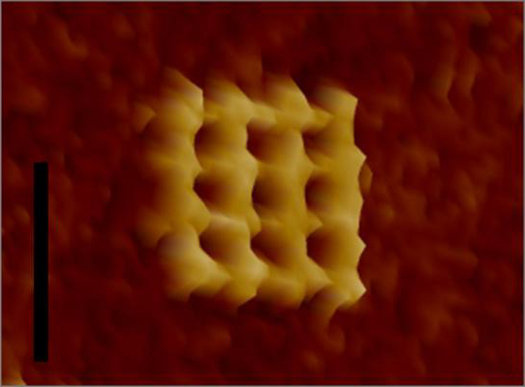
A Duke University engineer proposes that it's possible to use custom-made DNA to generate self-assembling nanostructures that could be used as a cheap replacement for silicon microchips:
In his latest set of experiments, Chris Dwyer, assistant professor of electrical and computer engineering at Duke's Pratt School of Engineering, demonstrated that by simply mixing customized snippets of DNA and other molecules, he could create literally billions of identical, tiny, waffle-looking structures.
Dwyer has shown that these nanostructures will efficiently self-assemble, and when different light-sensitive molecules are added to the mixture, the waffles exhibit unique and "programmable" properties that can be readily tapped. Using light to excite these molecules, known as chromophores, he can create simple logic gates, or switches.
Link via Popular Science | Image: Chris Dwyer/Duke University
Newest 5 Comments
Or they can use the teeny tiny DNA to play the world's tiniest game of tic-tac-toe.
Abusive comment hidden.
(Show it anyway.)
Should hit the consumer market in 20 years!
Abusive comment hidden.
(Show it anyway.)
The future of Corn Chex.
Abusive comment hidden.
(Show it anyway.)
It makes complete sense in the very near future every thing will be organic in nature. The vietnamese woman inventor on neatoramam who introduced a new organic moldable furniture intrieged me so. I have had futuristic dreams of just this.
Abusive comment hidden.
(Show it anyway.)
Microchips?
Abusive comment hidden.
(Show it anyway.)