And now for something completely different. A math puzzle. Or conundrum, if you will.
In the figure to the left, the bar above the number 9 indicates that it is to be repeated forever. For the remainder of this post, we will represent that concept by several nines with an ellipsis (.999...).
Now, here is the conundrum. .9 repeating is EQUAL TO ONE. Not CLOSE to one, mind you, but EQUAL to one.
Nonsense, you reply. It is obviously less than one. Not by much - by an infinitely small amount, in fact. But the simple fact (?) that it is not one is enough to demonstrate that it can't be equal to one. It's as close as you can get to one without being one.
Wrong. It is in fact equal to one, and that fact can be demonstrated mathematically in several ways.
The most easily understood is to revert to other familiar repeating digits. Everyone knows that 1/3 is 0.333... and that 2/3 is 0.666... If you add them together, you get 3/3, which is one.
But now note that the sum of the decimals on the right side of the equation is 0.999...
Therefore, one is equal to (not close to) .999...
You don't agree? Then try this. Subtract .999... from one. What you have is 0.000... An infinitely long string of zeroes, which can only be equal to zero. And if the subtraction of .999... from one leaves zero, then the .999... must be one. But, you say, there's a one at the end that string of zeroes. No, there isn't, because the string of 9s doesn't end.
There are other proofs at the Polymathematics blog, along with a long series of comments, an update refuting the counterarguments, and a final refutation of the most stubborn skeptics.
Link.
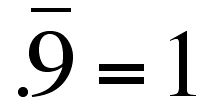
In the figure to the left, the bar above the number 9 indicates that it is to be repeated forever. For the remainder of this post, we will represent that concept by several nines with an ellipsis (.999...).
Now, here is the conundrum. .9 repeating is EQUAL TO ONE. Not CLOSE to one, mind you, but EQUAL to one.
Nonsense, you reply. It is obviously less than one. Not by much - by an infinitely small amount, in fact. But the simple fact (?) that it is not one is enough to demonstrate that it can't be equal to one. It's as close as you can get to one without being one.
Wrong. It is in fact equal to one, and that fact can be demonstrated mathematically in several ways.
The most easily understood is to revert to other familiar repeating digits. Everyone knows that 1/3 is 0.333... and that 2/3 is 0.666... If you add them together, you get 3/3, which is one.
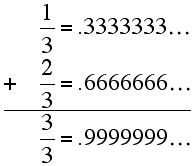
But now note that the sum of the decimals on the right side of the equation is 0.999...
Therefore, one is equal to (not close to) .999...
You don't agree? Then try this. Subtract .999... from one. What you have is 0.000... An infinitely long string of zeroes, which can only be equal to zero. And if the subtraction of .999... from one leaves zero, then the .999... must be one. But, you say, there's a one at the end that string of zeroes. No, there isn't, because the string of 9s doesn't end.
There are other proofs at the Polymathematics blog, along with a long series of comments, an update refuting the counterarguments, and a final refutation of the most stubborn skeptics.
Link.
Mr. Lombard: I actually thought of the concept when I was a fetus. So, as they say in Intellectual Property parlance, I "swear behind your conception date." :)
Thanks for the support, Hoax.
To explain it on its own terms, with no need for analogy. Let's say that you have a rifle with 10 horizontal aiming positions. Now, you have a target that lands at position 4 (8/2nds from your example) position. Can you hit it? Yes.
But can you hit a target at the 1/3rd horizontal position? Unfortunately, no. You need a better scope. You can change to a 100-point scope, or 1000 or 1 google plex. But you still have the same problem.
This is not a paradox - it is perfectly consistent. It is just another way of saying that you have a digital scale (10-point, 100, 1000, or whatever digital limit you are using). An infinitely-repeating digital expression will never perfectly express a fraction that does not divide evenly. That's what infinite repetition means - it is NOT FINITE.
/takes his bow
//knows he is a wise-a&&