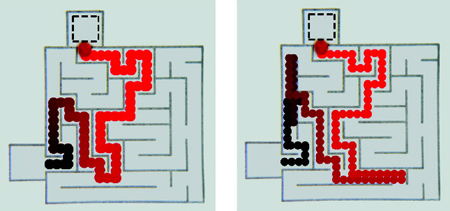
Physical chemists at Northwestern University have demonstrated that a simple droplet of oil can navigate a complex labyrinth.
Grzybowski's team made a number of silicon mazes roughly 6.5 square centimeters in size. To create the conditions for movement, the researchers filled the labyrinths with an alkaline solution of potassium hydroxide. The maze runners, placed at the entrance of the labyrinths, were millimeter-wide droplets of either mineral oil or the organic solvent dichloromethane, both loaded with a weak acid and red dye. The "prize," placed at the exit of each maze, was a lump of agarose gel soaked in hydrochloric acid. "We wanted to give [the droplets] a bit of a challenge and see if they could do more than just go in a straight line," Grzybowski says.
Over the course of a minute or so, each droplet found its way to the end of the maze.
The mechanism is explained at the link. The left diagram above shows that a droplet chose the shortest route from the entry to the dashed box where the "prize" was placed. The droplet on the right went astray twice but corrrected itself en route.
Istvan Lagzi, Bartosz Grzybowski, et al., JACS
Pulled along. Watch a droplet navigate a silicon maze.
The observation potentially has more than curiosity value; the researchers suggest that the basic principles involved may be applicable to the delivery of antineoplastic chemotherapy drugs to cancer cells.
Link.
Newest 3 Comments
it could be an artifact of that particular maze though, surely the test would have to be repeated on various different patterns?
Abusive comment hidden.
(Show it anyway.)
So can slime mold.
Abusive comment hidden.
(Show it anyway.)
Thanks, science. You never fail to cheer me up.
Abusive comment hidden.
(Show it anyway.)