Passover begins on the evening of April 22 (Monday) and will run through sunset on April 30. No, it doesn't always coincide with Easter. As they do every year, the Jewish a cappella group Six13 has unveiled another pop music parody for the holiday. This year their nine voices bring us "Matza Mia! An ABBA Passover." They've put new lyrics to four classic songs from the Swedish vocal group ABBA: "Take a Chance on Me," "Dancing Queen," "Gimme! Gimme! Gimme! (A Man After Midnight),” and “Mamma Mia!” They've also posted a song sheet if you want to use the new lyrics at your Seder or school program.
See also: previous Jewish holiday songs from Six13. I don't think anything will ever beat "5784" for Rosh Hashanah.

The school buses that roam the streets today look an awful lot like the first conventional school buses that came out of an American standardization conference in 1939. They are big, boxy, and bright yellow. They aren't the same buses, but they've carried that iconic look for 85 years. There are reasons for this: we want people to recognize school buses for what they are, and if if ain't broke, don't fix it. Also, school buses are different from consumer automobiles in that there are no clients to please. People who buy cars want modern styling, convenience, and the latest gadgets, while school buses aren't for status or luxury. We just want to get the kids to school and back safely.
However, you might be surprised at how school buses have evolved on the safety front. The only thing you might really notice is the rise of cab-over-engine buses, which makes it easier for drivers to see children crossing in front. Even though the first big, boxy, bright buses were already safer than cars, we've had many safety innovations in school buses over the years. Those improvements are worth every penny. Read about the evolution -and the lack of it- in school buses at Jalopnik. -via Boing Boing
(Image credit: H. Michael Miley)
Imagine a scenario in which the Milky Way galaxy is full of alien civilizations that are advanced enough to travel and communicate with each other, but they don't pay any attention to us here on Earth. That idea can be followed by all kinds of jokes about how human civilization isn't civilized, or otherwise deserving of company. But theoretically, there are other reasons we might not have been contacted by these advanced aliens. We might be honestly too far away to make the trip worth it. We may be relatively too young to understand them. They might know about us and have decided we have nothing useful to offer them. Or we may be among the "do not land here" list for other reasons. Yeah, some of those reasons are getting us closer to the old joke. It's easier to think that we are truly alone in the universe. This video from Kurzgesagt is really 10:15 long; the rest is an ad.

It's Barbiecue sauce! Get it?
The Mattel and Heinz companies have secretly developed a Barbie-themed sauce in honor of the doll's 65th anniversary "after a huge public demand." It's a vegan mayonnaise that is tainted with beetroot juice to match the official Barbie shade of pink (hex code #e0218a).
Fortunately, Heinz is only releasing its product in the UK and Spain, and the United States is thankfully outside of the blast radius. My condolences to the Europeans, though. The trauma begins today at Tesco stores in Britain.
-via Fast Company, which calls upon the end of Barbie product collaborations for humanitarian reasons.
Photo: Heinz UK
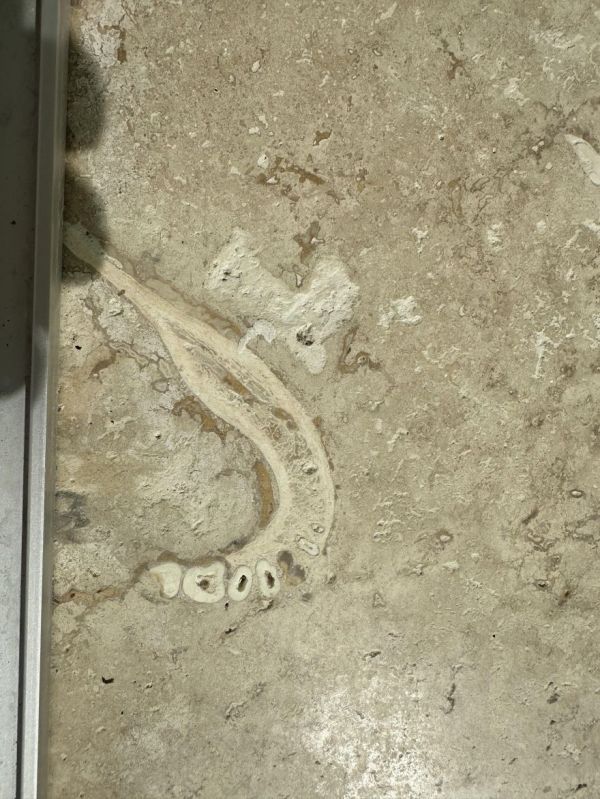
Travertine is a type of limestone that has become quite popular for home decorating because of the interesting natural patterns in it. Redditor Kidipadeli75 went to see the new travertine tiles his parents installed in their bathroom. Kidipadeli75 is a dentist, and recognized one of the patterns as a mandible! When he posted the picture to reddit, he got responses from other dentists, forensic odontologists, and archaeologists who concurred that it was a jawbone cut at an odd angle, possibly human. The tile was sourced from Turkey, and is believed to be around 200,000 years old, so it might be Neanderthal. Since the image was posted, Kidipadeli75 has been in contact with a paleoanthropology team.
John Hawks explains how this can happen, and it's more likely than you might think. Fossils abound in travertine, although they are mostly from animals. The process of retrieving and cutting travertine is fairly automated, so it would be easy to miss an obvious fossil like this one. So how would you feel about having human remains in your bathroom tile? -via Digg
(Image credit: Kidipadeli75)
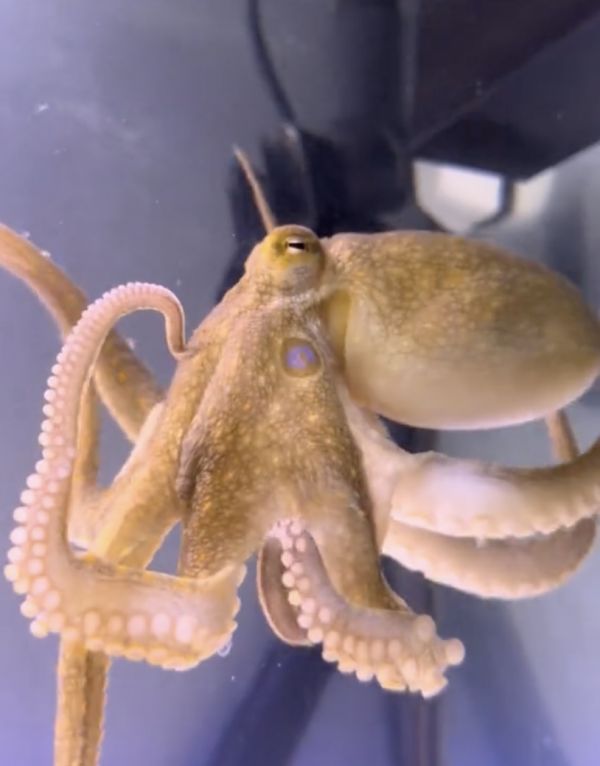
Young Cal Clifford has been obsessed with octopuses since he was two years old. By the time he was nine, his parents knew that it wasn't a passing fad and decided to get him a pet octopus. They procured Terrence, a two-spot octopus, and a 60-gallon tank. What they didn't know was that Terrance was a female who had already mated. Several months later, she laid eggs that produced 50 baby octopuses!
Cal's father, dentist Cameron Clifford, consulted Dr. Tim Tytle, a reptile expert who has two octopuses. They have separated all the surviving baby octopuses (half of them, a much better survival rate than in the wild) and are housing them at Tytle's duplex. Each have names, like Pearl, Seaoncé, Jay Sea, InverteBrett, Swim Shady, Squid Cudi, Bill Nye the Octopi, and Champ. The Cliffords, who now own 90% of the octopuses in Oklahoma, are looking for homes for the babies, but will not let them go to private families. Octopuses do not make good pets. Instead, they are reaching out to aquariums and research facilities.
Female octopuses normally die soon after laying eggs, but Terrence is still around five months later. Meanwhile, she and her offspring have gone viral with hundreds of thousands of people following the octopuses on TikTok. -via Metafilter
(Image credit: docktopus via TikTok)
We all recall that memorable scene in the movie Happy Feet when all the young emperor penguins go to sea for the first time, driven by instinct. They are terrified, but eventually the first one jumps in, and lets the others know it's okay. Scientists have recorded this first plunge many times, but they also found evidence that some juvenile migrations don't just go to the sea -they go in by jumping off high glacial cliffs! When you feel you must go to the sea, you go, whether it's a gentle jump off some floating ice or a plunge down a 50-foot cliff. For the first time, this phenomena has been filmed, using drones, by cinematographer Bertie Gregory for National Geographic. This footage is part of the documentary series Secrets of the Penguins, which will premiere a year from now, on Earth Day in 2025. -via Nag on the Lake
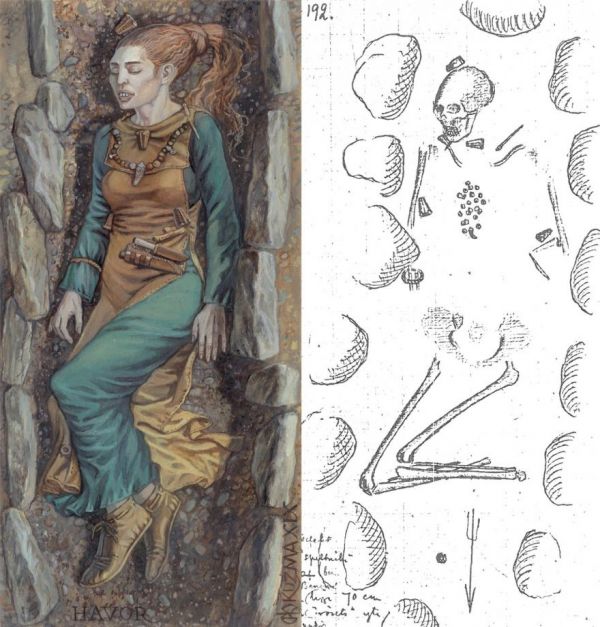
An archaeological excavation of a Viking burial ground in Gotland, a Swedish island in the Baltic Sea, revealed three adult women who had a feature not seen in Viking graves- skulls that had been shaped to produce a long cranium. Elongated skulls are shaped by binding the head in infancy, when the bones are soft, and have been found in many places around the world, but not in Sweden, and not in other Viking settlements. Why did it happen to these three women?
Vikings were no strangers to body modification, and sometimes sharpened their teeth to look more intimidating. But these Viking women were outliers. DNA tests showed they were from the Baltic Sea area. Could they have been born during their parents' travel to the Black Sea, were skull deformation was common? The burial sites indicate that they were accepted in the Gotland culture, and the misshapened skulls could have even been seen as a status symbol. Read about the mystery of the Viking women with long heads at Atlas Obscura.
(Image credit: Mirosław Kuźma/Matthias Toplak; ATA/Riksantikvarieämbetet)
The literal translation of tegelwippen is "tile wiping." In this context, it means getting rid of tiles. See, most homes in Dutch cities have their yard covered with tiles to make a patio. This makes lawn care easy, as all you have to do is pull the occasional weed from between the tiles. But there's a new campaign, spearheaded by Remco Moen Marcar, to encourage people to remove the tiles and plant trees and other greenery, in order to cool the city, improve drainage, and combat climate change. And what better way to get people involved than a competition?
The competition called the NK Tegelwippen began about a month ago and will continue through October, to find which town in the Netherlands can remove the most tiles from their private land, calculated as tiles per thousand residents. Those who've already taken the plunge say they are enjoying the outdoors more with cool gardens under the shade of trees. So far, the leader of the contest is the town of Venlo, at 144 tiles per thousand, a total of 14,636 tiles whipped away. The sponsors of the contest arrange to collect and dispose of the tiles, which are being recycled into building material. Read how the tegelwippen is going at The Guardian. -via Metafilter
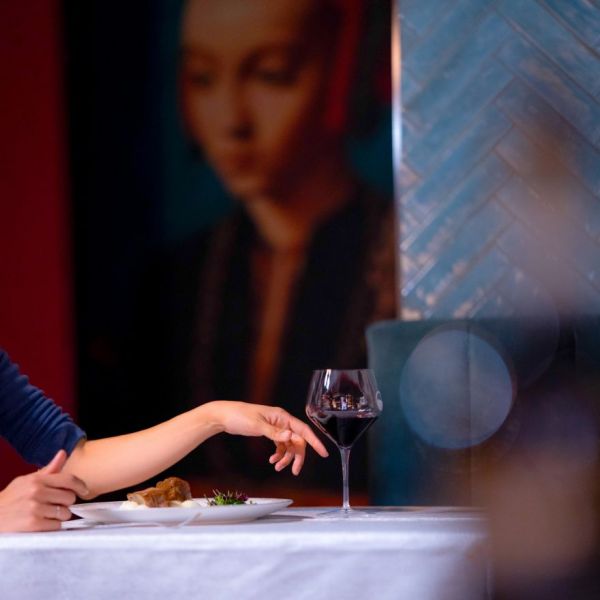
Al Condominio, a restaurant that opened last month in Verona, Italy, would like for its patrons to fully enjoy the social aspects of public dining. This requires putting away phones and, hopefully, talking to other human beings who are physically present.
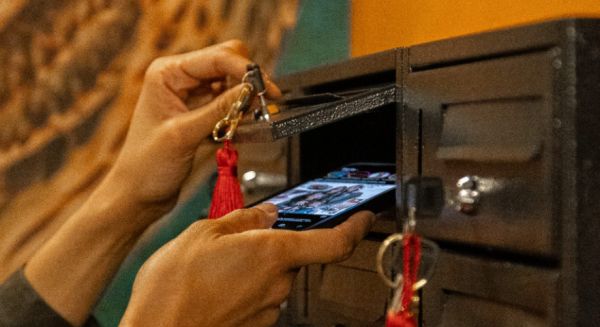
The Guardian reports that to encourage socializing, the restaurant encourages patrons to lock their phones in boxes. Once seated at a table, the patron hands the box key to a waiter, who provides free wine. So far, about 90% of patrons participate in this program.
Patrons can also write reviews and leave them in their phone boxes as they exit. Patrons who write the most positive reviews will receive free meals the next time that they visit.
-via Messy Nessy Chic | Photos: Al Condominio
Would you like to smell like McDonald's French fries? The company clearly thinks so and is marketing its smell broadly, including, most recently, branded perfume. It's also counting on the smell of its food to be so recognizable that people will identify it without any other data aside from the company's particular shade of red.
Ads of the World reports that these billboards in the Netherlands are set about 200 meters (that's about 112.5 DeForest Kelleys stacked end to end) from McDonald's restaurants. The company hopes that the smell will trigger cravings for the actual food products.
"It's the first billboard where the smell becomes the ad." I wonder what other products, brands, or companies could market themselves this way successfully. Perhaps comic book and gaming stores, as they usually have a noticeable aroma.
-via Marginal Revolution

In the early 1960s, an American adventurer named Burt Kerr Todd fell in love the with the isolated and impoverished Himalayan nation of Bhutan. He wanted to help the nation economically develop and so proposed that the kingdom produce highly unusual and therefore collectible postage stamps.
Among these innovative stamps were tiny yet completely functional vinyl records that shared information about and music from Bhutan, such as the above recording of the national anthem. Others provide basic information about the nation to international audiences that might have never have even heard of Bhutan.
The Vinyl Factory reports that Bhutan issued a set of seven stamps in 1972 in both English and Dzongkha.
-via Nag on the Lake

Disney Parks are going full Star Wars with a new line of Star Wars-themed food and drink items launching on Star Wars Day, which is, of course, May the 4th. The new items aren't limited to Galaxy's Edge, either. They will be available at various spots all across Disneyland, Walt Disney World, and Disneyland Paris. These include churros served in lightsaber hilts, a cake that looks like a stormtrooper helmet, death star chocolates, and the Princess of Alderaan Shake you see above, which is a salted caramel milkshake with whipped cream and edible glitter, garnished with two cinnamon rolls so you never forget who its named for. There are also serious entrees with alien names and various sweets with odd-colored icing to make them look alien. Check out the roundup of fanciful Star Wars foods coming to Disney Parks.
There's also an additional lineup of limited edition Star Wars food items that will only be available from May 4 until June 2, a period they call the Season of the Force, that you can check out here. -via Gizmodo
Remember a video from a few months ago in which different species of birds raced to show us how fast they can go? Red Side has made the same type of video for terrestrial animals. They are all shown moving at their species' maximum speed, the way they would only move if their lives were in danger. That means they are all shown running comically fast, one after another, as if it's a race. You won't see any sloths in this video, but it starts with a snail, and there's a turtle near the beginning making tracks like he's on fire. It's weird to see a kiwi being overtaken by a Komodo dragon, like the reptile wouldn't slow down long enough to eat the kiwi. The animals were produced by artificial intelligence, which hasn't quite mastered the way an elephant moves. Still, as funny as the race is, you'll learn about the relative speeds of various animals at their maximum. Meanwhile, if you ever see a critter running this fast in real life, you can be sure something scary is chasing them. Or else they are about to catch lunch.
It only takes about seven minutes to show us all the animals, then it switches and shows them to us again, from the perspective of the running creatures. It's a blur of landscape! -via Laughing Squid
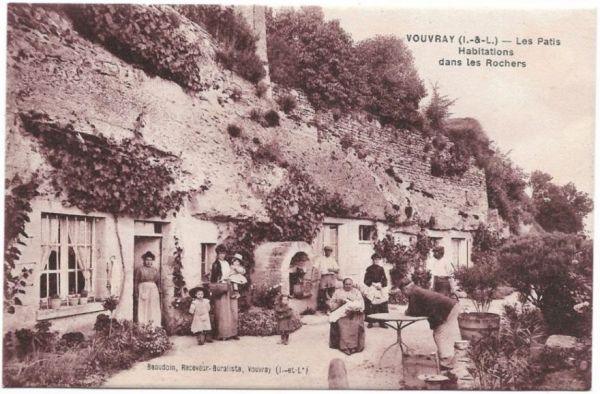
There are many thousands of caves that nature carved into the limestone of France. Neanderthals found shelter in them a half-million years ago, and later Homo sapiens did the same. In fact, people lived in those caves off and on up until the 20th century! And why not- they were sturdy rock fortresses that kept a habitable temperature year-round. Over time, the residents enlarged them, installed windows, doors, and chimneys, built out the fronts, and added gardens and modern amenities as they became available. There are around 14,000 such cave homes (habitations troglodytes) in the Loire Valley alone, although most are abandoned today.
These caves served as homes, churches, military bases, businesses, monasteries, and emergency hiding places for hundreds of years. One was even used as a secret place for satanic rituals. Now they are mostly empty sightseeing spots, but some have been converted into restaurants, nightclubs, and hotels. Read about the cave homes of France at Messy Nessy Chic.