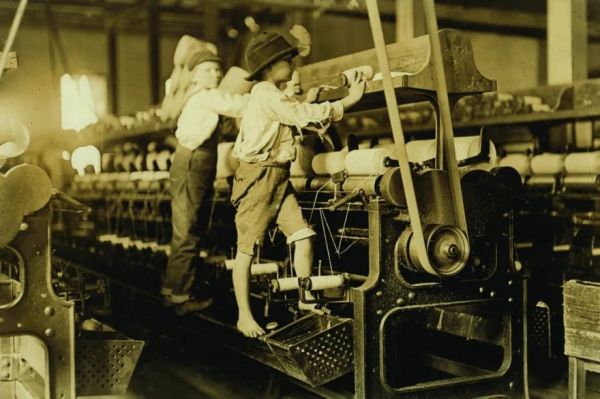
Around the turn of the 20th century, about two million children in America younger than 15 were full-time workers. Some were a lot younger than 15, and they worked dangerous jobs, sometimes 12 hours a day or more, just like their parents. The photo above shows two boys at a cotton mill in Georgia. An adult working this machine would have their feet on the floor, but children were assigned such work because they had smaller hands and arms that could manage the machines better. And of course, they weren't paid much.
The National Child Labor Committee was formed in 1907, and they commissioned sociologist and photographer Lewis Hine to document the practice in 1908. Hine knew that nothing would move popular opinion like a photograph. Factory overseers knew it, too. He had to sneak into workplaces, pretending to be an inspector or a Bible salesman to gain access, and he often took notes with his hands in his pockets to avoid detection. Hine's photos taken between 1909 and 1911 shocked the country, and led directly to the first federal child labor law in 1916. See samples of Hine's child labor photographs that led to changes in the system at Smithsonian.