Pucker up as we explore 10 smooches that changed religion, art, culture, and history.
1. The Kiss of Judas: A Betrayal or Just Misunderstood?
Nothing ends a good "bromance" quite like flagrant, murderous betrayal. A long time ago, a wandering preacher named Jesus was doing pretty well for himself—building up a following and promoting religious teachings—until one of his buddies sold him out to the authorities. In exchange for 30 pieces of silver, Judas Iscariot kissed Jesus on the cheek and, by doing so, identified him to Roman soldiers.
Although Judas double-crossed his best friend for a paltry sum, some scholars argue that Judas is the secret hero of Christianity. The claim is based on a recent translation of The Gospel of Judas, a text written by Jesus’ followers a couple hundred years after his death. In 1978, a farmer discovered the mysterious text in Egypt and sold it to an antiques dealer. Years later, a National Geographic Society team got hold of it. They restored and analyzed the document, and in 2006, they announced that the text painted Judas as a man of valor. According to their interpretation, he was actually Jesus’ most trusted friend, because he agreed to fake a betrayal so that Jesus could die a martyr and then be resurrected.
Soon after the National Geographic Society released its findings, other scholars started picking the interpretation apart. Chief among them was April D. DeConick, a Rice University biblical studies professor, who claimed the team made some critical errors, including translating several passages to mean the exact opposite of what they were intended to communicate. DeConick contends that the Gospel says Judas was a “demon” rather than a “spirit,” as interpreted by National Geographic, and that he was set apart “from the holy generation” rather than “for the holy generation.” With just a few tweaks in translation, Judas has gone right back to playing the bad guy.
2. The Kisses You Can Share with a Quaker
So we were surprised to learn that when teenage Quakers get together, their favorite activity is a free-for-all kissing game that often ends in bruising and rug burn. Alternately known as Ratchet Screwdriver, Bloody Winkum, or Wink, the game dates back to the early 1900s. To play, participants divide themselves into girl/boy pairs with one boy left over to be the “Winker.” The pairs sit on the floor, with each boy hugging a girl from behind. When the Winker winks at a girl, she tries to scramble across the room to kiss him, while her male partner does his best to hold her back. Hilarity (and release of pent-up sexual frustration) ensues.
But not everyone finds this game so hilarious. In 2002, the Children & Young People’s Committee of the Quakers in Britain issued a statement discouraging the game at official functions. And while that may not seem surprising, the reasoning is. The committee frowns upon the game because younger children and adults don’t get to play, thus making it ageist. Due to their egalitarian values, Quakers seldom segregate by age at get-togethers, and the committee didn’t want the very young or the very old to feel left out.
3. The Kiss that Proved No Means No
Gentlemen, a word: When a lady rejects your advances, you’d do best to listen. Take, for example, the story of Thomas Saverland, an English gentleman who was at a party in 1837 and, as a joke, kissed Miss Caroline Newton by force. In response, she bit off a chunk of his nose.
Saverland took her to court, where the judge found his case more hilarious than harrowing. The judge ruled, “When a man kisses a woman against her will, she is fully entitled to bite off his nose, if she so pleases.” A smart-mouthed barrister then added, “and eat it up, if she has a fancy that way.”
4. The Kiss That Said “Welcome to America!”
At the turn of the 20th century, immigration processing at Ellis Island was quite an ordeal. Immigrants had to prove they weren’t carrying any of a long list of illnesses, mental impairments, or moral defects. If you were sick (and it was curable), then you’d be detained in the hospital until you got better. The whole process could take hours, days, or months. And even then, you could be turned back. Also, ladies traveling alone and anyone with less than $20 in their pockets had to wait for a sponsor or family member to meet them. If no one was there to greet you, you were sent back.
Of course, all of this was further complicated by the fact that immigrants couldn’t go down to the pay phone and call Aunt Bertha when they landed. Instead, when relatives heard that the right ship had docked, they trucked over to Ellis Island and waited desperately by the Kissing Post—a giant wooden column just outside the room where the final stages of immigration took place. Ellis Island staffers gave the Kissing Post its name because families and lovers were generally swept up in emotion as they reconnected with their long losts. Today, the Kissing Post continues to be a symbol of hope and togetherness as the pillar that supports the American Family Immigration History Center. If you’re one of the 100 million Americans descended from immigrants who passed through Ellis Island, there’s a good chance the History Center there can help you find a picture of the ship that carried your ancestors.
5. The Eskimo Kiss: A Tale Taller than the Abominable Snowman
Popular wisdom claims that Eskimos rub noses because kissing on the lips would cause their mouths to freeze together. Not only is this completely untrue, but Eskimos don’t rub noses at all.
The myth of the Eskimo kiss was created by Hollywood in an early “documentary” called Nanook of the North, which took America by storm in 1922. To film it, director Robert J. Flaherty recorded real Inuits in the Arctic. However, in order to accommodate the huge, awkward cameras of the day, he staged all the scenes and built a three-sided igloo for interior shots. Nanook, the main character, wasn’t really named Nanook, and the women playing his wives weren’t really his wives. As for the term “Eskimo kiss,” that too was constructed by Flaherty to explain how one of the wives was nuzzling her baby. In actuality, the woman was giving her baby a kunik, an expression of affection in Inuit culture. Typically in kuniks, adults press the sides of their noses against the cheeks of their babies and breathe in their scent. Who kuniks whom differs from culture to culture, but it’s never a romantic gesture. Inuits kiss on the lips, just like everyone else.
6. The First Guy-on-Guy Kiss to Hit the Big Screen
Movie experts often credit Sunday Bloody Sunday, a 1971 film about a love triangle among two guys and a girl, with being the first mainstream feature film to depict two gay men kissing. That’s true, but it wasn’t the first time two guys kissed on screen. Apparently, straight men had been doing it for decades.
In 1927, two soldiers kissed tenderly in the silent movie Wings, which won Best Picture at the first Academy Awards. When the film was released, no one raised an eyebrow about the scene, partially because kissing in the trenches was remarkably common during World War I. According to British Academy Postdoctoral Fellow Dr. Santanu Das, letters and accounts of the war are peppered with stories of soldiers kissing, embracing, and giving each other pet names like “my Palestine Wife.” Das believes the war succeeded in breaking down the traditional limits on emotional and physical intimacy between men, allowing soldiers to form relationships that went beyond what was permissible at home. While it’s surprising to us today, that Wings scene didn’t even cause a stir in 1920s America.
7. The Kiss that Gave Artists Their 15 Minutes
If it weren’t for kissing, Andy Warhol might never have become The King of Pop Art. In 1963, Warhol was still a little-known commercial illustrator. But that all changed when he bought a silent-film camera and started shooting his friends and acquaintances kissing in unbroken, four-minute-long shots. The result was a series called Kiss, which took the art world by storm. In fact, New York’s Gramercy Arts Theater played a new “kiss” each week. The series helped cement Warhol’s place in the artsy underground, and it also launched the careers of several kissers.
8. The Prepubescent Kiss that Changed the Law
When first-grader Johnathan Prevette pecked his classmate on the cheek in Lexington, N.C., he quickly became a poster boy for everything that was wrong with America in 1996. After Johnathan’s classmate complained to a teacher, the 6-year-old was taken out of class for the day, missing an ice cream party. When the school told Johnathan’s parents that he’d violated the sexual harassment rules, a media circus followed. Critics pointed to the Prevette case as a sign that political correctness had gone too far, adding that innocent play didn’t deserve such harsh punishments. After all, pundits asked, is a child really capable of sexual harassment?
But while Johnathan was making headlines, another legal battle was raging. A 10-year-old Georgia girl named LaShonda Davis had been repeatedly groped by a bully in her class, to the point where she contemplated suicide. She told several of the teachers at her school, but no one did anything. LaShonda’s parents had to call the police—and sue the school—before the abuse stopped.
Both Johnathan and LaShonda deserved protection under the law, and both cases played a role in molding the current standards. In response to the Johnathan Prevette case, the Department of Education’s Office for Civil Rights issued new guidelines for identifying sexual harassment by putting the emphasis on common sense and telling schools to take age and maturity into account. But there was still a big question about whether schools should be accountable for students harassing each other. When LaShonda’s case went to the Supreme Court in 1999, their answer was yes, sort of. The Court decided that schools can be blamed, but only if they learn of the abuse and do nothing to stop it.
9. The Kiss That Could Send You to Jail
10. The Most Iconic Kiss in History
While the mystery will probably never be solved, Alfred Eisenstaedt has left us with a juicy back story. In his autobiography, the famed photographer writes that he followed around a sailor who moved through the crowd, kissing anything wearing a skirt. When the sailor hit on a nurse whose white dress contrasted nicely with his dark suit, Eisenstaedt snapped the shot. But he failed to get their names. Coincidentally, another photographer, Victor Jorgensen, took the same shot from a slightly different angle and also forgot to get the subjects’ names. Jorgensen’s version ran in the next day’s New York Times, but as a working military photographer at the time, he didn’t own the rights to his work. So while Eisenstaedt received glory and royalty checks for his image, Jorgensen simply got a nice clipping to hang on his fridge.
Don't forget to feed your brain by subscribing to the magazine and visiting mental_floss' extremely entertaining website and blog today for more!
1. The Kiss of Judas: A Betrayal or Just Misunderstood?
Nothing ends a good "bromance" quite like flagrant, murderous betrayal. A long time ago, a wandering preacher named Jesus was doing pretty well for himself—building up a following and promoting religious teachings—until one of his buddies sold him out to the authorities. In exchange for 30 pieces of silver, Judas Iscariot kissed Jesus on the cheek and, by doing so, identified him to Roman soldiers.
Although Judas double-crossed his best friend for a paltry sum, some scholars argue that Judas is the secret hero of Christianity. The claim is based on a recent translation of The Gospel of Judas, a text written by Jesus’ followers a couple hundred years after his death. In 1978, a farmer discovered the mysterious text in Egypt and sold it to an antiques dealer. Years later, a National Geographic Society team got hold of it. They restored and analyzed the document, and in 2006, they announced that the text painted Judas as a man of valor. According to their interpretation, he was actually Jesus’ most trusted friend, because he agreed to fake a betrayal so that Jesus could die a martyr and then be resurrected.
Soon after the National Geographic Society released its findings, other scholars started picking the interpretation apart. Chief among them was April D. DeConick, a Rice University biblical studies professor, who claimed the team made some critical errors, including translating several passages to mean the exact opposite of what they were intended to communicate. DeConick contends that the Gospel says Judas was a “demon” rather than a “spirit,” as interpreted by National Geographic, and that he was set apart “from the holy generation” rather than “for the holy generation.” With just a few tweaks in translation, Judas has gone right back to playing the bad guy.
2. The Kisses You Can Share with a Quaker
(Image credit: Wikipedia user Beatrice Murch)
The Religious Society of Friends, or Quakers, is a small Christian sect best known for rejecting all forms of violence, embracing progressive politics, and dedicating themselves to simple, restrained living. They’ve promoted a more harmonious world by founding causes such as Amnesty International, not to mention lending their name to oatmeal.So we were surprised to learn that when teenage Quakers get together, their favorite activity is a free-for-all kissing game that often ends in bruising and rug burn. Alternately known as Ratchet Screwdriver, Bloody Winkum, or Wink, the game dates back to the early 1900s. To play, participants divide themselves into girl/boy pairs with one boy left over to be the “Winker.” The pairs sit on the floor, with each boy hugging a girl from behind. When the Winker winks at a girl, she tries to scramble across the room to kiss him, while her male partner does his best to hold her back. Hilarity (and release of pent-up sexual frustration) ensues.
But not everyone finds this game so hilarious. In 2002, the Children & Young People’s Committee of the Quakers in Britain issued a statement discouraging the game at official functions. And while that may not seem surprising, the reasoning is. The committee frowns upon the game because younger children and adults don’t get to play, thus making it ageist. Due to their egalitarian values, Quakers seldom segregate by age at get-togethers, and the committee didn’t want the very young or the very old to feel left out.
3. The Kiss that Proved No Means No
Gentlemen, a word: When a lady rejects your advances, you’d do best to listen. Take, for example, the story of Thomas Saverland, an English gentleman who was at a party in 1837 and, as a joke, kissed Miss Caroline Newton by force. In response, she bit off a chunk of his nose.
Saverland took her to court, where the judge found his case more hilarious than harrowing. The judge ruled, “When a man kisses a woman against her will, she is fully entitled to bite off his nose, if she so pleases.” A smart-mouthed barrister then added, “and eat it up, if she has a fancy that way.”
4. The Kiss That Said “Welcome to America!”
At the turn of the 20th century, immigration processing at Ellis Island was quite an ordeal. Immigrants had to prove they weren’t carrying any of a long list of illnesses, mental impairments, or moral defects. If you were sick (and it was curable), then you’d be detained in the hospital until you got better. The whole process could take hours, days, or months. And even then, you could be turned back. Also, ladies traveling alone and anyone with less than $20 in their pockets had to wait for a sponsor or family member to meet them. If no one was there to greet you, you were sent back.
Of course, all of this was further complicated by the fact that immigrants couldn’t go down to the pay phone and call Aunt Bertha when they landed. Instead, when relatives heard that the right ship had docked, they trucked over to Ellis Island and waited desperately by the Kissing Post—a giant wooden column just outside the room where the final stages of immigration took place. Ellis Island staffers gave the Kissing Post its name because families and lovers were generally swept up in emotion as they reconnected with their long losts. Today, the Kissing Post continues to be a symbol of hope and togetherness as the pillar that supports the American Family Immigration History Center. If you’re one of the 100 million Americans descended from immigrants who passed through Ellis Island, there’s a good chance the History Center there can help you find a picture of the ship that carried your ancestors.
5. The Eskimo Kiss: A Tale Taller than the Abominable Snowman
Popular wisdom claims that Eskimos rub noses because kissing on the lips would cause their mouths to freeze together. Not only is this completely untrue, but Eskimos don’t rub noses at all.
The myth of the Eskimo kiss was created by Hollywood in an early “documentary” called Nanook of the North, which took America by storm in 1922. To film it, director Robert J. Flaherty recorded real Inuits in the Arctic. However, in order to accommodate the huge, awkward cameras of the day, he staged all the scenes and built a three-sided igloo for interior shots. Nanook, the main character, wasn’t really named Nanook, and the women playing his wives weren’t really his wives. As for the term “Eskimo kiss,” that too was constructed by Flaherty to explain how one of the wives was nuzzling her baby. In actuality, the woman was giving her baby a kunik, an expression of affection in Inuit culture. Typically in kuniks, adults press the sides of their noses against the cheeks of their babies and breathe in their scent. Who kuniks whom differs from culture to culture, but it’s never a romantic gesture. Inuits kiss on the lips, just like everyone else.
6. The First Guy-on-Guy Kiss to Hit the Big Screen
Movie experts often credit Sunday Bloody Sunday, a 1971 film about a love triangle among two guys and a girl, with being the first mainstream feature film to depict two gay men kissing. That’s true, but it wasn’t the first time two guys kissed on screen. Apparently, straight men had been doing it for decades.
In 1927, two soldiers kissed tenderly in the silent movie Wings, which won Best Picture at the first Academy Awards. When the film was released, no one raised an eyebrow about the scene, partially because kissing in the trenches was remarkably common during World War I. According to British Academy Postdoctoral Fellow Dr. Santanu Das, letters and accounts of the war are peppered with stories of soldiers kissing, embracing, and giving each other pet names like “my Palestine Wife.” Das believes the war succeeded in breaking down the traditional limits on emotional and physical intimacy between men, allowing soldiers to form relationships that went beyond what was permissible at home. While it’s surprising to us today, that Wings scene didn’t even cause a stir in 1920s America.
7. The Kiss that Gave Artists Their 15 Minutes
If it weren’t for kissing, Andy Warhol might never have become The King of Pop Art. In 1963, Warhol was still a little-known commercial illustrator. But that all changed when he bought a silent-film camera and started shooting his friends and acquaintances kissing in unbroken, four-minute-long shots. The result was a series called Kiss, which took the art world by storm. In fact, New York’s Gramercy Arts Theater played a new “kiss” each week. The series helped cement Warhol’s place in the artsy underground, and it also launched the careers of several kissers.
8. The Prepubescent Kiss that Changed the Law
When first-grader Johnathan Prevette pecked his classmate on the cheek in Lexington, N.C., he quickly became a poster boy for everything that was wrong with America in 1996. After Johnathan’s classmate complained to a teacher, the 6-year-old was taken out of class for the day, missing an ice cream party. When the school told Johnathan’s parents that he’d violated the sexual harassment rules, a media circus followed. Critics pointed to the Prevette case as a sign that political correctness had gone too far, adding that innocent play didn’t deserve such harsh punishments. After all, pundits asked, is a child really capable of sexual harassment?
But while Johnathan was making headlines, another legal battle was raging. A 10-year-old Georgia girl named LaShonda Davis had been repeatedly groped by a bully in her class, to the point where she contemplated suicide. She told several of the teachers at her school, but no one did anything. LaShonda’s parents had to call the police—and sue the school—before the abuse stopped.
Both Johnathan and LaShonda deserved protection under the law, and both cases played a role in molding the current standards. In response to the Johnathan Prevette case, the Department of Education’s Office for Civil Rights issued new guidelines for identifying sexual harassment by putting the emphasis on common sense and telling schools to take age and maturity into account. But there was still a big question about whether schools should be accountable for students harassing each other. When LaShonda’s case went to the Supreme Court in 1999, their answer was yes, sort of. The Court decided that schools can be blamed, but only if they learn of the abuse and do nothing to stop it.
9. The Kiss That Could Send You to Jail
(Image credit: Flickr user bradleyolin)
In the city of Guanajuato, Mexico, there’s a smooching spot called el Callejón del Beso, or the Alley of the Kiss. According to local legend, the alley was once the final scene of a tragic love affair. A young woman and her lover were meeting there to run away together, but when her father discovered them, he stabbed his daughter in the heart. As she lay dying, her lover kissed her hand for the last time, and the alley got its name. Today, it’s said that anyone who kisses there will have seven years of happiness. Thanks to its romantic history, the alley has become a popular tourist attraction, although that’s starting to change. On January 20, 2009, the ultra-conservative mayor of Guanajuato authorized a new municipal ordinance cracking down on public displays of affection. If he has his way, lip-locking in the open will carry with it a fine of $100 and up to 36 hours in jail.10. The Most Iconic Kiss in History
(Image credit: Victor Jorgensen)
On August 14, 1945, thousands of men and women embraced one another in New York City’s Times Square to celebrate victory over Japan. But two people—a sailor and a nurse—locked lips at just the right moment and became larger than life. More than a dozen men and at least three women claim to be the kissers in Alfred Eisenstaedt’s photograph. Of the men, our favorite is George Mendonça, a Rhode Island fisherman and World War II navy recruit, who claims he grabbed the strange nurse and kissed her right in front of his girlfriend. In fact, Mendonça says his girlfriend, now his wife, is in the background of the photo.While the mystery will probably never be solved, Alfred Eisenstaedt has left us with a juicy back story. In his autobiography, the famed photographer writes that he followed around a sailor who moved through the crowd, kissing anything wearing a skirt. When the sailor hit on a nurse whose white dress contrasted nicely with his dark suit, Eisenstaedt snapped the shot. But he failed to get their names. Coincidentally, another photographer, Victor Jorgensen, took the same shot from a slightly different angle and also forgot to get the subjects’ names. Jorgensen’s version ran in the next day’s New York Times, but as a working military photographer at the time, he didn’t own the rights to his work. So while Eisenstaedt received glory and royalty checks for his image, Jorgensen simply got a nice clipping to hang on his fridge.
__________________________
The above article was written by Maggie Koerth-Baker. It is reprinted with permission from the May/June 2009 issue of mental_floss magazine.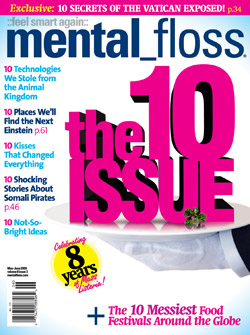
Don't forget to feed your brain by subscribing to the magazine and visiting mental_floss' extremely entertaining website and blog today for more!
Newest 5 Comments
Just a clarification about the 1927 Academy Awards that Wings "won". In the first awards, abandoned thereafter, the "best picture" award was split into two awards: one for artistic merit and another for film production. Wings won for production, not for artistic merit. The winner for artistic merit was Sunrise: A Song of Two Humans.
Abusive comment hidden.
(Show it anyway.)
I like the quakers. :)
Abusive comment hidden.
(Show it anyway.)
I played Winkum at church socials as a teen
Abusive comment hidden.
(Show it anyway.)
Unitarians play the same game, but it's better cause they're not hung up on their sexual orientations.
Abusive comment hidden.
(Show it anyway.)
So according to the National Geographic Society , Judas was like the Snape of the bible.
Abusive comment hidden.
(Show it anyway.)